

About This Coffee
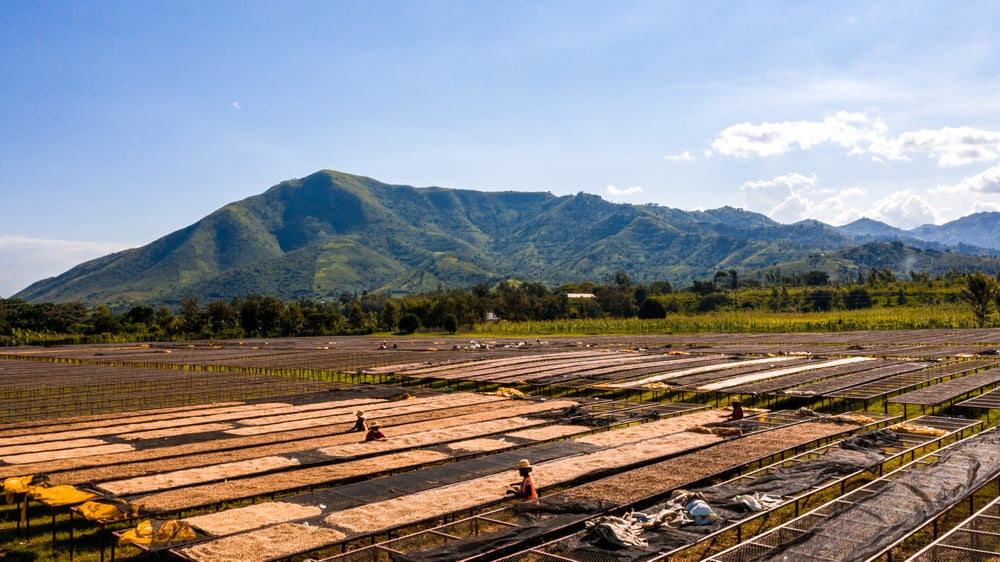
Mubuku Station is located on a 20-acre plot along the banks of the Mubuku River. This river flows from the glacial caps of the Upper Rwenzori Mountains all the way to Lake George. Along its path, it winds through fertile farmland on the east-facing slopes of the Rwenzori Mountain Range, past Kasese Station, and into Lake George and the broader African Great Lakes system.
Kasese lies close to the shores of Lake George, with the stunning Queen Elizabeth National Park to the south of the station. Even closer, the entrance to Rwenzori National Park is just one kilometer from our washing station. Both parks are UNESCO World Heritage Sites.
The drier, hotter climate at Mubuku Washing Station, combined with the presence of a quality control lab, creates the ideal environment for experimenting with honey, natural and anaerobic processes. This setup ensures even drying and consistent quality at every stage.
Purchases of this lot also contribute towards our IMPACT responsible sourcing goals by equipping IMPACT verified smallholder coffee farmers delivering to IMPACT verified farmers delivering to Katerera Coffee Washing Station (CWS) in Uganda with essential farming tools and practical support. By providing tool kits that include hoes, spades and pruning saws, this initiative tackles a key barrier to productivity – limited access to essential farm equipment.
Cultivation
More than 4,300 farmers contribute cherries to the Mubuku Station, spread across a vast network of farms and communities. For those living farther away, transporting cherries daily can be a significant challenge. To address this, we’ve built strong relationships with trusted partners who collect and deliver cherries to the station. This network is essential for maintaining a smooth workflow and ensuring timely payments to farmers.
Farmers primarily grow SL14 and often intercrop with bananas, vanilla, and beans to diversify their income.
Harvest & Post-Harvest
Cherries are delivered to the station daily, often via steep, muddy dirt roads. Upon arrival, they are floated and meticulously hand-sorted by trained staff before being laid on raised beds to dry.
After intake, cherry is pulped to remove part of the mucilage. Coffee is then laid on raised beds to sundry. Workers visually hand sort drying coffee to remove any damaged or defective beans. They also rake it frequently to ensure an even drying. It takes approximately 18 to 22 days for coffee to dry.
UGACOF/Sucafina Uganda
Our partner, UGACOF/Sucafina Uganda is committed to improving quality in Uganda by building new washing stations and infrastructure and training personnel in the region. Collaborations with our FarmerHub program and our sustainability partner, the Kahawatu Foundation, are building upon our work to expand farmers’ access to better resources and better training. Our connections to our more established operations in nearby Rwanda, Burundi and Kenya offer us advice and a perspective steeped in a familiarity with East Africa.
The bulk of our work in Uganda is focused in the West, near the Rwenzori Mountains. The biggest difference between East (Mount Elgon) and West (Rwenzori) is that Mount Elgon is a more established and competitive market. We are excited to be at the forefront of the drive for enhancing coffee production infrastructure, developing the industry and becoming reliable partners for farmers in the Rwenzori Mountain region.
It is clear to us that the potential in this region might exceed our expectations and even the potential of the popular Mount Elgon region. With an ever-growing demand for high quality Arabicas and a sustained interest from roasters and coffee drinkers in the East African origins, we are very confident that, with diligence and effort, Western Ugandan coffees will be able to take their place alongside the other great East African coffees.
While the scale of work in regions like this can sometimes be overwhelming, we have a clear plan that steadily increases coffee quality.
Our first step is the one that leads to the most immediate and noticeable improvement: harvesting techniques. Due to a long history of home-processing and a lack of incentive for high quality, harvesting in the region is often semi- or entirely non-selective. Thanks to our extended network of cherry collection sites, we meet with farmers every day during the harvest season and can give real-time feedback that can impact the quality of the next day’s harvest. At the collection sites, we can insist on higher levels of care and reward meticulous picking. Though we’re still in the early years, we have seen a clear difference in quality from one year to another and even from the first week of the harvest to the last.
Future steps will include working with farmers to improve their access to materials and knowledge of better farming practices. This means making fertilizer more accessible, encouraging farmers to plant shade canopies and more. We’re planning on building demonstration plots, input access sites across the region and training a new generation of skilled washing station staff. We know it will take time, but we have a strategy and are committed to realizing this vision.
Coffee in Uganda
Uganda is the native home to one species of Robusta, and commercial coffee production in the country goes back to the beginning of the 20th century.
Our partner, UGACOF/Sucafina Uganda is committed to improving quality in Uganda by building new washing stations and infrastructure and training personnel in the region. Collaborations with our FarmerHub program and our sustainability partner, the Kahawatu Foundation, are building upon our work to expand farmers’ access to better resources and better training. Our connections to our more established operations in nearby Rwanda, Burundi and Kenya offer us advice and a perspective steeped in a familiarity with East Africa.
The bulk of our work in Uganda is focused in the West, near the Rwenzori Mountains. The biggest difference between East (Mount Elgon) and West (Rwenzori) is that Mount Elgon is a more established and competitive market. We are excited to be at the forefront of the drive for enhancing coffee production infrastructure, developing the industry and becoming reliable partners for farmers in the Rwenzori Mountain region.
It is clear to us that the potential in this region might exceed our expectations and even the potential of the popular Mount Elgon region. With an ever-growing demand for high quality Arabicas and a sustained interest from roasters and coffee drinkers in the East African origins, we are very confident that, with diligence and effort, Western Ugandan coffees will be able to take their place alongside the other great East African coffees.