
About This Coffee
The Western Highlands are centrally located in Papua New Guinea. This diverse mountain range has heights towering above 2,800 meters above sea level.
The main crop runs from May to September and the fly crop from January to February. These coffees are marked by a candy sweetness, a tea-like mouthfeel and balanced body.
Cultivation
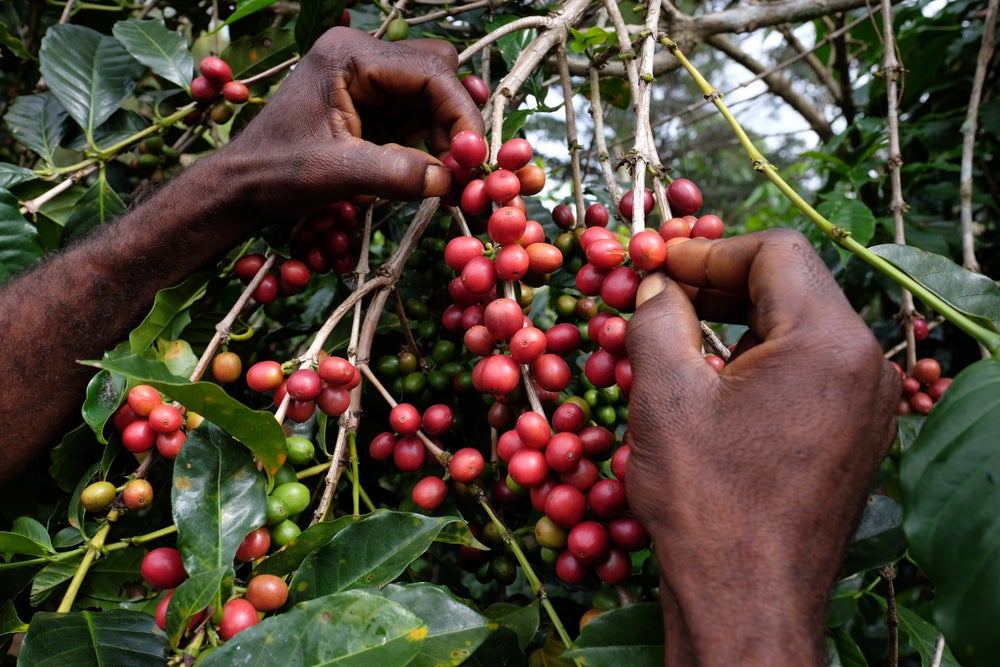
Most farmers in PNG grow coffee on small plots of land intercropped with other cash and subsistence crops. Most land where coffee is grown can more aptly be described as “coffee gardens” than as farms or plantations.
Smallholder farmers in the Western Highlands cultivate coffee on small farms that are usually 5 hectares or smaller, mini plantations are 5 to 29 hectares and plantations are above 30 hectares.
Harvest & Post-Harvest
Many smallholders in PNG process their cherry at home. Farmers pulp their cherry—usually with small drum pulpers or other hand-powered methods—and then ferment them for approximately 36 hours. After washing the parchment to remove any remaining mucilage, producers will dry parchment to 10.5% moisture content. The predominant drying methods are sun drying on raised beds or tarps or mechanical dryers, of which the Asaro dryer is most popular.
Drying typically occurs in two stages. First, skin drying reduces overall moisture content from approximately 55% to around 43%. The second stage, main drying, is comprised of several smaller changes that can be confirmed by farmers by conducting simple tests and by looking at the color of the inside of the bean.
Some farmers sell their coffee as cherry. While this often means that farmers receive less money at the time of sale, it can sometimes mean higher profits in the long run. Mills that receive cherry can retain more control over quality. In turn, higher quality coffee can sell for higher prices and enable mills to pay farmers more for high quality cherry.
About Peaberries
PB stands for peaberry. Peaberry is a name given to a very specific shape of coffee bean. In Spanish, peaberries are called “caracol”, which means “snail”. The name aptly describes the shape of the peaberry bean, which appears slightly curved in on itself.
Peaberries are the result of a natural mutation in the coffee cherry. Whereas there are usually two beans nestled together in each fruit, a cherry with a peaberry mutation only forms one bean. Thus, peaberries are a single, rounder bean.
Peaberry mutations occur in approximately 5% of all coffee. The beans are known for being rounder, smaller and denser, which can contribute to a more even roast color when handled correctly. Many people find peaberries to have a sweeter flavor profile, as well.
Since peaberries are a natural mutation that is not visible from the outside of the cherry, peaberries must be sorted out during the screen grading stage of dry milling. The peaberry screens have the smallest holes, which are oblong to allow the rounder beans to fall through.
Coffee in Papua New Guinea
Papua New Guinea (PNG) is a relative newcomer to the specialty coffee scene. The remote locations of the nation’s smallholders—who produce 85% of total coffee in the country—combined with historically-poor infrastructure has made the transition to specialty difficult. Nonetheless, the country is working towards innovative solutions that will hopefully lead to better quality coffee and improved livelihoods for the nation’s smallholder coffee producers.