
About This Coffee
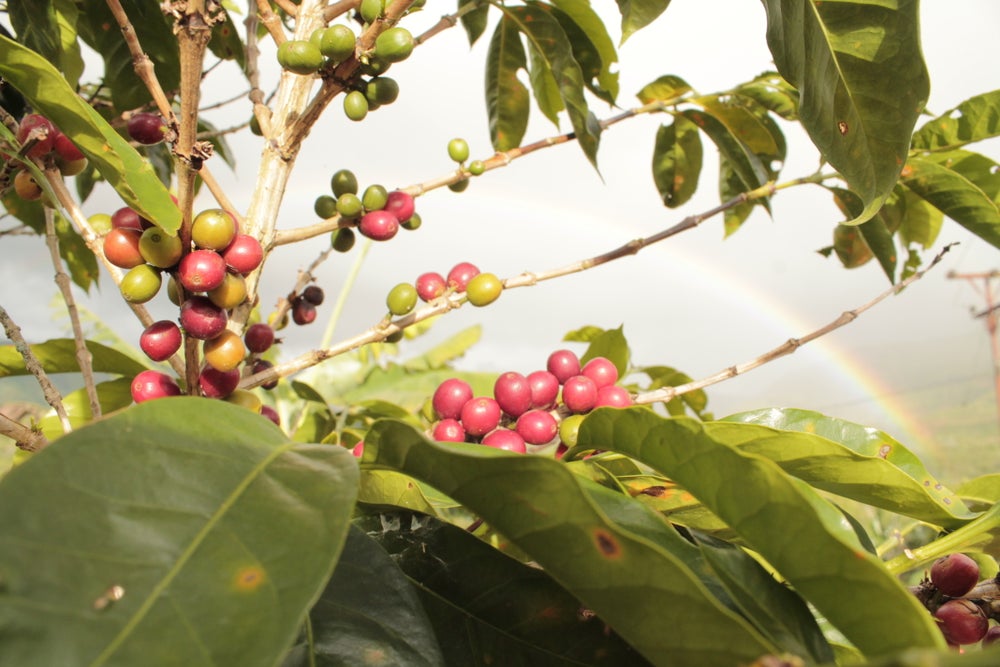
There are 13 different varieties on the estate’s 250 hectares of coffee, including some local hybrids Rasuna, Long Berry, Andong Sari, Toraja, S795 (Jember), Jantung, and the well known Caturra, Catuai, Villa Sarchi and Typica.
The estate has established a farmers’ support center that distributes coffee seeds and offers information and advice on farm management. The center also distributes shade trees and provides information on how to use organic fertilizers.
The estate employs between 800 and 1,000 local workers. Workers and their families have access to an on-site health clinic, free housing, electricity, drinking water, healthcare and a nursery & kindergarten for young children. They also built a church and mosque on the grounds for workers’ use and have been instrumental in purchasing computers for local schools.
Cultivation
Over half of the estate’s 468 hectares are currently planted with coffee trees. Another 30 hectares of the estate are a dedicated nursery for the local varieties grown on the estate. New seedlings are nurtured in sandy beds. After 3 months, the young plants are moved to polybags for 7 to 8 months and then planted in plots and labeled to identify varieties.
A significant swathe of the estate is conservation land that protects native species and builds buffer zones around tributaries, to minimize runoff into local waterways. As a newer estate, the owners plan to continue to expand both coffee production and their outreach services to local farmers.
Coffees trees are spaced and shade grown under local Lamtoro trees (river tamarind). In addition to the estate’s focus on production methods, its geographic location contributes to its high-quality coffees. North Sumatra’s ideal climate has helped make it famous for its coffee production.
About Giling Basah: Wet Hulled Process
Indonesia is perhaps best known for its unique wet hulling process (giling basah). Though its exact origins are unclear, wet hulling most likely originated in Aceh during the late 1970s.
Wet hulling’s popularity can be attributed to producers’ need for prompt payments. It was also adopted specifically by many producers who lacked the drying infrastructure that was needed to shelter drying parchment from the high humidity and inconsistent rainfall typical in Sumatra. At higher elevations with constant humidity and unpredictable rainfall, drying can prove to be slow, risky and difficult.
The basic process for wet hulling is as follows: Cherry is harvested and pulped at or near the farm on small hand-cranked or motorized pulpers. The coffee is fermented overnight in small tanks, buckets, or bags and washed with clean water the following morning. Parchment is sundried for between half a day and two days, depending on the weather. This first drying is for skin drying, which eases the removal of parchment.
At this juncture, the moisture content is between 30 and 40%. Parchment is delivered to a processor (often by the village collector) for wet hulling. A wet hulling machine is larger, requires more power and runs at a faster speed than a traditional dry huller. After the hulling, the coffee seed is whitish and pliable and is called labu. It is laid out to dry on tarps or patios, where it reduces in size and reaches 14 to 15% moisture content. This stage is known as asalan and is unsorted and with defects. Much of the internal commercial trade is for asalan. Exporters, most of whom are based in Medan, will finish the drying down to 12 to 13% moisture content and will sort and prepare coffee for shipment.
Our premium and specialty wet-hulled coffees are produced in direct collaboration with village collectors and processors so that the drying, storage and lot integrity remain in place from the farmer all the way to you. In this way, we can export cleaner, more stable and more traceable regional lots.
Coffee in Indonesia
Indonesia has a long coffee producing history, but recently their coffees have been overlooked by the specialty market. Thanks to our innovative and ever-expanding supply chain, we are proud to bring you high-quality coffees from many of Indonesia’s unique regions, accompanied by in-depth traceability information.
Indonesia is perhaps best known for its unique wet hulling process (giling basah). Though its exact origins are unclear, wet hulling most likely originated in Aceh during the late 1970s.
Wet hulling’s popularity can be attributed to producers’ need for prompt payments. It was also adopted specifically by many producers who lacked the drying infrastructure that was needed to shelter drying parchment from the high humidity and inconsistent rainfall typical in Sumatra. At higher elevations with constant humidity and unpredictable rainfall, drying can prove to be slow, risky and difficult.