
About This Coffee
The Wet Hulled process is a unique coffee processing method primarily used in Indonesia and increasingly in other coffee-producing countries such as Vietnam. This method is particularly suited to humid climates where drying coffee is challenging.
Harvest & Post-Harvest
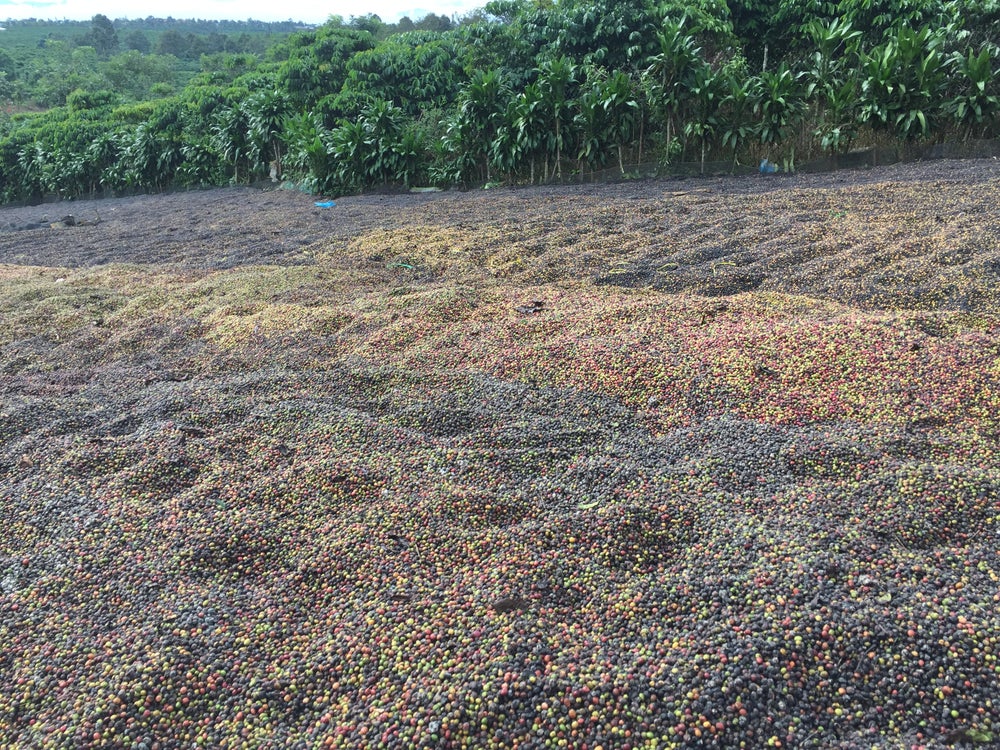
After harvesting, farmers process their cherry using the traditional wet hulling method. Following harvest, cherry is pulped and fermented to loosen the mucilage. Coffee is washed with clean water to remove any remaining mucilage and partially dried to a moisture content of around 30-40%. At this stage, coffee is hulled to remove the parchment layer while still wet. This gives coffee a distinctive bluish-green appearance. Collectors may either wet hull the parchment themselves or sell the parchment on to someone who will. After hulling, parchment is laid out to dry moisture decreases to 14-15% before export.
Coffee in Vietnam
Coffee played in a major role in Vietnam’s stunning economic transformation from the extreme poverty in the late-1980s to the relative prosperity in the 2010s. Our Vietnam offerings highlight some of the best that the country has to offer, including more recent forays into specialty coffees.
The main variety planted in Vietnam is Catimor, a hybrid of Caturra and Timor (itself an Arabica-Robusta hybrid). While Catimor boasts high yields and high disease-resistance, it’s not typically prized for its cup quality. This encourages producers to refine their selection and processing techniques.
Producers are also focusing on improving their selection and processing techniques. This focus on improvement begins at harvest time. Farmers and their workers have begun to employ more selective harvesting techniques, and better post-harvest quality controls are increasingly being implemented.
Other producers are venturing into experimental processing to increase harvest quality and, ultimately, sale price. Some producers are focusing on yeast or enzyme fermentations, others are using anaerobic fermentation. At this point, most of this experimentation is used on microlots. In the future, more farmers may turn to processing most or all of their harvest using advanced or experimental processes to help increase sale prices.