
About This Coffee
Thadeo Mwakilasa purchased Thadeo Farm in 2002. Thadeo was drawn to coffee farming because of his grandparents, who were also coffee farmers. He wanted to continue the family tradition of coffee production. Today, Thadeo’s son furthers their family legacy of coffee production with his own coffee farm in Tanzania. Thadeo dreams of becoming a large estate owner with an established private coffee estate. His coffee has all the makings of a popular estate with its notes of ripe black currant, chocolate and caramel.
Cultivation
Thadeo’s farm has about 8,500 trees. The average production is 2kg per tree. He has big plans for his farm and intended to plant more coffee trees on the unforested areas of his land.
Harvest & Post-Harvest
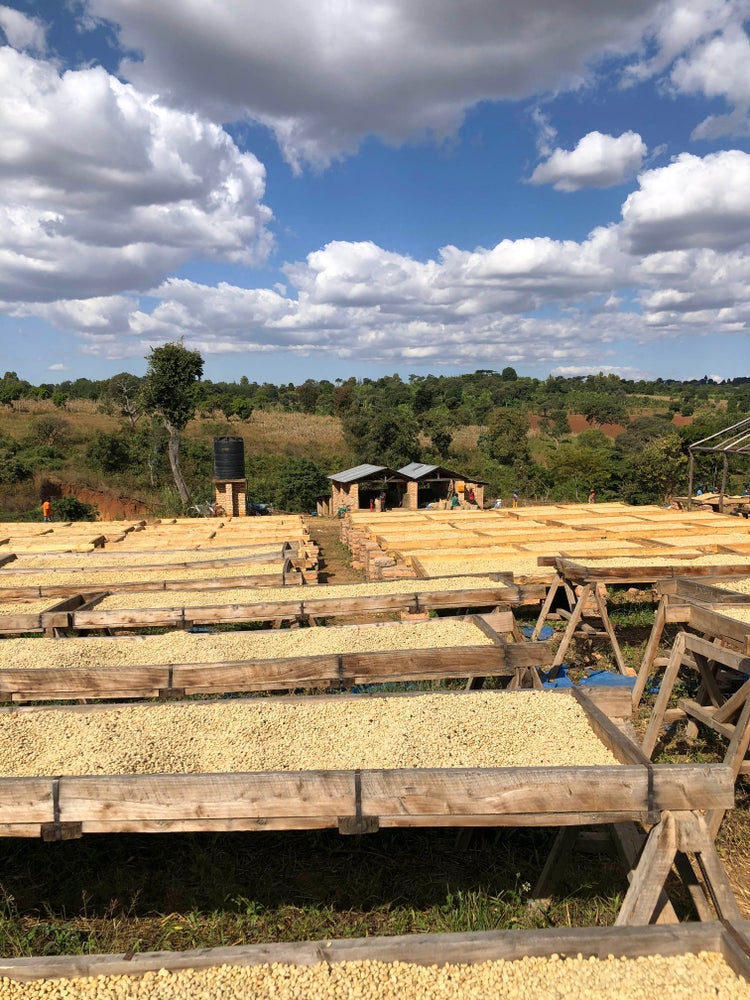
Cherry is selectively handpicked and delivered to the farm’s onsite wet mill. Cherry is pulped and then fermented. fermented. Following fermentation, parchment is washed in clean water and then laid to dry on raised bed. Parchment is turned regularly to ensure even drying.
AB
Coffee in Tanzania is graded according to size. AB beans are those that are between 15 and 18 meaning that beans are between 6 and 7 millimeters in size.
Coffee in Tanzania
Coffee’s roots in Tanzania can be traced via oral history back to the Haya tribe of Northwest Tanzania in the 16th century. Following German and then British colonial rule, the Tanzanian coffee industry has undergone many transformations and adjustments in an effort to create the most equal, profitable and high-quality coffee possible. Today, our in-country partner, Sucafina Tanzania, is invested in improving the coffee and the lives of smallholder farmers through a variety of initiatives.
Coffee in Tanzania was grown almost exclusively in the North for a long time. The Kilimanjaro, Arusha, Tarime, Kagera, Kigoma and Karatu/Ngorongoro regions were prized for their ideal Arabica growing conditions. At the time, coffee production was so concentrated in the north that Moshi, a northern municipality, was the only hub for all coffee milling and sales.
Operations in Moshi grew to truly massive proportions in the 1950s and early-1960s. Since both Tanzania, Kenya and Burundi were under British rule in the post-war decades, Moshi was the second milling and sales hub (after Nairobi, Kenya) for British coffee production.
Coffee cultivation has extended southwards in recent years. In addition to the historical powerhouse regions in the north, coffee is now also grown in the southern regions of Ruvuma and Mbeya/Mbozi. Most Southern expansion of coffee growing occurred in the 1970s and 1980s and was encouraged by two projects supported by European backers. In an ironic twist, today 75 to 85% of total coffee production in Tanzania today comes from farms in the south.