
About This Coffee
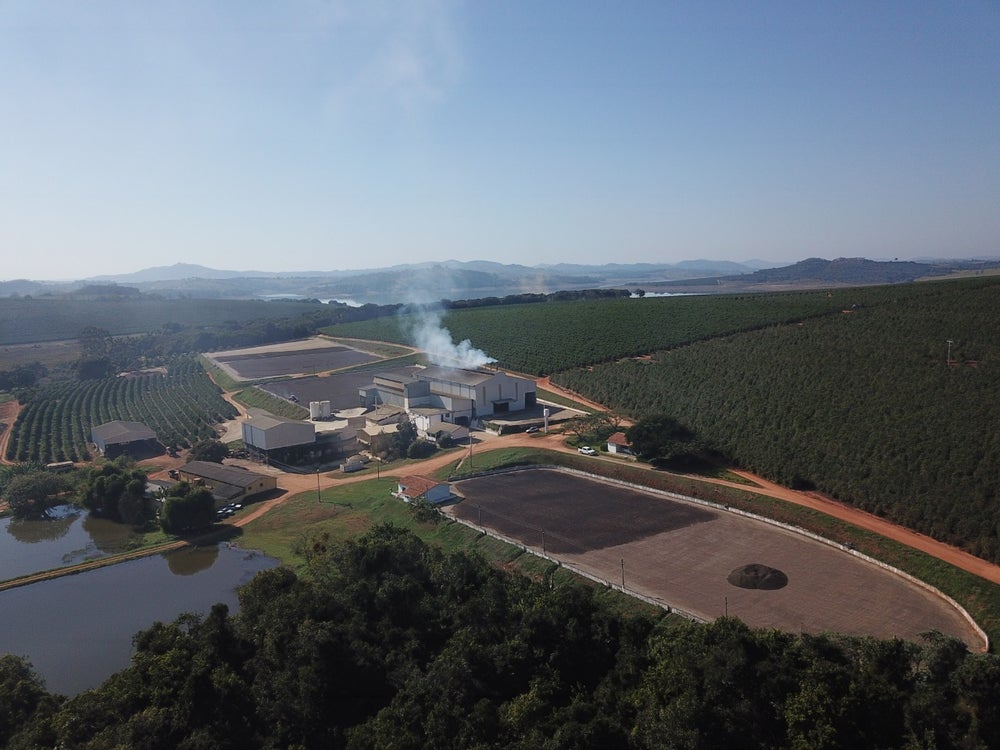
The Brito family has farmed on Fazenda Santa Hedwirges for 4 generations. They named the farm after Saint Edwiges (Hedwig) and have cultivated coffee there for over 90 years. The farm is located at 900 meters above sea level and their focus on high-quality coffee production, combined with the superb conditions, result in a bright and fruit coffee that’s bursting with berries.
Cultivation
With a focus on preserving the farm for the coming generations, the Britos are constantly implementing sustainable methods. They seek to promote biodiversity and environmental health by planting native trees, establishing wastewater and sewage treatment, and by using inputs in environmentally sustainable ways.
Harvest & Post-Harvest
The Britos have approximately 120 employees and total employment goes up to 220 people during the harvest season. Cherry is laid on patios or dried in a status mechanical dryer. On the patio, cherry is raked frequently to ensure even drying. It takes approximate 10 to 15 days for cherry to dry on the patios, or 36 to 48 hours in the dryer. Depending on weather conditions, cherry may be dried using both methods.
Coffee in Brazil
Just under 40% of all coffee in the world is produced in Brazil - around 3.7 million metric tons annually. With so much coffee produced, it’s no wonder that the country produces a wide range of qualities. Brazil produces everything from natural Robusta, to the neutral and mild Santos screen 17/18, to the distinctive Rio Minas 17/18. In recent years, Brazilian producers have also begun investing more heavily in specialty coffee production. Through our in-country partners in Brazil, including our sister company, we are able to provide a wide range of Brazilian coffees to our clients: from macrolot to microlot.
Today, the most prolific coffee growing regions of Brazil are Espirito Santo, São Paulo, Minas Gerais, and Bahia. Most Brazilian coffee is grown on large farms that are built and equipped for maximizing production output through mechanical harvesting and processing. The relatively flat landscape across many of Brazil’s coffee regions combined with high minimum wages has led most farms to opt for this type of mechanical harvesting over selective hand-picking.
In the past, mechanization meant that strip-picking was the norm; however, today’s mechanical harvesters are increasingly sensitive, meaning that farms can harvest only fully ripe cherries at each pass, which is good news for specialty-oriented producers.
In many cases and on less level sections of farms, a mixed form of ‘manual mechanized’ harvesting may be used, where ripe coffee is picked using a derriçadeira – a sort of mechanized rake that uses vibration to harvest ripe cherry. A tarp is spanned between coffee trees to capture the cherry as it falls.
With the aid of these newer, more selective technologies, there’s a growing number of farms who are increasingly concerned with – and able to deliver - cup quality.