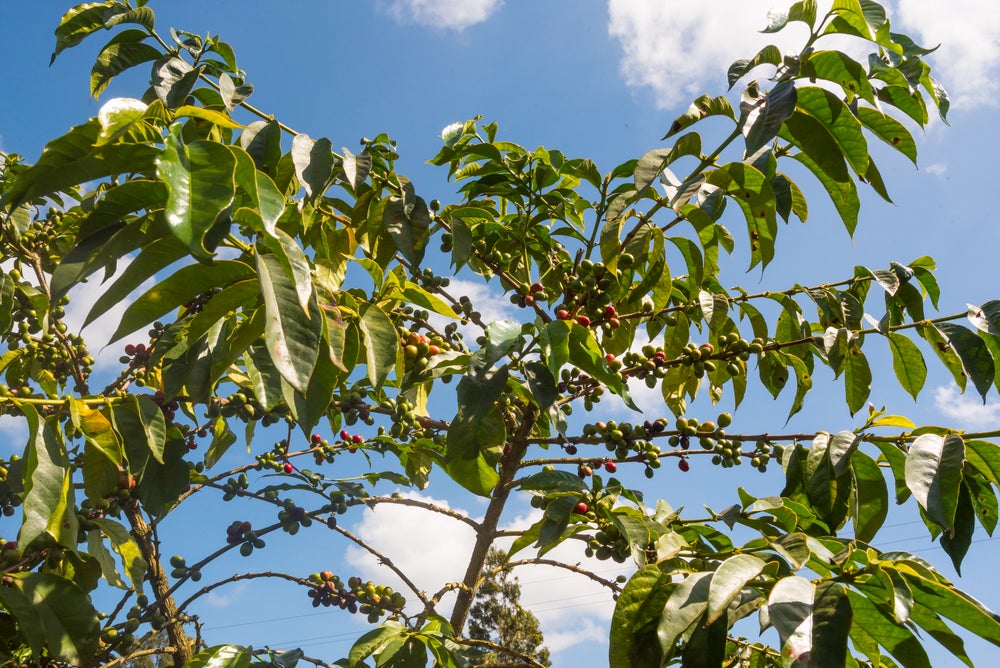

About This Coffee
Kibisi Factory is owned and operated by Kibisi Farmer Cooperative Society (FCS). Farmers delivering to the station cultivate coffee at 1,550 to 1,620 meters above sea level. They grow SL28, SL34, Batian, K7 and Ruiru 11 varieties and deliver ripe, red cherry to the station.
Cultivation
Farmers delivering to Kibisi cultivate primarily SL28, SL34, Batian, K7 and Ruiru 11 in small coffee gardens that are, on average, smaller than 1 hectare. ‘SL’ varieties are cultivars originally released by Scott Agricultural Laboratories (SAL) in the 1930s and 1940s. They soon became the go-to trees for many growers in Kenya due to their deep root structure, which allows them to maximize scarce water resources and flourish even without irrigation. They are cultivated with a serious eye to sustainability and Good Agricultural Practices, with minimal environmental impact where possible. Ruiru 11 and Batian are newer varieties known for their disease resistance and high yields. They both start yielding fruit after just 2 years.
K7 is found mostly in Kenya and Tanzania and is known for its resistance to Coffee Leaf Rust (CLR) and Coffee Berry Disease (CBD). The variety also has high yields and good cup potential at high altitudes. The plant is recognizable by its branch’s wide spread.
K7 was selected from seedlings on Legetet Estate in Muhorohi, an estate owned by a man named R.H. Walker. In Kenya, K7 is less common in high altitude areas, but it remains a popular choice in some lower altitude regions due to its slight resistance to CLR.
Farmers receive technical agronomic support from Sucafina Kenya. They also receive soil sampling from Kahawatu Foundation. The soil sampling program addresses a key step in farmer profitability. Lower input costs mean lower overall production costs and higher profits. More targeted input application also translates into healthier trees and higher quality cherry. Prior to Kahawatu’s soil sampling program, farmers had little access to soil analysis methods. Fertilizer, when applied, would be formulated according to a generalized recipe rather than one uniquely suited to the farm’s exact needs. Now, with better access to information through technology and agronomical assistance, farmers can apply the right fertilizer recipe at the right time, improving yields and cherry quality.
Harvest & Post-Harvest
Smallholders selectively handpick only ripe cherry and deliver it to Kibisi Factory. At intake, the Cherry Clerk oversees meticulous visual sorting and floating, accepting only dense, ripe cherry.
After intake, cherry is pulped and fermented for approximately 12 to 16 hours. Following fermentation, coffee is washed in clean water and soaked for 12 to 24 hours. After soaking, parchment is laid to dry on raised beds. Workers rake parchment frequently to ensure even drying. They cover drying parchment during the hottest time of day, to maintain slow, even drying and at night, to shelter parchment from moisture. It takes approximately 7 to 14 days for parchment to dry.
About Peaberries
PB stands for peaberry. Peaberry is a name given to a very specific shape of coffee bean. In Spanish, peaberries are called “caracol”, which means “snail”. The name aptly describes the shape of the peaberry bean, which appears slightly curved in on itself.
Peaberries are the result of a natural mutation in the coffee cherry. Whereas there are usually two beans nestled together in each fruit, a cherry with a peaberry mutation only forms one bean. Thus, peaberries are a single, rounder bean.
Peaberry mutations occur in approximately 5% of all coffee. The beans are known for being rounder, smaller and denser, which can contribute to a more even roast color when handled correctly. Many people find peaberries to have a sweeter flavor profile, as well.
Since peaberries are a natural mutation that is not visible from the outside of the cherry, peaberries must be sorted out during the screen grading stage of dry milling. The peaberry screens have the smallest holes, which are oblong to allow the rounder beans to fall through.
Coffee in Kenya
Though coffee growing had a relatively late start in Kenya, the industry has gained and maintained a impressive reputation. Since the start of production, Kenyan coffee has been recognized for its high-quality, meticulous preparation and exquisite flavors. Our in-country sister company, Sucafina Kenya, works with farmers across the country to ensure these exceptional coffees gain the accolades they deserve.
Today, more than 600,000 smallholders farming fewer than 5 acres compose 99% of the coffee farming population of Kenya. Their farms cover more than 75% of total coffee growing land and produce nearly 70% of the country’s coffee. These farmers are organized into hundreds of Farmer Cooperative Societies (FCS), all of which operate at least one factory. The remainder of annual production is grown and processed by small, medium and large land estates. Most of the larger estates have their own washing stations.
Most Kenyan coffees are fully washed and dried on raised beds. The country still upholds its reputation for high quality and attention to detail at its many washing stations. The best factories employ stringent sorting practices at cherry intake, and many of them have had the same management staff in place for years.