
About This Coffee
Asman Arianto is originally from Palembang, South Sumatra but has been living and working in Aceh Tengah since 1998. Most of the farmers in Aceh Tengah are migrants. Many of them were evacuated from Sinabung Berastagi in North Sumatra after the long-dormant volcano became continuously active again in 2013.
When he arrived in Aceh, Asman entered the coffee industry and began collecting and processing wet-hulled coffee. He soon switched to collecting cherry and processing as Fully washed, Honey or Natural.
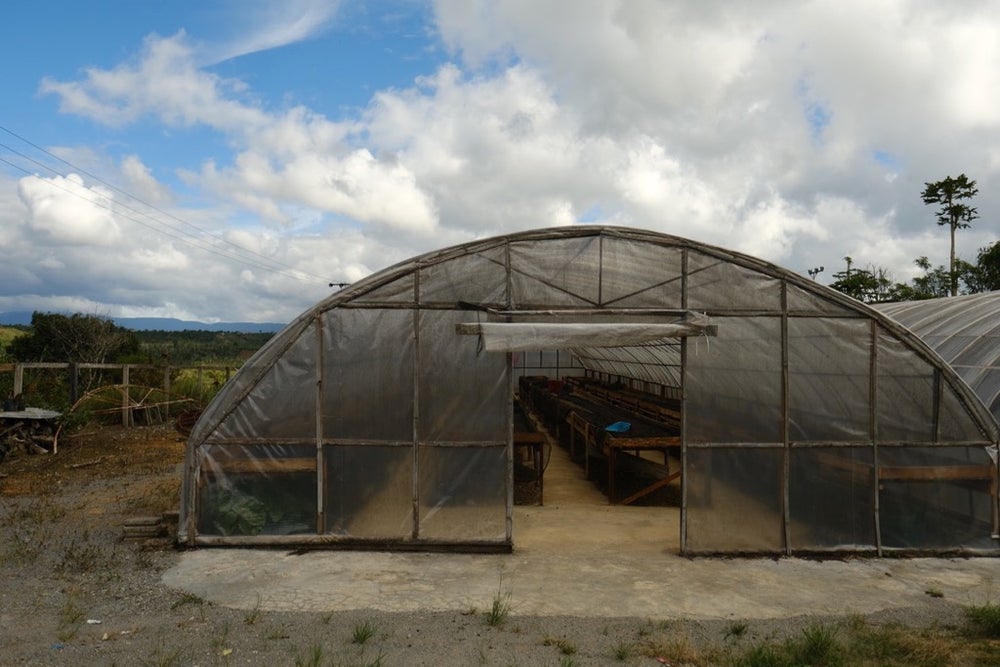
He decided he wanted to build a cooperative to unite coffee farmers. In 2018, Asman formed the Ribang Gayo Musara Cooperative. His goal is to offer competitive prices that can help farmers reinvest in their farms and their families. The cooperative currently has over 350 members who deliver cherry to their processing facility in Pantan Musara.
The benefits for cooperative members are threefold. First, they get higher prices for their cherry when they sell to the cooperative. Second, as cooperative members, they receive end-of-season ‘second payment’ premiums that share a portion of profits earned for higher-quality lots. Finally, the cooperative provides training and outreach for farmers in everything from cultivation to processing.
Cultivation
Almost all farms on Sumatra are small. On average, farms are between 0.5 to 2.5 hectares. Coffee is usually the primary cash crop for farmers, but most also intercrop their trees alongside vegetables, maize and fruit. This intercropped produce will make up a substantial part of the family’s diet for the year.
In addition to growing coffee as a cash crop, many smallholder farmers also work as hired laborers at the nearby tea plantations. Tea is also a huge crop in the area. The bigger tea plantations are often near coffee farms. When the harvest is finished, coffee farmers will go there and pick leaves under contracted labor.
About Giling Basah: Wet Hulled Process
Indonesia is perhaps best known for its unique wet hulling process (giling basah). Though its exact origins are unclear, wet hulling most likely originated in Aceh during the late 1970s.
Wet hulling’s popularity can be attributed to producers’ need for prompt payments. It was also adopted specifically by many producers who lacked the drying infrastructure that was needed to shelter drying parchment from the high humidity and inconsistent rainfall typical in Sumatra. At higher elevations with constant humidity and unpredictable rainfall, drying can prove to be slow, risky and difficult.
The basic process for wet hulling is as follows: Cherry is harvested and pulped at or near the farm on small hand-cranked or motorized pulpers. The coffee is fermented overnight in small tanks, buckets, or bags and washed with clean water the following morning. Parchment is sundried for between half a day and two days, depending on the weather. This first drying is for skin drying, which eases the removal of parchment.
At this juncture, the moisture content is between 30 and 40%. Parchment is delivered to a processor (often by the village collector) for wet hulling. A wet hulling machine is larger, requires more power and runs at a faster speed than a traditional dry huller. After the hulling, the coffee seed is whitish and pliable and is called labu. It is laid out to dry on tarps or patios, where it reduces in size and reaches 14 to 15% moisture content. This stage is known as asalan and is unsorted and with defects. Much of the internal commercial trade is for asalan. Exporters, most of whom are based in Medan, will finish the drying down to 12 to 13% moisture content and will sort and prepare coffee for shipment.
Our premium and specialty wet-hulled coffees are produced in direct collaboration with village collectors and processors so that the drying, storage and lot integrity remain in place from the farmer all the way to you. In this way, we can export cleaner, more stable and more traceable regional lots.
More about Ribang Gayo Musara
Want to learn more? Have a look at our recent interview with Asman.
Sucafina in Indonesia
Sucafina has established offices and quality labs in Indonesia that are staffed by an experienced team who manage our activities across this vast and diverse island nation. We partner with farmers, cooperatives, collectors, mills, and exporters from many producing islands including Sulawesi, Flores, Bali, Java and Sumatra. We work to identify the best producers across Indonesia and support their ability to improve quality, increase capacity and access the market.
We regularly travel to visit partner producers. Visits are essential to maintaining and strengthening the relationships that are integral to our communal success. Visits help us gather accurate, up to date information on harvest and post-harvest timing and practices. We also use this time with producers to help identify challenges they are facing and determine where we can help them work towards sustainable, affordable solutions. Our local team oversees logistics to ensure that coffee moves safely and efficiently from farm to mill to port, and on to you. With comprehensive quality control at multiple stages of the supply chain, we ensure the integrity of each shipment and work continuously on quality improvement.
Indonesia has an impressive diversity of coffees to offer and the industry continues to evolve and change. Whether you’re looking for consistent deliveries of the classic wet-hulled profile from North Sumatra or Aceh, the clean washed coffees from Flores or Sulawesi, or experimental micro-lots from the new generation of producers emerging around the archipelago, the team at Sucafina Indonesia is ready to help.
Coffee in Indonesia
Indonesia has a long coffee producing history, but recently their coffees have been overlooked by the specialty market. Thanks to our innovative and ever-expanding supply chain, we are proud to bring you high-quality coffees from many of Indonesia’s unique regions, accompanied by in-depth traceability information.
Indonesia is perhaps best known for its unique wet hulling process (giling basah). Though its exact origins are unclear, wet hulling most likely originated in Aceh during the late 1970s.
Wet hulling’s popularity can be attributed to producers’ need for prompt payments. It was also adopted specifically by many producers who lacked the drying infrastructure that was needed to shelter drying parchment from the high humidity and inconsistent rainfall typical in Sumatra. At higher elevations with constant humidity and unpredictable rainfall, drying can prove to be slow, risky and difficult.