
About This Coffee
Gizawu Alemu cultivates Kurume variety coffee on his 3.73 hectare farm in Boji, Yirgacheffe. The high altitudes of 1,859 meters above sea level produce the ideal conditions of warm days and cool nights for sweet, dense cherry.
Harvest & Post-Harvest
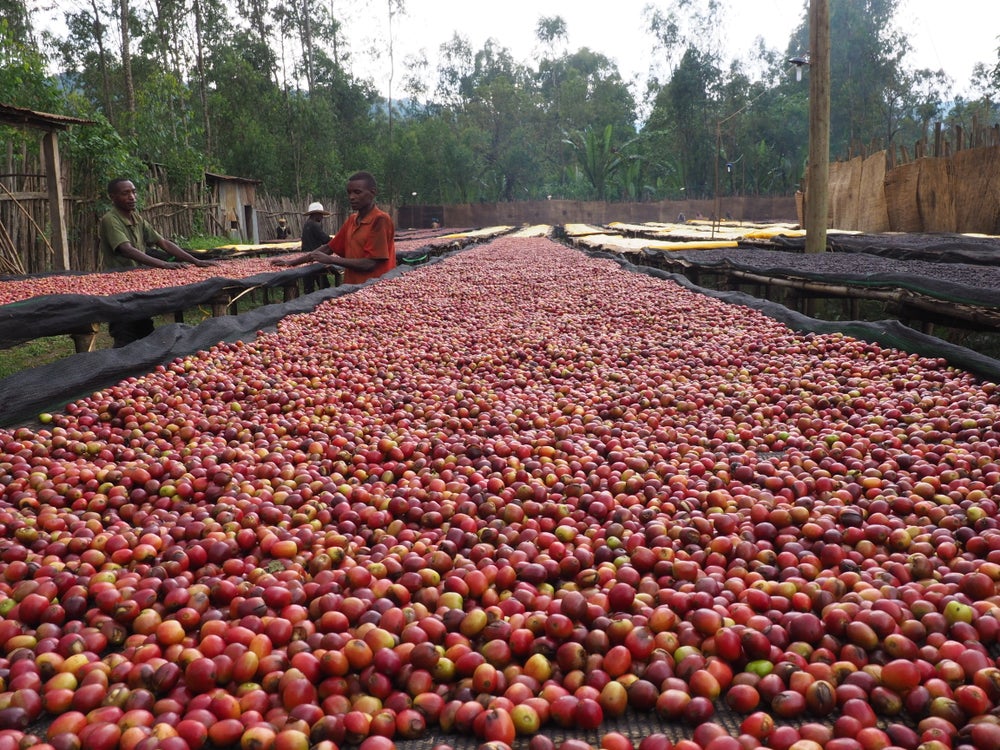
Gizawu selectively handpicks ripe, red cherry and processes it on his farm. He lays cherry on raised beds to dry. He rakes cherry frequently to ensure even drying and covers it at the hottest part of the day and at night. It takes approximately 22 to 28 days for cherry to dry.
About Lalisaa
Lalisaa is a term used to describe something that is flourishing and growing. Our Lalisaa coffees, initiated by Sucafina staff, began with the recognition that the supply chain in Ethiopia was failing to benefit smallholder farmers or reward them for producing quality coffee.
The program encourages strong growing practices, rewards the production of quality coffee and helps farmers take control of their part of the supply chain by partnering directly with smallholders.
New farmers are onboarded each year for a training program that is intended to help farmers improve yields and quality while also accessing new markets and financial services. Farmers in the program participate in a wide range of activities including designing, and later revising, a farm management plan, accessing financing for larger farm projects and more.
Currently, Lalissa is compromised of 97 farmers located within the acclaimed coffee-producing regions of Kochere, Gedeb, Yirgacheffe, Shakiso, Bule Hora and Sidama. In addition to working with farmers to improve quality and yield, Sucafina Ethiopia is, through Lalisaa, making introductions between roasters and farmers. By bringing roasters to visit farmers and begin discussions, Lalisaa coffees are helping make connections and developing relationships between farmers and their potential clients. This will enable direct trade relationships that can benefit both farmers and roasters.
About Yirgacheffe
Yirgacheffe is a district in Southern Ethiopia’s Sidamo region. Yirgacheffe is widely recognized as one of coffee’s ‘birth regions.’ Washed coffees coming from this district are so well-known and sought-after that Yirgacheffe is considered its own micro-region.
The majority of coffees grown in Yirgacheffe are local landrace varieties (which are often also called Ethiopian heirloom). Other varieties grown in the region were developed by the Jimma Agricultural Research Centre (JARC). JARC is an important research center for Ethiopia and has done a great deal of work on developing disease-resistant and high-yielding varieties that still demonstrate quality in the profile.
Most farmers in the region farm on fewer than 5 hectares (many counting their coffee farms in terms of trees rather than area). Cultivation methods are traditional for the most part, with coffee being grown as part of an integrated ‘coffee garden,’ intercropped with other food crops.
Coffee in Ethiopia
While Ethiopia is famous as coffee’s birthplace, today it remains a specialty coffee industry darling for its incredible variety of flavors. While full traceability has been difficult in recent history, new regulations have made direct purchasing possible. We’re partnering directly with farmers to help them produce top quality specialty lots that are now completely traceable, adding value for farmers and roasters, alike.
The exceptional quality of Ethiopian coffee is due to a combination of factors. The genetic diversity of coffee varieties means that we find a diversity of flavor, even between (or within) farms with similar growing conditions and processing. In addition to varieties, processing methods also contribute to end quality. The final key ingredients for excellent coffee in Ethiopia are the producing traditions that have created the genetic diversity, processing infrastructure and great coffee we enjoy today.
Most producers in Ethiopia are smallholders, and the majority continue to cultivate coffee using traditional methods. As a result, most coffee is grown with no chemical fertilizer or pesticide use. Coffee is almost entirely cultivated, harvested and dried using manual systems.