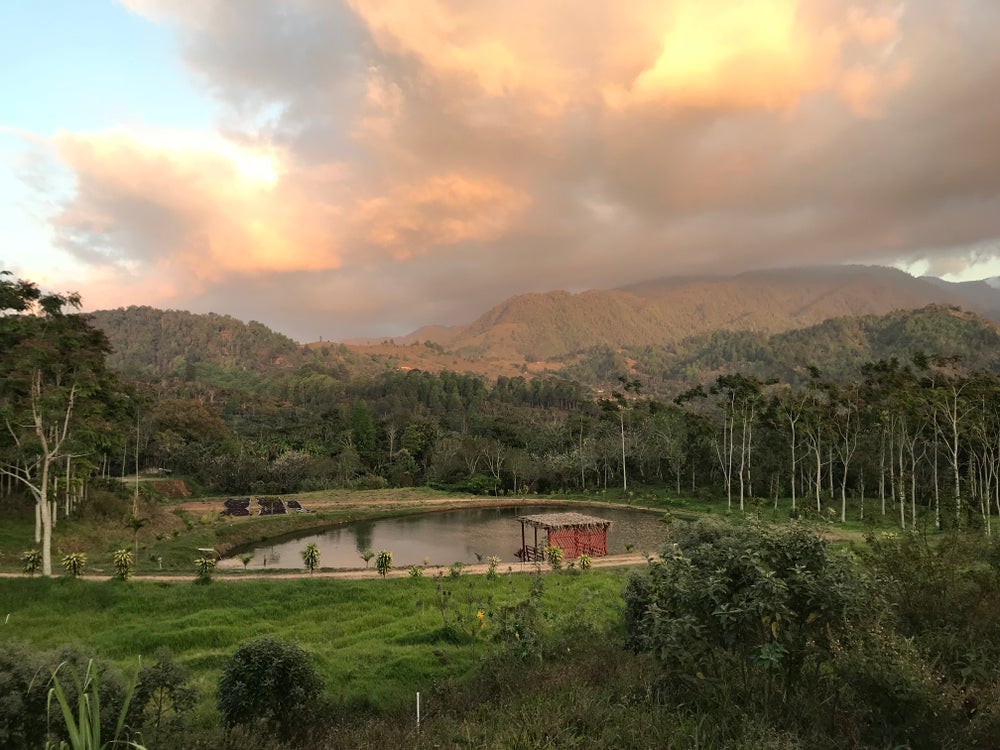

About This Coffee
Omar Rodríguez Interiano founded Cooperativa Cafetalera Capucas Limitada (COCAFCAL) in 1999 to help him share the keys to his specialty coffee cultivation and marketing success with other farmers in the region. Today, COCAFCAL has over 950 members. Members are located in 16 communities in the department of Copán.
COCAFCAL maintains partnerships with financial institutions at the national and international level. This enables them to access credit to purchase cherry from members at good prices that support their livelihoods.
A partnership with Texas A&M University supports scientific research into coffee and gives farmers access to new information and skills. Members can also access education through Universidad Nacional Autónoma de Honduras through a partnership that created the first virtual university in Western Honduras. It’s the first university tele-learning center in rural Honduras.
COCAFCAL also invests in the local communities where they work. They fund street repairs, field schools for producers, soccer programs for local children and a coffee tasting program for the children of cooperative members. They have contributed to local health centers and provide money for transportation to medical clinics in emergencies. They also fund medical clinics that travel to remote areas and provide basic health and dental care.
Cultivation
COCAFCAL is a pioneer in improving the production of liquid and solid organic fertilizers. They have fertilizer plants for both solid and liquid fertilizers where they produce fertilizer to meet the needs of the cooperative and its partners.
They also support and train farmers in reforestation, coffee agroforestry systems and protecting local forests and water sources.
To help producers improve coffee production, diversify their incomes, improve diets and access traditional medicines, the cooperative provides technical assistance, training, financing and marketing services for beekeeping. Members keep both Apis Melífera and Melipona (stingless, native bees). COCAFCAL also promotes fish farming as another way to diversify income.
Harvest & Post-Harvest
The cooperative centralizes cherry processing to maintain high-quality coffee quality. Cherry is selectively handpicked and delivered to cooperative wet mills. Cherry is pulped and then fermented. Following fermentation, parchment is washed in clean water to remove remaining mucilage and laid to dry. Drying parchment is monitored 24 hours a day by specially trained staff. It takes 10 to 20 days for parchment to dry.
The cooperative has built solar dryers that have 800 screens and can dry up to 800 quintals (80 metric tons) of coffee at a time. The solar dryers also provide consistent employment to over 12 people throughout the year. The cooperative provides also technical assistance and financing to help members build their own solar dryers.
About COCAFCAL
COCAFCAL teaches members how to leverage their experience as small producers to increase the quality of their coffee and tell their own stories. “Being small producers is our guarantee of good agricultural practices and the best quality for our clients,” says Omar Rodríguez Romero, COCAFCAL’s general manager.
The cooperative is focused on building a sustainable future for coffee production by managing resources rationally and transparently.
The cooperative organizes medical and dental brigades to serve remote communities and makes doctor’s visits free for producers who can reach their clinic in Capucas.
Rather than simply tell members what they should be doing to improve coffee quality, the cooperative created the “Coffee Academy” to provide training in cupping and quality control to producers and the children of producers. Through the Coffee Academy, producers can experience firsthand the value of improving cultivation and processing and learn how to assess the value of their own coffees.
COCAFCAL’s virtual classroom expands university access for young adults in coffee-producing communities. Their collaboration with the National Autonomous University of Honduras (UNAH) will make it possible for countless young adults who were previously constrained by geographic or financial barriers to get university degrees.
Young consumers are driving decaf’s resurgence and, like their caffeine-drinking peers, they’re expecting high-quality coffees that are often traceable and certified. With more than 50% of the world’s population under 30, the demand for decaffeinated coffee – and the need for specialty decaf that tastes good and meets ethical or environmental standards – is rising.
Swiss Water offers an alternative to consumers concerned by methyl chloride (MC) and ethyl acetate (EA) processes. Because water processing does not use added chemical compounds, coffees can maintain organic certifications and customers can be assured of the absence of additional chemicals.
The difficulty of decaffeination is that many of the flavor compounds that give coffee its excellent taste are, like caffeine, water-soluble. Thus, any decaffeination method needs to effectively single out and remove the caffeine molecule while preserving as many of the flavor compounds as possible.
The process begins with a batch of green coffee beans that are soaked in water to remove the caffeine. In water, many of the flavor compounds are also removed as well, but don’t worry! This is intentional and will preserve help flavor in the future.
This first batch of beans are then discarded. This process only needs to happen once because the mixture produced by soaking those beans, called green coffee extract (GCE), can be maintained and reused to decaffeinate many batches of green beans.
The principle behind water processing is that water can only absorb a set amount of flavor compounds and caffeine before it is completely saturated. When water is fully saturated, it cannot accept (and remove) any more flavor compounds, even if they’re in the coffee. That first batch of beans created a fully saturated water mixture, the GCE. In order to process the beans for decaffeination, the GCE is run through a filter to remove only the caffeine.
Now the GCE is fully saturated except for caffeine. When a new batch of green beans are placed in the GCE, the only compound from the new beans that will be accepted into the GCE is caffeine, everything else will remain in the beans because the GCE is already saturated with those chemicals and unable to ‘take’ anymore.
SWP decaf composition varies from lot to lot, but SWP does provide traceability info. Please reach out to [email protected] if you need any help tracing your lot.
Coffee in Honduras
Honduras is a small yet mighty coffee producer. The country boasts the largest per capita coffee production in the world. Beginning in 2017, Honduras began placing in third place for Arabica production volume globally. For this slot, they compete with Ethiopia—a country 10 times larger than Honduras. The two countries trade between third and fourth place annually, but the achievement is impressive, nonetheless.
Honduras has everything it needs to become a premier specialty coffee producer. The country has the right growing conditions, abundant fertile soils and soaring altitudes (nearly all farms are at more than 1,000 meters above sea level), plus a variety of microclimates.
Beginning in the early 2000s the industry began to focus on quality. Improved infrastructure (better mechanical dryers, centralized wet mills, an increasing number of solar dryers), quality control/assurance trainings (separating lots by qualities, cupping schools, etc.), the rise of specialty-focused exporters, increased volumes of certified coffees and the strengthening cooperative movement all have worked in tandem to make Honduran coffee ‘one to watch’.
It is only in more recent years that coffee production in Honduras has reached specialty levels comparable to other Central American countries, but specialty roasters are responding with enthusiasm. In 2017, a lot in the Cup of Excellence garnered the highest price ever paid for a Cup of Excellence coffee in any country: $124.50 per pound (approximately $56.50 per kg).
Above all, while Honduras increasingly offers high end microlots, what the country arguably represents overall is exceptional value. Quality has improved massively over the last 15 years, and in addition to unique specialty lots, the country offers very solid, clean blenders at very attractive prices.