
About This Coffee
Peaberry coffee beans are known for their high density. They are said to roast more evenly than typical coffee beans because their rounder shape allows them to roll more easily. Tanzania is famous for its peaberry coffee. This coffee is named after the Chagga tribe in Southern Tanzania. In the cup it’s earthy and full of cocoa and citrus.
Harvest & Post-Harvest
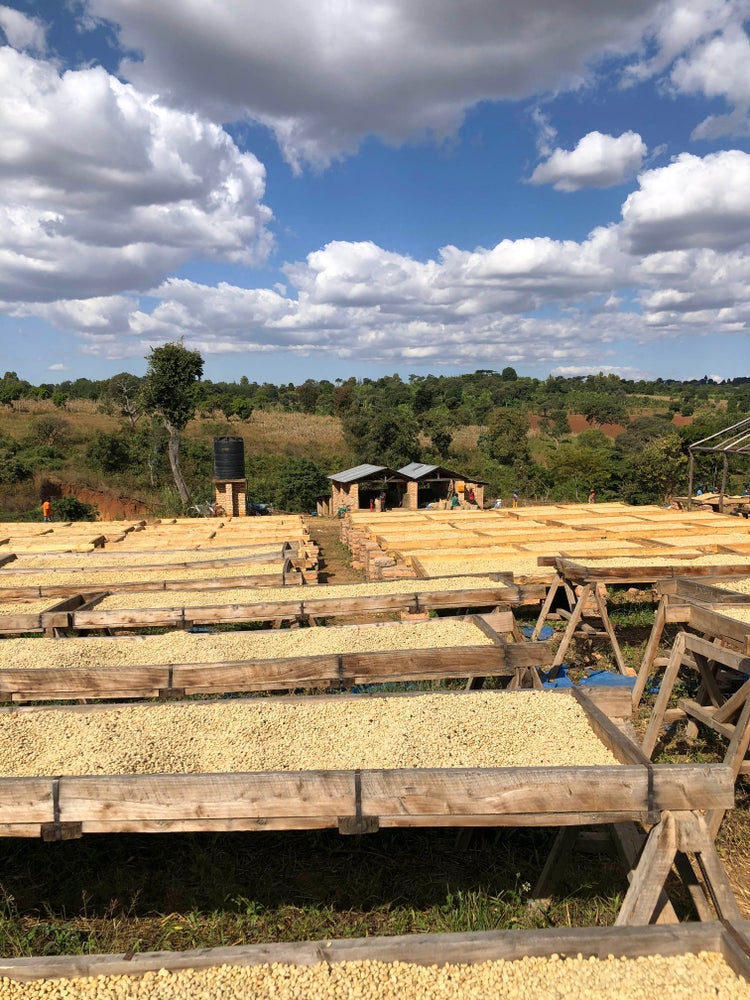
Smallholders selectively handpick cherry and deliver it to washing stations for processing. Processing methods vary significantly across Tanzania but since it’s Fully washed, the general strokes include pulping, fermentation, washing in clean water and drying, typically on raised beds. Peaberries, a natural mutation, are handpicked from Fully washed lots and combined in this separate peaberry blend.
About Peaberries
PB stands for peaberry. Peaberry is a name given to a very specific shape of coffee bean. In Spanish, peaberries are called “caracol”, which means “snail”. The name aptly describes the shape of the peaberry bean, which appears slightly curved in on itself.
Peaberries are the result of a natural mutation in the coffee cherry. Whereas there are usually two beans nestled together in each fruit, a cherry with a peaberry mutation only forms one bean. Thus, peaberries are a single, rounder bean.
Peaberry mutations occur in approximately 5% of all coffee. The beans are known for being rounder, smaller and denser, which can contribute to a more even roast color when handled correctly. Many people find peaberries to have a sweeter flavor profile, as well.
Since peaberries are a natural mutation that is not visible from the outside of the cherry, peaberries must be sorted out during the screen grading stage of dry milling. The peaberry screens have the smallest holes, which are oblong to allow the rounder beans to fall through.
Coffee in Tanzania
Coffee’s roots in Tanzania can be traced via oral history back to the Haya tribe of Northwest Tanzania in the 16th century. Following German and then British colonial rule, the Tanzanian coffee industry has undergone many transformations and adjustments in an effort to create the most equal, profitable and high-quality coffee possible. Today, our in-country partner, Sucafina Tanzania, is invested in improving the coffee and the lives of smallholder farmers through a variety of initiatives.
Coffee in Tanzania was grown almost exclusively in the North for a long time. The Kilimanjaro, Arusha, Tarime, Kagera, Kigoma and Karatu/Ngorongoro regions were prized for their ideal Arabica growing conditions. At the time, coffee production was so concentrated in the north that Moshi, a northern municipality, was the only hub for all coffee milling and sales.
Operations in Moshi grew to truly massive proportions in the 1950s and early-1960s. Since both Tanzania, Kenya and Burundi were under British rule in the post-war decades, Moshi was the second milling and sales hub (after Nairobi, Kenya) for British coffee production.
Coffee cultivation has extended southwards in recent years. In addition to the historical powerhouse regions in the north, coffee is now also grown in the southern regions of Ruvuma and Mbeya/Mbozi. Most Southern expansion of coffee growing occurred in the 1970s and 1980s and was encouraged by two projects supported by European backers. In an ironic twist, today 75 to 85% of total coffee production in Tanzania today comes from farms in the south.