Wednesday, June 24, 2026
Chart of the Quarter
Go beyond the numbers! Every quarter, our Head of Research & Quant Trading, Ilya Byzov, breaks down a key chart to help you decode the trends, data and dynamics driving the global coffee market.

Q3 2026: Robusta production forecasts climbed again
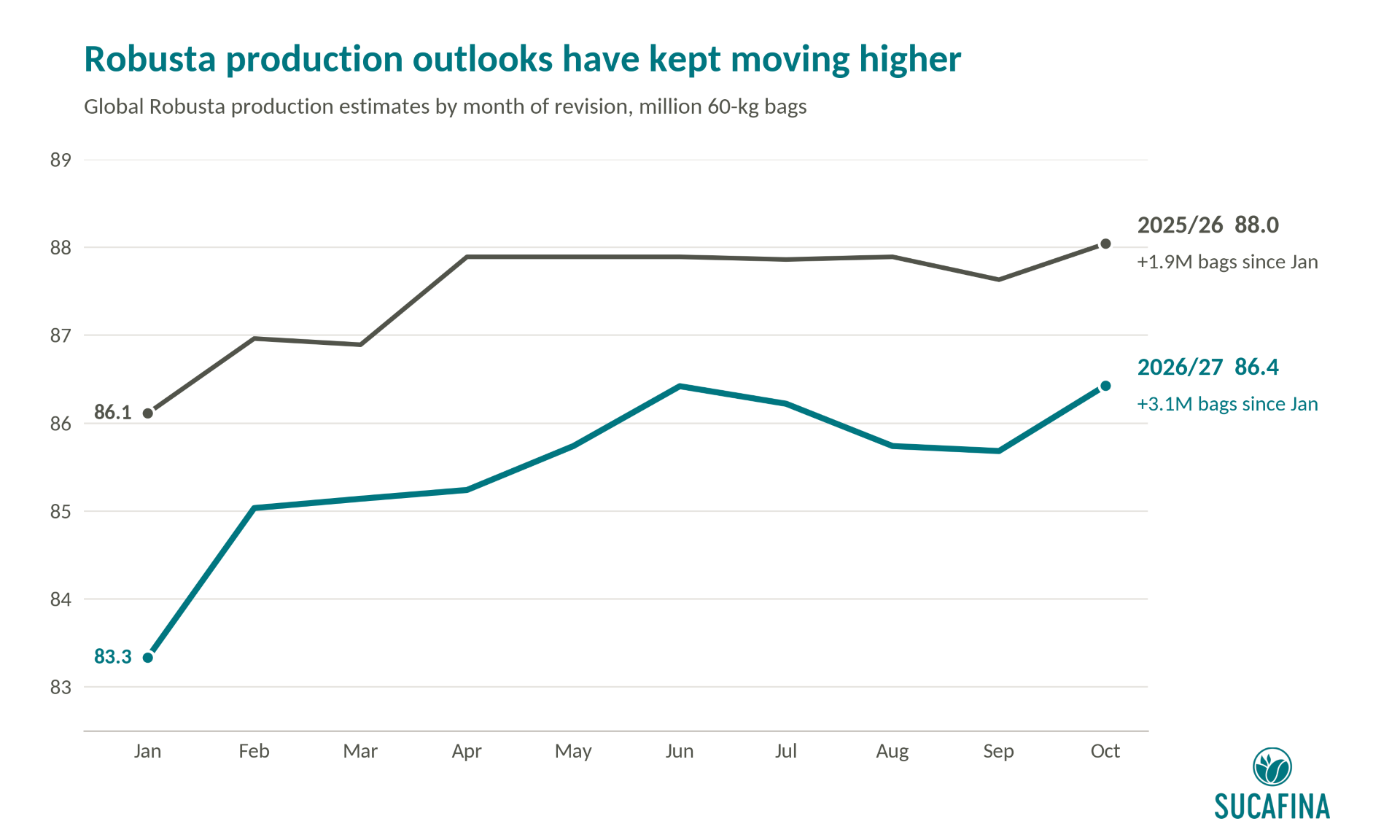
This iteration of Chart of the Quarter focuses on Arabica's physiologically stronger yet more bitter sibling - Robusta. It has been well documented that the production response from 2024's record-setting prices for Robusta has been tremendous. Farmers throughout the globe – from Brazil to Vietnam to Uganda – have responded to the challenge of feeding the world's increasing Robusta demand in stride.
In Brazil, the returns on investment for growing Robusta exceeded that for Arabica for multiple years (due to much higher yields/ha) without major challenges in weather that Arabica had to face with regard to cold weather. In Vietnam, farmers began adopting new planting techniques, utilizing new higher-yielding varieties planted in a tighter tree spacing to improve productivity. Finally, in Uganda, the government's efforts to provide farmers with free coffee seedlings finally took root, erupting in a Robusta-growing craze where even city dwellers can see, through social media, the massive ROI that Robusta coffee farms can bring.
These three independent drivers of growth coincided with relatively mild weather throughout 2026 to result in increasing crop estimates. Overall, Robusta production jumped from what had already been a record of 78 million bags in 24/25 to a new record of 88 million bags for 25/26.
The chart above shows the evolution of our Robusta production outlook for the 25/26 and 26/27 crop throughout this calendar year. What is clear is that we have steadily revised our already record crop figures higher: from an expected 86.1 million bags to 88 million bags for the 25/26 crop (as of today) and for the soon to be harvested 26/27 crop, we’ve gone from 83.3 million to 86.4 million bags.
This type of adjustment helps to explain why Robusta prices have been so muted relative to Arabica over the past year. Although demand for Robusta continues at a record-high 86 million bags, upward production revisions have consistently kept pace with demand increases, overwhelming the bullish arguments for Robusta.
Despite the drawback from recent downward price action, which may be putting a damper on further Robusta expansion, the future for Robusta seems bright. Our research expectation is that both consumption and production of Robusta will reach 50% of the total coffee market by 2030.
Q2 2026: Is coffee cocoa (with a ten-month delay)?
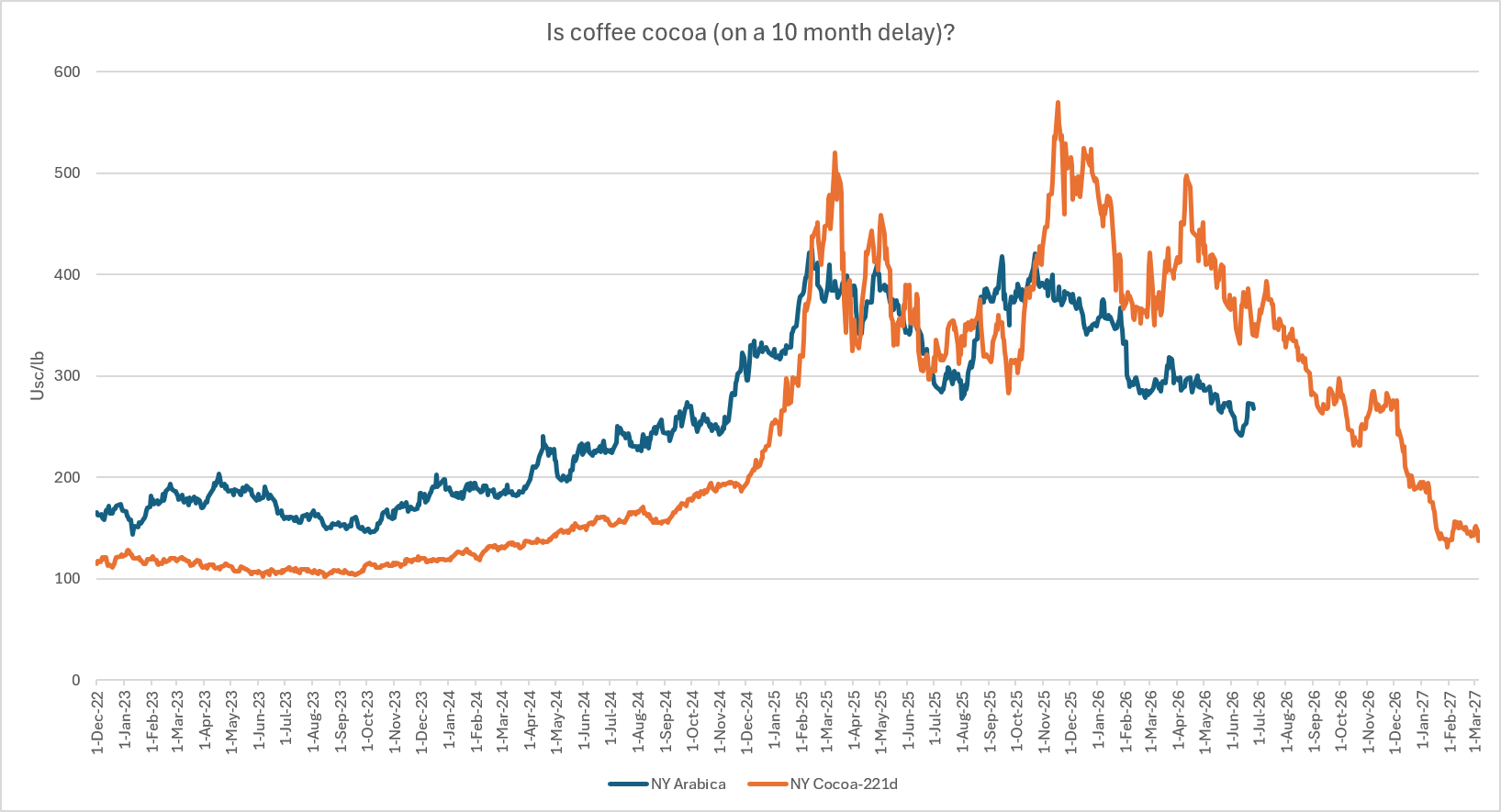
This Quarter's Chart shows coffee futures prices for Arabica and cocoa futures prices (NY Cocoa), converted to USC/lb as a common unit. The Cocoa futures are on a 10-month delay, showing prices on a 220-day offset. The reason for picking the timeline of 10 months is due to the difference in the timing of the Net Speculator position, which peaked for Cocoa in September 2023, on the back of an outbreak of disease and disrupted weather patterns in West Africa. Coffee's peak speculative positioning occurred in April 2024, remaining elevated for the next 6 months as prices climbed from $2.21 to over $4 per pound.
Cocoa and Coffee markets are related in the soft commodity space, and are often traded as a basket by cross-commodity funds. It is clear that just as the price action was peaking for cocoa, money managers were looking for a similar fundamental storyline to diversify into, and found it in coffee. Now that both markets are well past their peak price action, it is interesting to see how bullish investments get unwound from the perspective of prices. Overall, the resemblance in prices is striking, with coffee seeing a slightly less volatile price action. The latest selloff in coffee futures in May and June looks well aligned with cocoa's selloff following its last major rally to above $5/lb. Currently, coffee prices are consolidating in a lower range after sharply declining in early June. If "cocoa on a delay" continues to be an analog, we would expect this consolidation to continue until early August before resuming their downtrend.