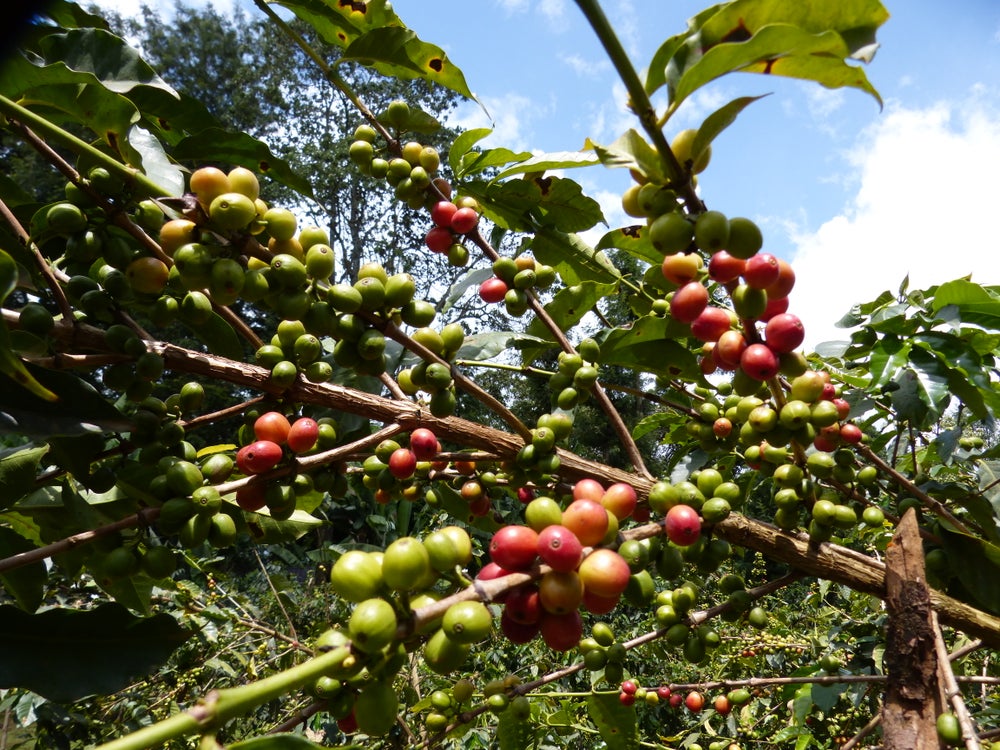

About This Coffee
The name for Wanya Estate comes from the combination of owner Josephine’s middle name, Wawaira with her late husband, John Kirk Nyaga Kamunyori. They merged the “Wa” from Josephine’s name with the “Nya” from John Kirk’s name to create Wanya Estate in 2008.
Today, Josephine cultivates SL28 and Ruiru 11 coffee trees on her 2.6 hectare estate. She works with her brother, who is a member of Kiburi Farmers’ Cooperative Society in Kirinyaga to cultivate high-quality coffees like this one.
Cultivation
Josephine cultivates SL-28 and Ruiru 11 on her estate. SL-28 was one of the many cultivars released by Scott Agricultural Laboratories (SAL) in the 1930s and 1940s. These cultivars soon became the cultivars of choice for many growers in Kenya due to their deep root structure, which allows them to maximize scarce water resources and flourish even without irrigation. Ruiru 11 is a new variety known for its disease resistance and high yields. It also starts yielding fruit after just 2 years.
Josephine receives regular training in Good Agricultural Practices from KENYACOF (Sucafina in Kenya) including proper fertilizer application, pruning guidance and renovation advice, which helps her to keep her small estate in optimal condition.
Prior to Sucafina in Kenya’s soil sampling program, farmers had little access to soil analysis methods. Fertilizer, when applied, would be formulated according to a generalized recipe rather than one uniquely suited to the farm’s exact needs. Now, with better access to information through technology and agronomical assistance, farmers can apply the right fertilizer recipe at the right time, improving yields and cherry quality.
Harvest & Post-Harvest
Traditionally, many farmers of this size in the country did not own their own processing equipment. They have historically delivered cherry to a centralized cooperative-owned ‘Factory’ (as washing stations are called, locally), where their production is combined with that of others from their region. Josephine has her own, small wet mill where she is able to process her own coffee, ensuring full traceability back to her farm.
Josephine selectively handpicks ripe, red cherry and processes it on her farm. Cherry is selectively sorted and then pulped. Coffee ferments in fermentation tanks for 12 to 16 hours. Following fermentation, parchment is washed in clean water and laid to dry on raised beds. Josephine rakes parchment frequently to ensure even drying.
AA Grade
Kenyan coffees are classified by size. AA beans are the largest size. AA grade coffees are those that are 17/18 screen size, meaning that they are larger than 7.2 millimeters.
Coffee in Kenya
Though coffee growing had a relatively late start in Kenya, the industry has gained and maintained a impressive reputation. Since the start of production, Kenyan coffee has been recognized for its high-quality, meticulous preparation and exquisite flavors. Our in-country sister company, Sucafina Kenya, works with farmers across the country to ensure these exceptional coffees gain the accolades they deserve.
Today, more than 600,000 smallholders farming fewer than 5 acres compose 99% of the coffee farming population of Kenya. Their farms cover more than 75% of total coffee growing land and produce nearly 70% of the country’s coffee. These farmers are organized into hundreds of Farmer Cooperative Societies (FCS), all of which operate at least one factory. The remainder of annual production is grown and processed by small, medium and large land estates. Most of the larger estates have their own washing stations.
Most Kenyan coffees are fully washed and dried on raised beds. The country still upholds its reputation for high quality and attention to detail at its many washing stations. The best factories employ stringent sorting practices at cherry intake, and many of them have had the same management staff in place for years.