
About This Coffee
Husband and wife duo Haile Gebre and Dimbelal Endale founded Mora Mora River Valley Development Organic Coffee’ (Moredocofe) in 2002. As Moredocofe, Gebre and Endale own 2 farms and 1 washing station that also buys ripe cherry from nearby smallholder out-growers.
Cultivation
In addition to producing great quality coffee, Moredocofe is dedicated to working with nearby smallholders to give them access to tools for improving coffee quality and address a changing climate. Moredocofe runs a seedling nursery that shares seedlings at no charge to all out-growers and provides trainings on cherry selection and best agricultural practices. They also use their sample roaster to expand access to cupping knowledge and enable small producers to taste their own coffees—many for the first time—and better understand feedback about quality and taste.
Gebre and Endale operate a program on Moredocofe’s 2 farms that transforms organic material into organic compost. They also encourage smallholder out-growers to start similar programs to improve coffee quality and protect the land.
Harvest & Post-Harvest
Moredocofe’s washing station receives cherry from both its farms and the farms of the 300+ smallholder producers who grown
Coffee cherries are delivered daily to the station from Moredocofe’s farm, as well as their 300 out-grower partners, who each have around 2–3 hectares of land located at 1,800–1,900m above sea level.
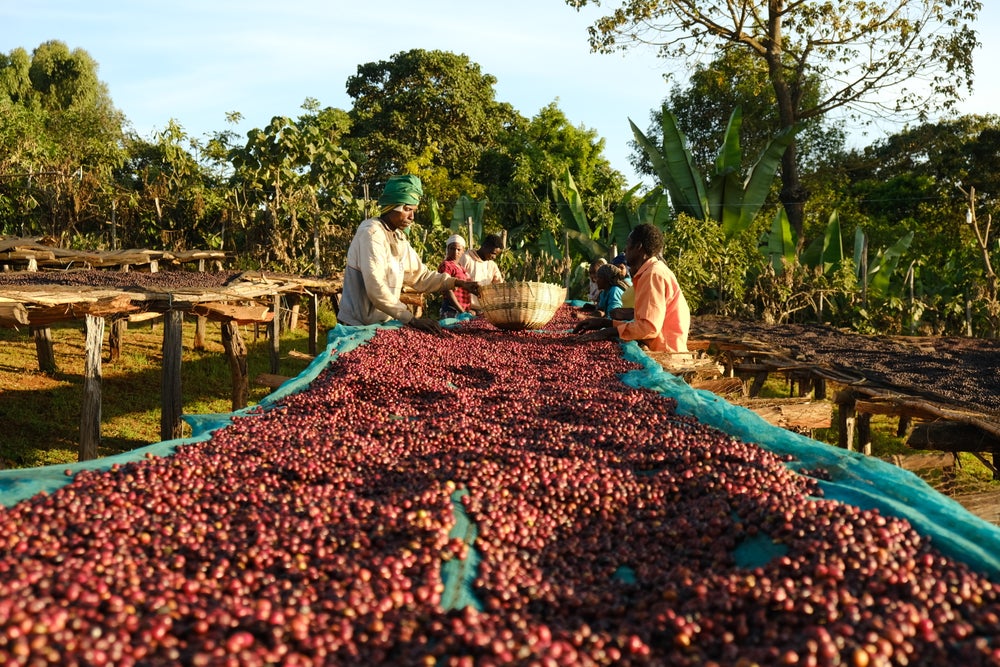
This Natural lot benefits from the knowledge of countless generations of Ethiopian coffee producers who have been processing Natural coffee since time immemorial. At intake, cherry is visually hand sorted to remove any underripes, overripes or damaged cherry and then floated to grade by density. Finally, cherry is laid to sundry in thin layers on raised beds. For the first few days, workers turn drying cherry almost constantly to promote even drying. After a few days, frequent turning continues as the layers of cherry are gradually thickened. Thicker layers helps slow drying and stabilize water activity. Cherry is covered from the direct heat of the midday sun and overnight to prevent moisture build up on cherry.
About Guji
Guji coffee has only recently been distinguished from neighboring Sidamo and Yirgacheffe. However, due to their incredible quality and unique profiles, they are quickly gaining international recognition.
The Guji region receives ample rainfall and is marked by steep mountainous terrain: perfect conditions to support the vast array of coffee grown here.
Ethiopia Grade 1
Grades in Ethiopia depend on visual inspection for defects and on cup quality. Grade 1 is considered the highest quality coffee. Grade 1 and 2 are considered specialty coffee, grades 3-9 are classified as commercial coffee. Grade 1 is free of cup faults and taints and has zero quakers.
Rainforest Alliance
RFA stands for Rainforest Alliance, a certification system that emphasizes climate-smart agriculture. RFA farms have at least 40% of land covered by canopy, significant species diversity (at least 12 native tree species per hectare, on average) and a system of natural vegetation buffers between agricultural land and bodies of water. The farms also use organic fertilizers.
Coffee in Ethiopia
While Ethiopia is famous as coffee’s birthplace, today it remains a specialty coffee industry darling for its incredible variety of flavors. While full traceability has been difficult in recent history, new regulations have made direct purchasing possible. We’re partnering directly with farmers to help them produce top quality specialty lots that are now completely traceable, adding value for farmers and roasters, alike.
The exceptional quality of Ethiopian coffee is due to a combination of factors. The genetic diversity of coffee varieties means that we find a diversity of flavor, even between (or within) farms with similar growing conditions and processing. In addition to varieties, processing methods also contribute to end quality. The final key ingredients for excellent coffee in Ethiopia are the producing traditions that have created the genetic diversity, processing infrastructure and great coffee we enjoy today.
Most producers in Ethiopia are smallholders, and the majority continue to cultivate coffee using traditional methods. As a result, most coffee is grown with no chemical fertilizer or pesticide use. Coffee is almost entirely cultivated, harvested and dried using manual systems.