
About This Coffee
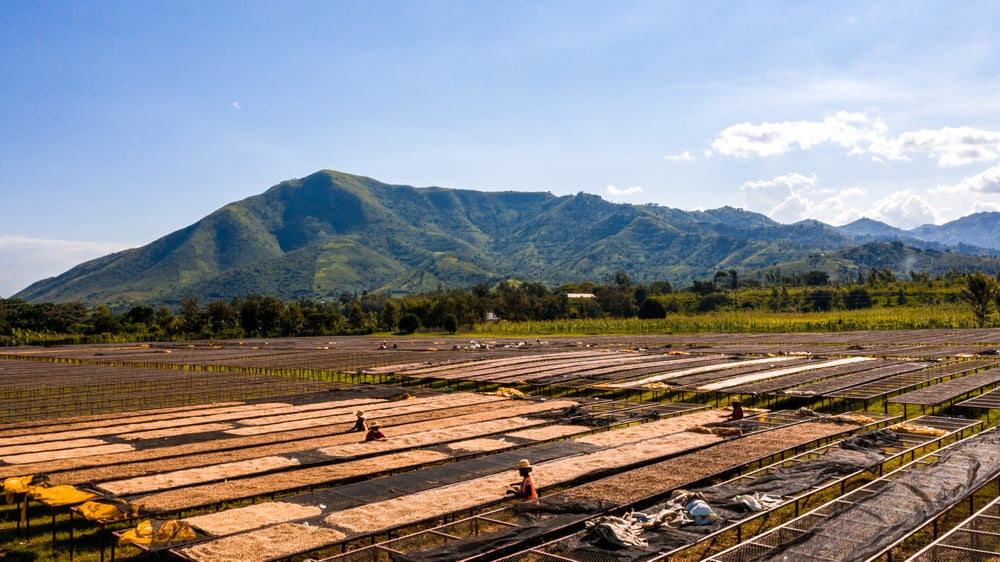
Kisiizi washing station is located in Rukungiri, Western Uganda. Farmers who deliver their cherry cultivate coffee at 1,500 to 1,900 meters above sea level in a fertile and ideal microclimate. The station is named for the nearby village, which is called Kisiizi.
Cultivation
In the east, the fertile volcanic soil surrounding Mount Elgon volcano makes for productive coffee farms, and to the west, the Rwenzori mountains offer high altitudes perfect for Arabica cultivation.
Most farms are small, an average of 1 to 1.5 hectares on average. Most work is done by the family. Coffee is usually the primary cash crop for farmers, but most also intercrop their trees alongside plantains, bananas and fruit. This intercropped produce makes up a substantial part of the family’s diet for the year.
Harvest & Post-Harvest
Farmers selectively handpick ripe cherry and deliver it to washing stations or supply chain agents near them. Cherry is carefully sorted at intake where under- and over-ripes, along with any foreign matter, are removed. In order to offer fair prices, farmers are paid the same for their quality cherry regardless of where they bring their cherries.
Quality assurance begins as soon as farmers deliver their cherry. All cherry is floated in small buckets as a first step to check quality. Cherries are then wet processed under constant supervision. Pulping, fermentation, washing, grading through channels and a final soaking are all closely monitored.
Wet parchment is sorted and any damaged beans that remain are removed. Then, parchment is moved to raised beds where it is turned regularly to ensure even drying. Parchment is covered at the hottest part of the day and overnight to prevent cracking and/or condensation. Workers also regularly inspect drying parchment and remove any damaged beans. Table are marked with tags to ensure traceability.
After drying, parchment is delivered to our dry mill in Kampala. The mill has the capacity to mill smaller lots separately to help preserve quality and traceability.
UGACOF/Sucafina Uganda
Our partner, UGACOF/Sucafina Uganda is committed to improving quality in Uganda by building new washing stations and infrastructure and training personnel in the region. Collaborations with our FarmerHub program and our sustainability partner, the Kahawatu Foundation, are building upon our work to expand farmers’ access to better resources and better training. Our connections to our more established operations in nearby Rwanda, Burundi and Kenya offer us advice and a perspective steeped in a familiarity with East Africa.
The bulk of our work in Uganda is focused in the West, near the Rwenzori Mountains. The biggest difference between East (Mount Elgon) and West (Rwenzori) is that Mount Elgon is a more established and competitive market. We are excited to be at the forefront of the drive for enhancing coffee production infrastructure, developing the industry and becoming reliable partners for farmers in the Rwenzori Mountain region.
It is clear to us that the potential in this region might exceed our expectations and even the potential of the popular Mount Elgon region. With an ever-growing demand for high quality Arabicas and a sustained interest from roasters and coffee drinkers in the East African origins, we are very confident that, with diligence and effort, Western Ugandan coffees will be able to take their place alongside the other great East African coffees.
While the scale of work in regions like this can sometimes be overwhelming, we have a clear plan that steadily increases coffee quality.
Our first step is the one that leads to the most immediate and noticeable improvement: harvesting techniques. Due to a long history of home-processing and a lack of incentive for high quality, harvesting in the region is often semi- or entirely non-selective. Thanks to our extended network of cherry collection sites, we meet with farmers every day during the harvest season and can give real-time feedback that can impact the quality of the next day’s harvest. At the collection sites, we can insist on higher levels of care and reward meticulous picking. Though we’re still in the early years, we have seen a clear difference in quality from one year to another and even from the first week of the harvest to the last.
Future steps will include working with farmers to improve their access to materials and knowledge of better farming practices. This means making fertilizer more accessible, encouraging farmers to plant shade canopies and more. We’re planning on building demonstration plots, input access sites across the region and training a new generation of skilled washing station staff. We know it will take time, but we have a strategy and are committed to realizing this vision.
Coffee in Uganda
Uganda is the native home to one species of Robusta, and commercial coffee production in the country goes back to the beginning of the 20th century.
Our partner, UGACOF/Sucafina Uganda is committed to improving quality in Uganda by building new washing stations and infrastructure and training personnel in the region. Collaborations with our FarmerHub program and our sustainability partner, the Kahawatu Foundation, are building upon our work to expand farmers’ access to better resources and better training. Our connections to our more established operations in nearby Rwanda, Burundi and Kenya offer us advice and a perspective steeped in a familiarity with East Africa.
The bulk of our work in Uganda is focused in the West, near the Rwenzori Mountains. The biggest difference between East (Mount Elgon) and West (Rwenzori) is that Mount Elgon is a more established and competitive market. We are excited to be at the forefront of the drive for enhancing coffee production infrastructure, developing the industry and becoming reliable partners for farmers in the Rwenzori Mountain region.
It is clear to us that the potential in this region might exceed our expectations and even the potential of the popular Mount Elgon region. With an ever-growing demand for high quality Arabicas and a sustained interest from roasters and coffee drinkers in the East African origins, we are very confident that, with diligence and effort, Western Ugandan coffees will be able to take their place alongside the other great East African coffees.