
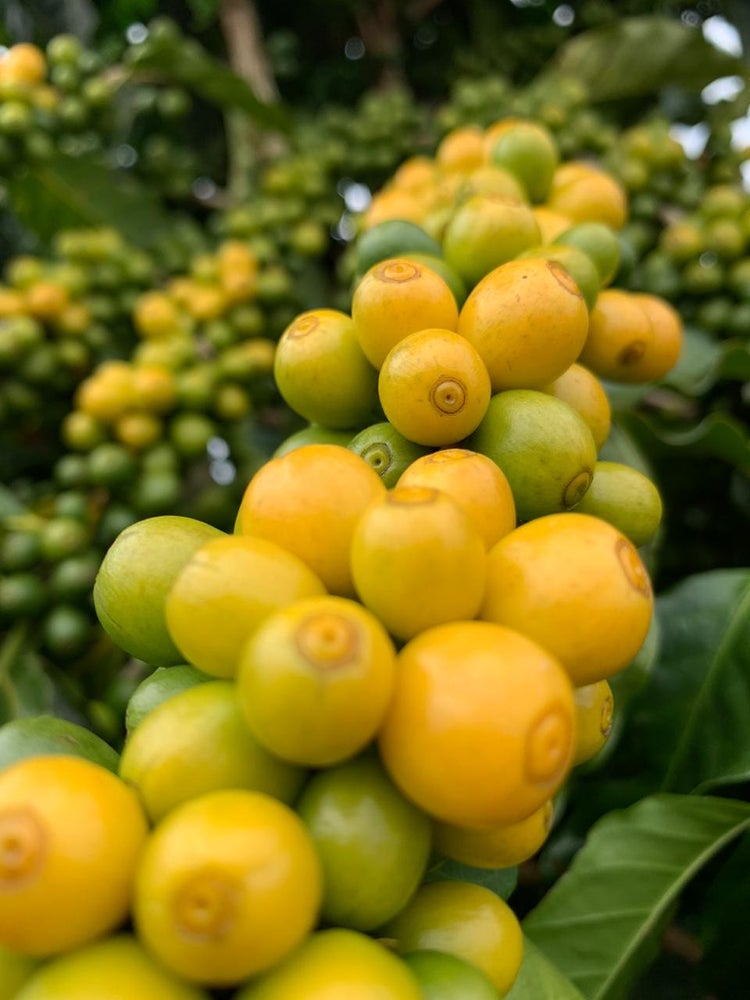
Harvest & Post-Harvest
Most Brazilian coffee is grown on huge farms, built and equipped for mechanical harvesting and processing, maximizing productivity. The relatively flat landscape across many of Brazil’s coffee regions combined with high minimum wages has led most farms to opt for this type of mechanical harvesting over selective hand-picking.
In the past, this mechanization meant that strip-picking was the norm; however, today’s mechanical harvesters are increasingly sensitive, meaning that farms can harvest only fully ripe cherries at each pass, which is good news for specialty-oriented producers.
In many cases and on less level sections of farms, a mixed form of ‘manual mechanized’ harvesting may be used, where ripe coffee is picked using a derricadeira – a sort of mechanized rake that uses vibration to harvest ripe cherry. A tarp is spanned between coffee trees to capture the cherry as it falls.
With the aid of these newer, more selective technologies, there’s a growing number of farms who are increasingly concerned with – and able to deliver - cup quality.
After harvest, cherry is typically laid to dry in thin layers on patios. Under direct sunlight, cherry is carefully monitored and turned frequently.
About Cerrado Mineiro
The Cerrado Mineiro is a mix of grassy savannah, scrublands and forests with a rich biodiversity of over 10,000 plant species and 800 bird species. It is the largest woodland savannah in South America. At over 2 million square kilometers, it’s three times the size of Texas and constitutes 21% of all of Brazil’s land area.
Since the 1960s, over 40% of the Cerrado Mineiro’s original land mass has been converted into agricultural land. Coffee has been grown in the area for over 40 years and there are now over 3,000 farms, most of which are smallholder plots.
Cerrado coffee is known for its more pronounced and elegant acidity.
Young consumers are driving decaf’s resurgence and, like their caffeine-drinking peers, they’re expecting high-quality coffees that are often traceable and certified. With more than 50% of the world’s population under 30, the demand for decaffeinated coffee – and the need for specialty decaf that tastes good and meets ethical or environmental standards – is rising.
Swiss Water offers an alternative to consumers concerned by methyl chloride (MC) and ethyl acetate (EA) processes. Because water processing does not use added chemical compounds, coffees can maintain organic certifications and customers can be assured of the absence of additional chemicals.
The difficulty of decaffeination is that many of the flavor compounds that give coffee its excellent taste are, like caffeine, water-soluble. Thus, any decaffeination method needs to effectively single out and remove the caffeine molecule while preserving as many of the flavor compounds as possible.
The process begins with a batch of green coffee beans that are soaked in water to remove the caffeine. In water, many of the flavor compounds are also removed as well, but don’t worry! This is intentional and will preserve help flavor in the future.
This first batch of beans are then discarded. This process only needs to happen once because the mixture produced by soaking those beans, called green coffee extract (GCE), can be maintained and reused to decaffeinate many batches of green beans.
The principle behind water processing is that water can only absorb a set amount of flavor compounds and caffeine before it is completely saturated. When water is fully saturated, it cannot accept (and remove) any more flavor compounds, even if they’re in the coffee. That first batch of beans created a fully saturated water mixture, the GCE. In order to process the beans for decaffeination, the GCE is run through a filter to remove only the caffeine.
Now the GCE is fully saturated except for caffeine. When a new batch of green beans are placed in the GCE, the only compound from the new beans that will be accepted into the GCE is caffeine, everything else will remain in the beans because the GCE is already saturated with those chemicals and unable to ‘take’ anymore.
SWP decaf composition varies from lot to lot, but SWP does provide traceability info. Please reach out to [email protected] if you need any help tracing your lot.
Coffee in Brazil
Just under 40% of all coffee in the world is produced in Brazil - around 3.7 million metric tons annually. With so much coffee produced, it’s no wonder that the country produces a wide range of qualities. Brazil produces everything from natural Robusta, to the neutral and mild Santos screen 17/18, to the distinctive Rio Minas 17/18. In recent years, Brazilian producers have also begun investing more heavily in specialty coffee production. Through our in-country partners in Brazil, including our sister company, we are able to provide a wide range of Brazilian coffees to our clients: from macrolot to microlot.
Today, the most prolific coffee growing regions of Brazil are Espirito Santo, São Paulo, Minas Gerais, and Bahia. Most Brazilian coffee is grown on large farms that are built and equipped for maximizing production output through mechanical harvesting and processing. The relatively flat landscape across many of Brazil’s coffee regions combined with high minimum wages has led most farms to opt for this type of mechanical harvesting over selective hand-picking.
In the past, mechanization meant that strip-picking was the norm; however, today’s mechanical harvesters are increasingly sensitive, meaning that farms can harvest only fully ripe cherries at each pass, which is good news for specialty-oriented producers.
In many cases and on less level sections of farms, a mixed form of ‘manual mechanized’ harvesting may be used, where ripe coffee is picked using a derriçadeira – a sort of mechanized rake that uses vibration to harvest ripe cherry. A tarp is spanned between coffee trees to capture the cherry as it falls.
With the aid of these newer, more selective technologies, there’s a growing number of farms who are increasingly concerned with – and able to deliver - cup quality.