
About This Coffee
Over 9,730 farmers deliver cherry to Kiangothe Factory. Farmers cultivate SL28, SL34, Batian and Ruiru-11 variety coffees at 1,700 to 1,900 meters above sea level. Most farms are small, with 200 to 350 trees on average and most of the labor is done by the family. The factory is operated by Kabare Farmers’ Cooperative Society.
Cultivation
Kiangothe sits in the southern foothills of Mt. Kenya. The rich, red volcanic soils and high altitude provide the ideal conditions for cultivating, ripe red cherry.
Harvest & Post-Harvest
Smallholders handpick ripe cherry and deliver it to the factory that day. At intake, cherry is meticulously sorted. All sorting is overseen by the cherry clerk, who ensures that only ripe, undamaged cherry Is received.
Once sorted, cherry is pulped on the factory’s pulper and then density sorted. Pulped cherry is fermented for 10 to 24 hours. Skilled staff oversees fermentation, checking regularly to ensure fermented is halted at just the right moment. After fermentation, cherry is sent through washing and grading channels.
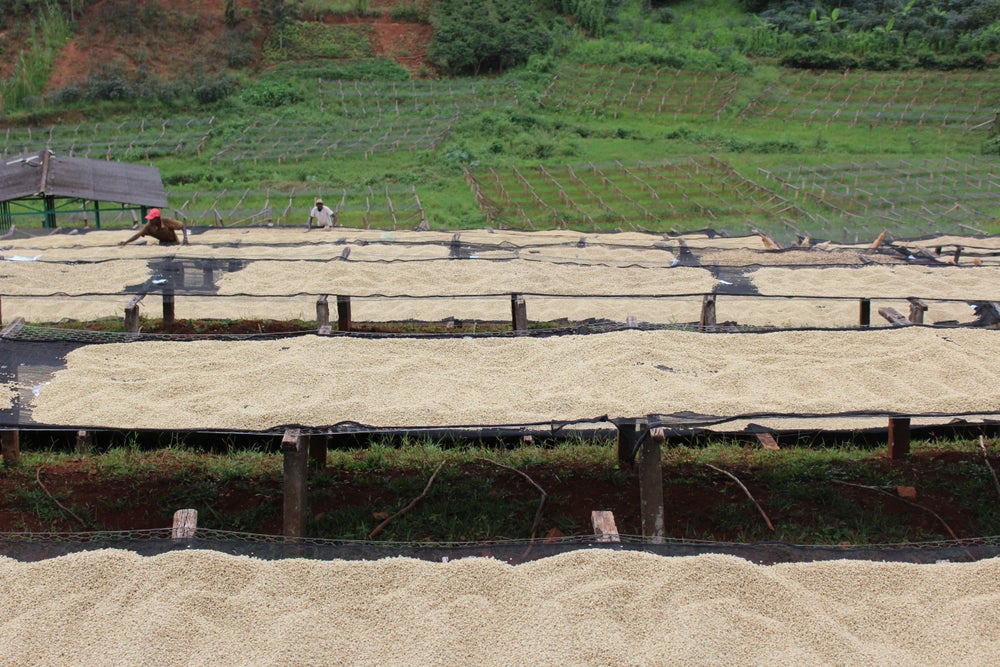
Parchment is soaked in clean water for 12 hours and then placed on deep beds to drain for 1 to 2 hours. During this time, workers sort through drying parchment and remove any damaged or defective bean. Then, parchment is moved to raised drying beds where it will dry for 14 to 18 days. Staff continues to sort drying parchment to remove any remaining defective beans and turn parchment constantly to promote even drying.
About Kirinyaga
Kirinyaga County is nestled at the foothills of Mt. Kenya, roughly 112 km from Nairobi. The region is well-known for its exceptional coffee. Sucafina partners with numerous coffee farmers and cooperatives in the region, working with them to improve processing capacity, access to agricultural inputs and agricultural practices.
The locals in this area call Mt. Kenya ‘Kirinyaga’, the namesake of the county, meaning the crest of whiteness due to its famous snow-capped peaks.
AA Grade
Kenyan coffees are classified by size. AA beans are the largest size. AA grade coffees are those that are 17/18 screen size, meaning that they are larger than 7.2 millimeters.
Coffee in Kenya
Though coffee growing had a relatively late start in Kenya, the industry has gained and maintained a impressive reputation. Since the start of production, Kenyan coffee has been recognized for its high-quality, meticulous preparation and exquisite flavors. Our in-country sister company, Sucafina Kenya, works with farmers across the country to ensure these exceptional coffees gain the accolades they deserve.
Today, more than 600,000 smallholders farming fewer than 5 acres compose 99% of the coffee farming population of Kenya. Their farms cover more than 75% of total coffee growing land and produce nearly 70% of the country’s coffee. These farmers are organized into hundreds of Farmer Cooperative Societies (FCS), all of which operate at least one factory. The remainder of annual production is grown and processed by small, medium and large land estates. Most of the larger estates have their own washing stations.
Most Kenyan coffees are fully washed and dried on raised beds. The country still upholds its reputation for high quality and attention to detail at its many washing stations. The best factories employ stringent sorting practices at cherry intake, and many of them have had the same management staff in place for years.