
About This Coffee
Pitalito lies in the southernmost part of Huila. Producers are focused almost exclusively on producing specialty coffee. While the majority of trees are either Castillo or Caturra, farmers in Pitalito also cultivate more ‘exotic’ varieties than any other region in Colombia.
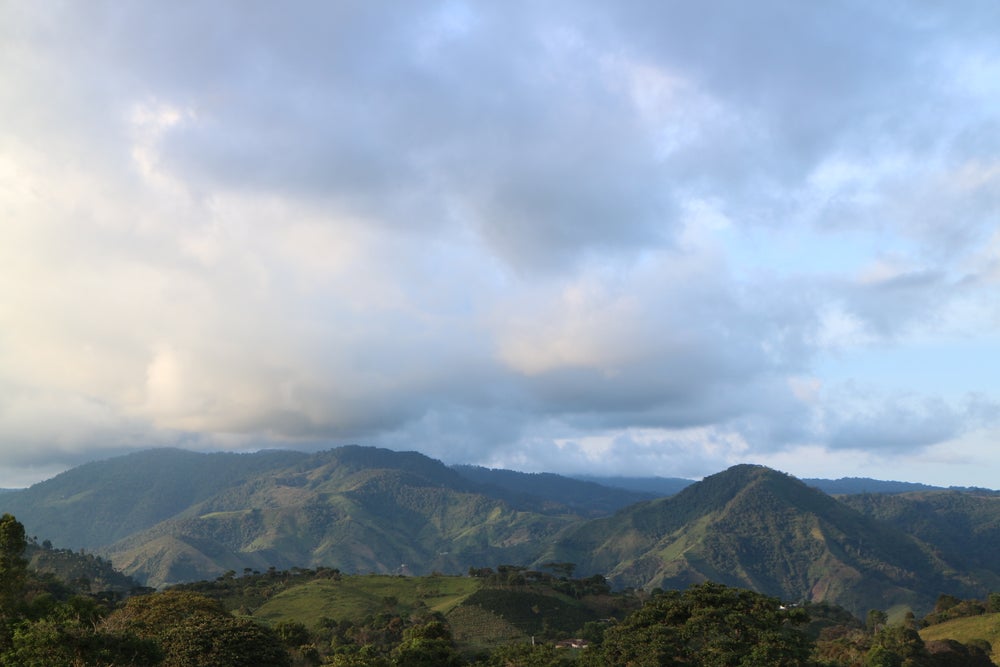
The high altitude of 1,400 to 1,900 meters above sea level is made even more farmable by the amiable geography. Thanks to gentle, rolling hills, Pitalito is much easier to farm than the steep cliffs that are common in many other regions in Colombia. Most farms sit on a large plateau that looks over the Valley of Laboyos.
Harvest & Post-Harvest
Farmers here are mainly smallholders. In fact, 80% of coffee farms are smaller than 3 hectares. On smaller farms, nearly all labor is done by the family. Very few farms hire farmhands. As a result, quality can be carefully controlled and families can focus more energy on intensive farming practices that result in high quality coffee. Families take great pride in their coffee production.
Sugarcane Decaf Process
Sugarcane decaffeination utilizes a naturally occurring compound, ethyl acetate (EA) to decaffeinate coffee. The EA process is relatively simple. The coffee beans are moistened with water and EA is circulated throughout. The EA binds with the caffeine in the bean and extracts the caffeine while leaving most of the other flavor compounds. After the desired caffeine level is reached, the EA residue on the beans is removed by steaming them.
About Huila
The Huila region is one of the most well-known coffee growing areas of Colombia. The Department of Huila has a population of 1.125 million and is located in the southwest of the country. The capital of the department is Neiva, a city of about 380,000.
Along with Cauca and Nariño, Huila is one the three departments where the Colombian Massif is located. A massif is a group of mountain ranges and the Colombian Massif, which is known locally as Nudo de Almaguer, provides up to 70% of safe drinking and agricultural water for the Colombian population.
The Magdalena River, Colombia’s largest river, runs through the region, providing plenty of water for coffee farming and generating (directly and indirectly) up to 86% of Colombia's GDP. The mountain range also features the fertile volcanic soil so typical to the Andean Mountains.
Supremo Grade
Screen sizes remain fairly uniform across countries but grade names are often unique to the country of origin. In the Colombian grading system, Supremo is the largest size bean.
The process of separating beans by size is a crucial stage of the dry milling process. A screen grading machine has a series of screens stacked on top of each other. Green coffee is fed into the machine, and as the screens are shaken, beans that are smaller than holes on a specific screen will fall through to a lower screen until they reach a screen with holes too small for them to fit.
Supremo is typically screen sizes 17 to 18.
Coffee in Colombia
Colombia has been producing and exporting coffee renowned for their full body, bright acidity and rich aftertaste, since the early 19th century.
Colombia boasts a wide range of climates and geographic conditions that produce their own unique flavors in coffee. This also means that harvest times can vary quite a bit. In fact, between all its different regions, Colombia produces fresh crop nearly all year round.
The increasing focus on the specialty industry is changing the way traders and farmers do business. It is becoming more common for farmers to isolate the highest quality beans in their lots to market separately. These higher-quality lots are often sold under specific brands or stories.
Besides its wide variety of cup profiles, Colombia has quickly expanded its certification options over the past 10 years. The most common certifications available are Fairtrade, Rainforest Alliance and Organic.