
About This Coffee
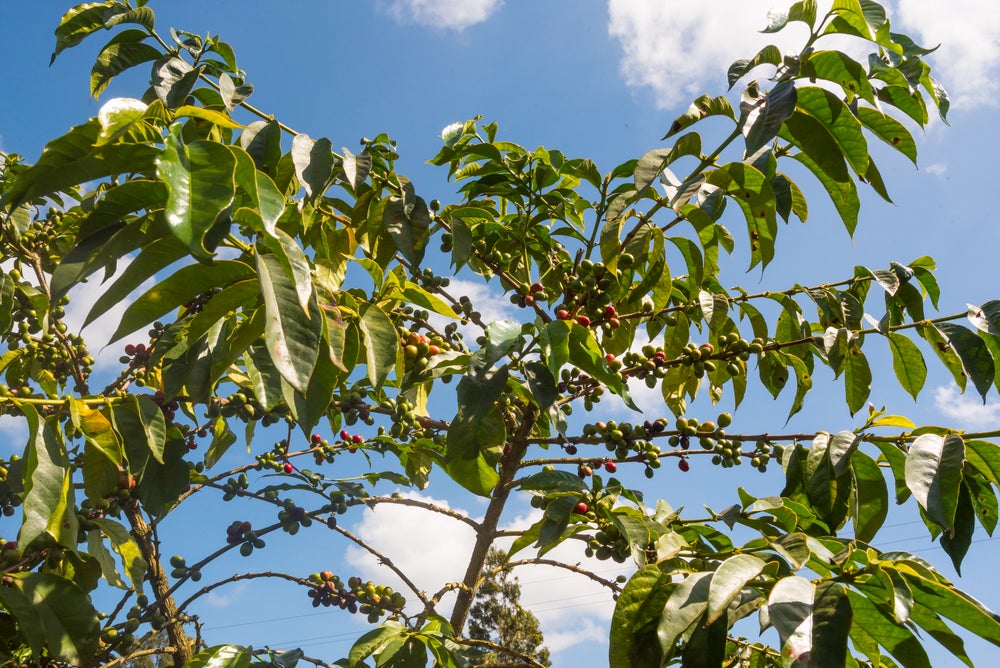
When we first met Cecilia Wanjiku Haniel, owner of Faith Estates, we did not know what tremendous potential she had to not just run an impressive farm herself, but also to motivate the surrounding community to excel in coffee production.
Cecilia knew she wanted to be a coffee farmer from an early age. Growing up, she used to admire her neighbors who grew coffee. She saw the benefits of coffee production and grew up with a desire to become a coffee farmer herself. That journey began in 1972 when she took over Faith Estates.
She founded a group of more than 30 small estate owners in Kirinyaga who meet monthly for trainings, business planning and to share coffee growing and processing knowledge. The business idea is simple and perfect. Those who can commit to quality practices are processing their cherry together, and we market this coffee as Faith Estates.
Cecilia believes in empowering not just coffee farmers, but her community. She has contributed to sponsoring education for children in her village and she strives to empower young people to become leaders in their communities.
In the future, Cecilia aims to expand Faith Estates’ reach in the supply chain and begin roasting and preparing their coffees for sale in supermarkets and other local stores.
Harvest & Post-Harvest
After selective handpicking on the various farms, coffee is pulped using a drum pulper. Then, coffee is dry fermented for 24 hours or so, depending on the ambient temperature. After fermentation, parchment is washed in clean water and lays it to dry on raised beds.
When she first founded her producer group, Cecilia struggled to find reliable machinery. The machinery they did have broke down frequently and were inefficient. With help from Sucafina Kenya, Cecilia and Faith Estates were able to access better machinery and additional resources, like lower-cost farm inputs.
The 'C' Stigma
Letter grades on Kenyan coffees refer to bean size, not coffee quality. So why do C lots tend to score lower? Enter the ‘C Stigma.’
The ‘C Stigma’ itself actually contributes to lower quality C lots. Because we expect lower quality, C grades are usually sold for lower prices. Due to low prices, resources and time are rarely spent to prep C lots as thoroughly as higher grades. Thus, by expecting less of C lots and by paying lower prices for them we are contributing to the circumstances that make C lots lower quality than AA and AB.
The ‘C Stigma’ is hurting everyone. Quality-focused farmers like the ones we work with are often unable to sell their C lots at value-added prices, even though they have the potential to be of high cup quality. C lots can compose up to 17% of any 100-bag lot. Because of this, we’re missing out on affordable, high-quality coffees.
The only way to break the cycle is to start placing more value on C lots. If we pay a bit more for C lots and emphasize better prep, we’ll make it possible and desirable for farmers to invest the time and money in prepping C lots the same way they prep their AA and AB lots.
Coffee in Kenya
Though coffee growing had a relatively late start in Kenya, the industry has gained and maintained a impressive reputation. Since the start of production, Kenyan coffee has been recognized for its high-quality, meticulous preparation and exquisite flavors. Our in-country sister company, Sucafina Kenya, works with farmers across the country to ensure these exceptional coffees gain the accolades they deserve.
Today, more than 600,000 smallholders farming fewer than 5 acres compose 99% of the coffee farming population of Kenya. Their farms cover more than 75% of total coffee growing land and produce nearly 70% of the country’s coffee. These farmers are organized into hundreds of Farmer Cooperative Societies (FCS), all of which operate at least one factory. The remainder of annual production is grown and processed by small, medium and large land estates. Most of the larger estates have their own washing stations.
Most Kenyan coffees are fully washed and dried on raised beds. The country still upholds its reputation for high quality and attention to detail at its many washing stations. The best factories employ stringent sorting practices at cherry intake, and many of them have had the same management staff in place for years.