
About This Coffee
When Tamiru Tadesse founded Alo Coffee in 2020, he chose Alo Kebelle for his washing station. This unique and risky choice stood out because the high altitude of the village and surrounding farms – 2,100 to 2,280 meters above sea level – had not been conducive for coffee growing previously. With increasingly warm temperatures due to climate change, Tamiru bet that the village would soon be in a good climate for growing coffee and his efforts have paid off. In 2021, an anaerobic lot from Alo Coffee placed in the Cup of Excellence tasting competition.
Tamiru works with 60 farmers who deliver to the main Alo washing station in Bembe village and a total of 800 farmers who deliver to his other stations. Since the beginning, he’s been intent on supporting the local community and reinvesting profits from everyone’s hard work into community goods, including a school and seedling nursery. He also makes sure that quality bonuses are delivered during the time of year when most farming families are struggling with cash shortages.
Harvest & Post-Harvest
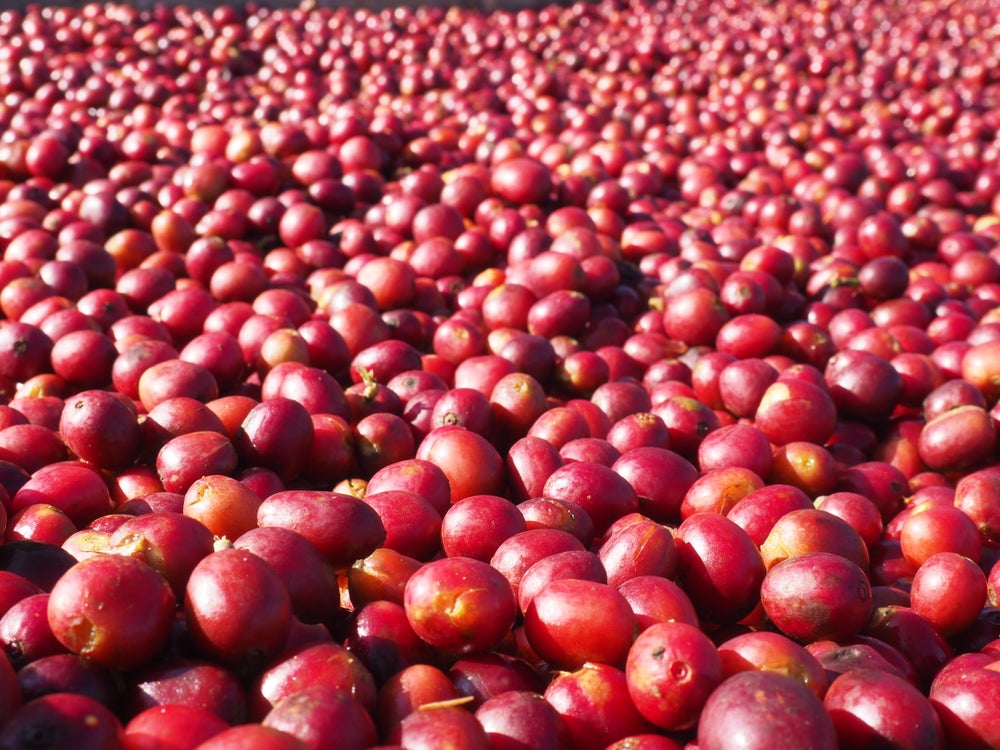
Farmers selectively handpick ripe, red cherry and deliver it to Alo’s main washing station in Bembe. At intake, cherry is visually hand sorted very rigorously to accept only ripe cherry. Cherry is moved to raised beds to dry. Workers rake cherry frequently to ensure even drying. It takes approximately 21 days for cherry to dry.
About Sidama
The Sidama (sometimes referred to as Sidamo) region of Southern Ethiopia holds the distinction as one of the three trademarked coffee regions of Ethiopia. Alongside Harrar and Yirgacheffe, Sidama holds a Designation of Origin for coffee grown in the region. That's unsurprising when you consider the high altitudes of 1,550 to 2,200 meters above sea level, plentiful rainfall and fertile soil that makes the coffee grown in this region so remarkable.
The Sidama region is named after the indigenous ethnic group, the Sidama, who call the region their home. On Sidama’s Eastern border lies the large regions of Arsi and Bale while to the West, Sidama is bordered by Gamogofa.
Sidamo lies in the path of the Great Rift Valley and thanks to this, the countryside of Sidama is lush and green. There are several freshwater lakes that provide drinking and agricultural water and account for the densely populated nature of this region.
The Great Rift Valley spans from the northernmost tip of Ethiopia across Kenya and all the way to the southernmost region of Tanzania. It is home to some of the oldest-known fossils of humankind, which suggests its importance in the early development of humanity.
Ethiopia Grade 1
Grades in Ethiopia depend on visual inspection for defects and on cup quality. Grade 1 is considered the highest quality coffee. Grade 1 and 2 are considered specialty coffee, grades 3-9 are classified as commercial coffee. Grade 1 is free of cup faults and taints and has zero quakers.
Coffee in Ethiopia
While Ethiopia is famous as coffee’s birthplace, today it remains a specialty coffee industry darling for its incredible variety of flavors. While full traceability has been difficult in recent history, new regulations have made direct purchasing possible. We’re partnering directly with farmers to help them produce top quality specialty lots that are now completely traceable, adding value for farmers and roasters, alike.
The exceptional quality of Ethiopian coffee is due to a combination of factors. The genetic diversity of coffee varieties means that we find a diversity of flavor, even between (or within) farms with similar growing conditions and processing. In addition to varieties, processing methods also contribute to end quality. The final key ingredients for excellent coffee in Ethiopia are the producing traditions that have created the genetic diversity, processing infrastructure and great coffee we enjoy today.
Most producers in Ethiopia are smallholders, and the majority continue to cultivate coffee using traditional methods. As a result, most coffee is grown with no chemical fertilizer or pesticide use. Coffee is almost entirely cultivated, harvested and dried using manual systems.