
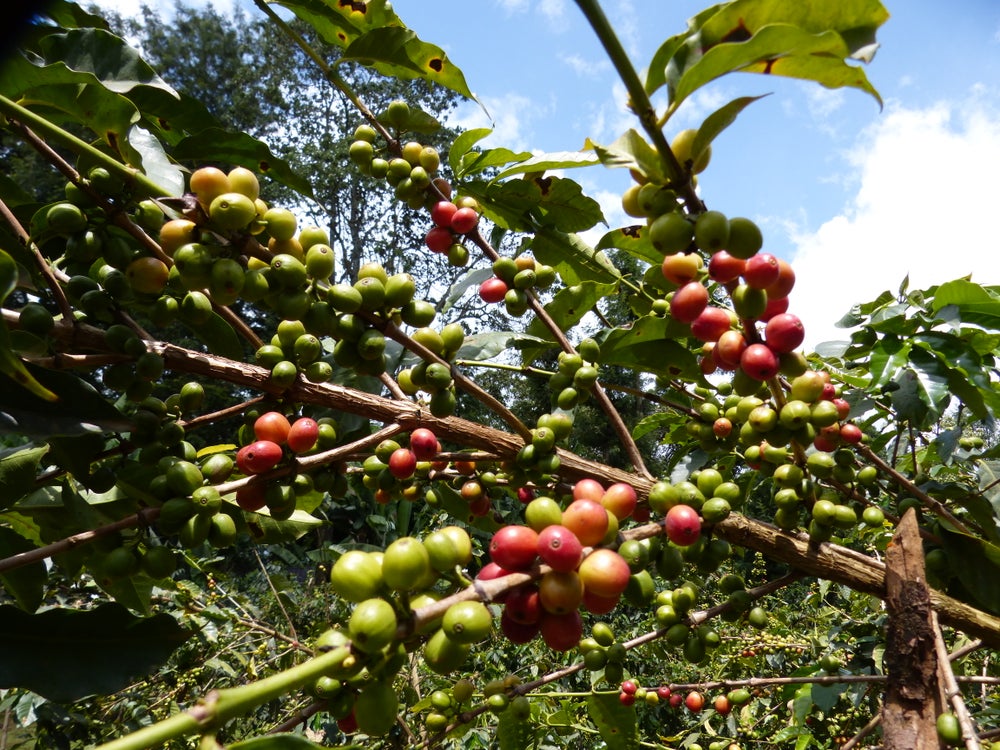
About This Coffee
Mwalimu Ndichu Kibe is a retired teacher who started coffee farming in 1965. He is the proud father of 8 children. His goal is to improve the quality of his coffee to better access markets and increase his livelihood. With more income from higher quality coffee, he would be better able to support his family.
Cultivation
With help from Sucafina/Kahawa Bora, Mwalimu also has access to training about improved pruning, cultivation and harvesting methods. Kahawa Bora’s field staff have also performed soil analysis on small estates to inform correct input application, which helps improve yields and quality while reducing cost and environmental impact. This focus on high quality at all stages of cultivation and processing has increased cup scores in a short period of time.
Harvest & Post-Harvest
Traditionally, many farmers of this size in the country did not own their own processing equipment. They have historically delivered cherry to a centralized cooperative-owned ‘Factory’ (as washing stations are called, locally), where their production is combined with that of others from their region. Mwalimu has his own, small wet mill where he is able to process his own coffee, ensuring full traceability back to his farm.
Cherry is selectively handpicked and then pulped. Coffee is then fermented for 18 hours in a small tank before being washed in clean water to remove any remaining mucilage. All wastewater from the washing process is cleaned to ensure environmental impact is limited.
Parchment is transferred to raised beds where it sundries for 7 to 21 days. Parchment is turned regularly to ensure even drying.
Even for farmers who may have their own processing setup, the dry-milling setup within Kenya does not well serve small-to-medium size farmers. Dry mills have lot minimums, which are usually about 50 bags of parchment per lot. This is often unattainable for smaller farmers, necessitating that they merge their lots with others, losing traceability, which in turn lowers their overall returns and removes the potential for name recognition and direct-trade relationships.
To cater to single producer lots that are very small, Kahawa Bora/Sucafina has a separate microlot milling line that was custom-made to hull (remove the parchment from the green coffee beans) lots as small as one bag at a time. This line makes it possible for growers to maintain their own ‘brand’ when selling their coffee. We feel this is a push in the right direction for Kenyan growers to gain market access to quality-focused buyers overseas.
AA Grade
Kenyan coffees are classified by size. AA beans are the largest size. AA grade coffees are those that are 17/18 screen size, meaning that they are larger than 7.2 millimeters.
Coffee in Kenya
Though coffee growing had a relatively late start in Kenya, the industry has gained and maintained a impressive reputation. Since the start of production, Kenyan coffee has been recognized for its high-quality, meticulous preparation and exquisite flavors. Our in-country sister company, Sucafina Kenya, works with farmers across the country to ensure these exceptional coffees gain the accolades they deserve.
Today, more than 600,000 smallholders farming fewer than 5 acres compose 99% of the coffee farming population of Kenya. Their farms cover more than 75% of total coffee growing land and produce nearly 70% of the country’s coffee. These farmers are organized into hundreds of Farmer Cooperative Societies (FCS), all of which operate at least one factory. The remainder of annual production is grown and processed by small, medium and large land estates. Most of the larger estates have their own washing stations.
Most Kenyan coffees are fully washed and dried on raised beds. The country still upholds its reputation for high quality and attention to detail at its many washing stations. The best factories employ stringent sorting practices at cherry intake, and many of them have had the same management staff in place for years.