
About This Coffee
Dedan Kimathi University (DeKUT) farm has been under cultivation since the early 1900s. It was originally a large, private landholding, but since the 1970s it has been utilized by the university to train students in a wide range of agricultural practices and technologies.
DeKUT was the first university in Kenya to be chartered under the new universities act of 2012, but the university itself goes back to 1972. The University offers a wide range of courses, but perhaps most notable, here, are its agricultural training programs.
In addition to coffee, the farm has a wide range of other crops and livestock.
Cultivation
On the farm, SL28, SL34, Ruiru 11 and Batian are cultivated at 1,600 to 1,750 meters above sea level. Since 2014, the farm has focused on renovating their plots, replacing older and less productive trees with the improved Batian variety. Batian was introduced by Coffee Research Institute (CRI) in 2010 and is named after the highest peak on Mt. Kenya. The variety is resistant to both CBD and CLR and has the added benefit of early maturity - cropping after only two years.
Students are trained in Good Agricultural Practices, including soil fertility, pruning, maintenance and other agronomical topics. They even participate in harvest competitions to learn selective harvesting techniques and to better understand, firsthand, the challenges and rewards of farming.
Harvest & Post-Harvest
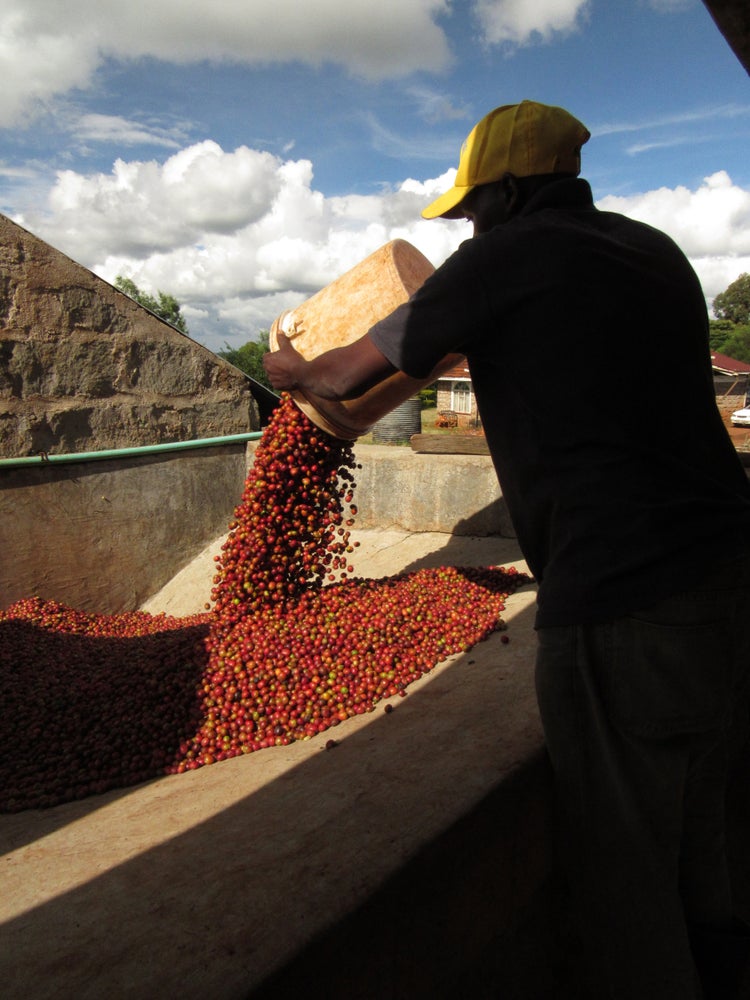
Cherry is selectively handpicked and then pulped. Coffee is then dry fermented for 16 to 24 hours and washed in clean water to remove any remaining mucilage. The clean parchment is transferred to raised beds where it sundries for 14 to 20 days. As it dries, parchment is turned regularly to ensure even drying.
About Nyeri County
Nyeri County is one Kenya's most famous growing regions.
The name Nyeri is derived from the Masaai word nyiro, meaning red, after the red volcanic soil in the area. The name was adapted by white settler farmers to Nyeri. Most farmers in the area today grow tea and coffee as cash crops. Coffee varieties in the region are usually a mix between SL 28, SL 34 (roughly 80%) Batian and Ruiri 11.
AA Grade
Kenyan coffees are classified by size. AA beans are the largest size. AA grade coffees are those that are 17/18 screen size, meaning that they are larger than 7.2 millimeters.
Coffee in Kenya
Though coffee growing had a relatively late start in Kenya, the industry has gained and maintained a impressive reputation. Since the start of production, Kenyan coffee has been recognized for its high-quality, meticulous preparation and exquisite flavors. Our in-country sister company, Sucafina Kenya, works with farmers across the country to ensure these exceptional coffees gain the accolades they deserve.
Today, more than 600,000 smallholders farming fewer than 5 acres compose 99% of the coffee farming population of Kenya. Their farms cover more than 75% of total coffee growing land and produce nearly 70% of the country’s coffee. These farmers are organized into hundreds of Farmer Cooperative Societies (FCS), all of which operate at least one factory. The remainder of annual production is grown and processed by small, medium and large land estates. Most of the larger estates have their own washing stations.
Most Kenyan coffees are fully washed and dried on raised beds. The country still upholds its reputation for high quality and attention to detail at its many washing stations. The best factories employ stringent sorting practices at cherry intake, and many of them have had the same management staff in place for years.