
Cultivation
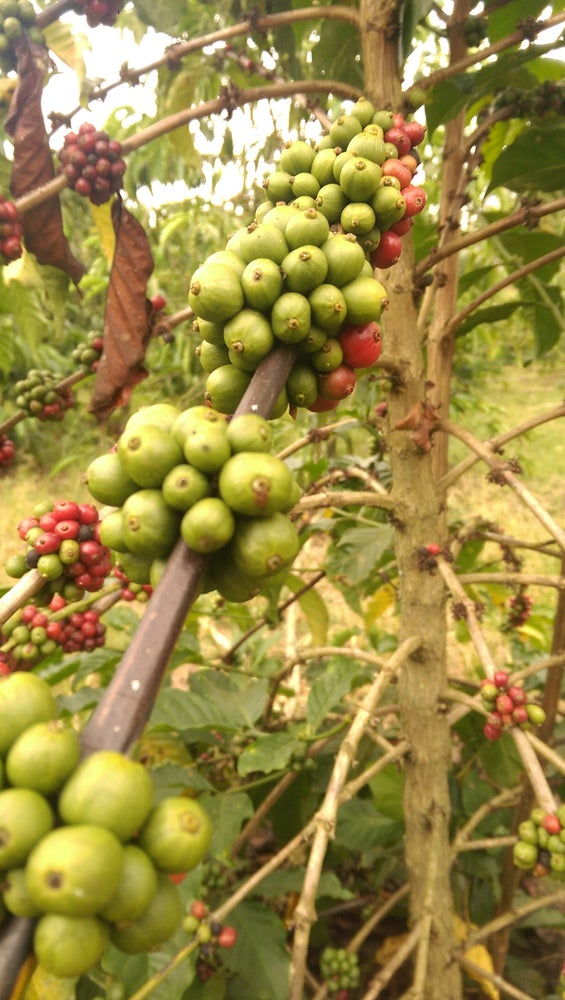
Most farms are inherited from parents and grandparents. Now, as coffee farming becomes more lucrative, farmers are renovating and expanding their inherited farms.
In the east, the fertile volcanic soil surrounding Mount Elgon volcano makes for productive coffee farms, and to the west, the Rwenzori mountains offer high altitudes perfect for Arabica cultivation. Farmers typically intercrop their coffee with subsistence and cash crops including bananas, beans, vanilla, passion fruit, cassava, maize and groundnuts.
Harvest & Post-Harvest
Most farms are small, an average of 0.5 to 1 hectares on average. Most work is done by the family. Farmers selectively handpick ripe, red cherry and lay it to dry on raised beds or on patios. They rake drying cherry frequently to ensure even drying. It takes approximately 2 to 3 weeks for cherry to dry.
Rainforest Alliance
RFA stands for Rainforest Alliance, a certification system that emphasizes climate-smart agriculture. RFA farms have at least 40% of land covered by canopy, significant species diversity (at least 12 native tree species per hectare, on average) and a system of natural vegetation buffers between agricultural land and bodies of water. The farms also use organic fertilizers.
Coffee in Uganda
Uganda is the native home to one species of Robusta, and commercial coffee production in the country goes back to the beginning of the 20th century.
Our partner, UGACOF/Sucafina Uganda is committed to improving quality in Uganda by building new washing stations and infrastructure and training personnel in the region. Collaborations with our FarmerHub program and our sustainability partner, the Kahawatu Foundation, are building upon our work to expand farmers’ access to better resources and better training. Our connections to our more established operations in nearby Rwanda, Burundi and Kenya offer us advice and a perspective steeped in a familiarity with East Africa.
The bulk of our work in Uganda is focused in the West, near the Rwenzori Mountains. The biggest difference between East (Mount Elgon) and West (Rwenzori) is that Mount Elgon is a more established and competitive market. We are excited to be at the forefront of the drive for enhancing coffee production infrastructure, developing the industry and becoming reliable partners for farmers in the Rwenzori Mountain region.
It is clear to us that the potential in this region might exceed our expectations and even the potential of the popular Mount Elgon region. With an ever-growing demand for high quality Arabicas and a sustained interest from roasters and coffee drinkers in the East African origins, we are very confident that, with diligence and effort, Western Ugandan coffees will be able to take their place alongside the other great East African coffees.