
About This Coffee
In 2015, the Café Monteverde producer group identified Nueva Esperanza as a region with untapped potential. While coffee was already grown in the area, traditional practices were limiting both quality and productivity. Café Monteverde and its technical team began working closely with local producers, offering hands-on training and introducing improved cultivation techniques.
Since that time, coffee quality has risen, yields have improved and farming has become a more reliable source of income for local families. Today, coffee is at the center of community development. Alongside its agricultural focus, the project now includes reforestation programs and education initiatives like La Escuelita, where children learn about environmental care and sustainable food systems.
In parallel, the group is advancing a renovation plan aiming to plant 150,000 new coffee seedlings. Through ongoing technical support, environmental stewardship and deep community involvement, Monteverde Nueva Esperanza represents a long-term vision for sustainable coffee built on shared opportunity.
Cultivation
With altitudes ranging from 1,800 to 2,000 meters, this region of Amazonas offers cool temperatures and rich microclimates ideal for growing high-quality coffee. Each member of the producer group farms independently, applying best practices taught by Café Monteverde’s technical staff. The coop cultivates traditional and hybrid varieties that offer both resilience and cup quality.
Harvest & Post-Harvest
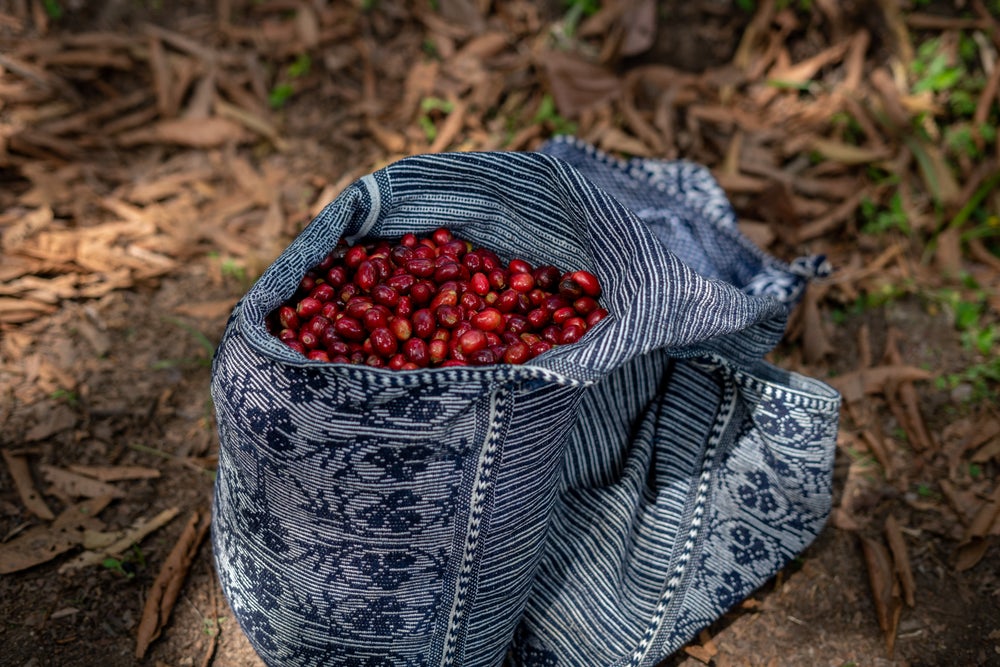
Members and their families selectively handpick ripe, red cherry and process it on their farms. They pulp cherry and ferment it for 12 to 24 hours in plastic tanks. Following fermentation, parchment is washed in clean water and laid to dry on raised beds inside solar dryers.
About Monteverde
Café Monteverde establishes relationships with a wide range of producers and producer organizations. In addition to producing a range of their own micro-lots from Finca Timbuyacu, Alfonso and Karim focus on providing a range of services for producer-members and helping market their coffee.
Monteverde helps member farms take steps to ensure good soil management and conservation. Members plant living barriers and diverse shade trees and add contour lines to reduce erosion. Alfonso and Karim also take an active role in the communities of their producers. In 2010, the organization collectively purchased a playground for children in one producer community. Then, in 2014, they purchased 40 new mattresses for children whose sleeping conditions were substandard.
Since it was founded, Café Monteverde has been establishing relationships with a wide range of producers and producer organizations. In addition to producing a range of their own micro-lots from Finca Timbuyacu, the cooperative also markets group lots and provides a range of services for the producers with whom they work.
Monteverde helps member farms take steps to ensure good soil management and conservation. Members plant living barriers and diverse shade trees and add contour lines to reduce erosion. Araoz and Tejada are also taking an active role in the communities of their producers. In 2010, the organisation collectively purchased a playground for children in one producer community. Then, in 2014, they purchased 40 new mattresses for children whose sleeping conditions were substandard
Coffee in Peru
Peru holds exceptional promise as a producer of high-quality coffees. The country is the largest exporter of organic Arabica coffee globally. With extremely high altitudes and fertile soils, the country’s smallholder farmers also produce some stunning specialty coffees.
Though coffee arrived in Peru in the 1700s, very little coffee was exported until the late 1800s. Until that point, most coffee produced in Peru was consumed locally. When coffee leaf rust hit Indonesia in the late 1800s, a country central to European coffee imports at the time, Europeans began searching elsewhere for their fix. Peru was a perfect option.
Between the late 1800s and the first World War, European interests invested significant resources into coffee production in Peru. However, with the advent of the two World Wars, England and other European powers became weakened and took a less colonialist perspective. When the British and other European land owners left, their land was purchased by the government and redistributed to locals. The Peruvian government repurchased the 2 million hectares previously granted to England and distributed the lands to thousands of local farmers. Many of these farmers later grew coffee on the lands they received.
Today, Peruvian coffee growers are overwhelmingly small scale. Farmers in Peru usually process their coffee on their own farms. Most coffee is Fully washed. Cherry is usually pulped, fermented and dried in the sun on raised beds or drying sheds. Drying greenhouses and parabolic beds are becoming more common as farmers pivot towards specialty markets.
After drying, coffee will then be sold in parchment to the cooperative. Producers who are not members of a cooperative will usually sell to a middleman.
The remoteness of farms combined with their small size means that producers need either middlemen or cooperatives to help get their coffee to market. Cooperative membership protects farmers greatly from exploitation and can make a huge difference to income from coffee. Nonetheless, currently only around 15-25% of smallholder farmers have joined a coop group.