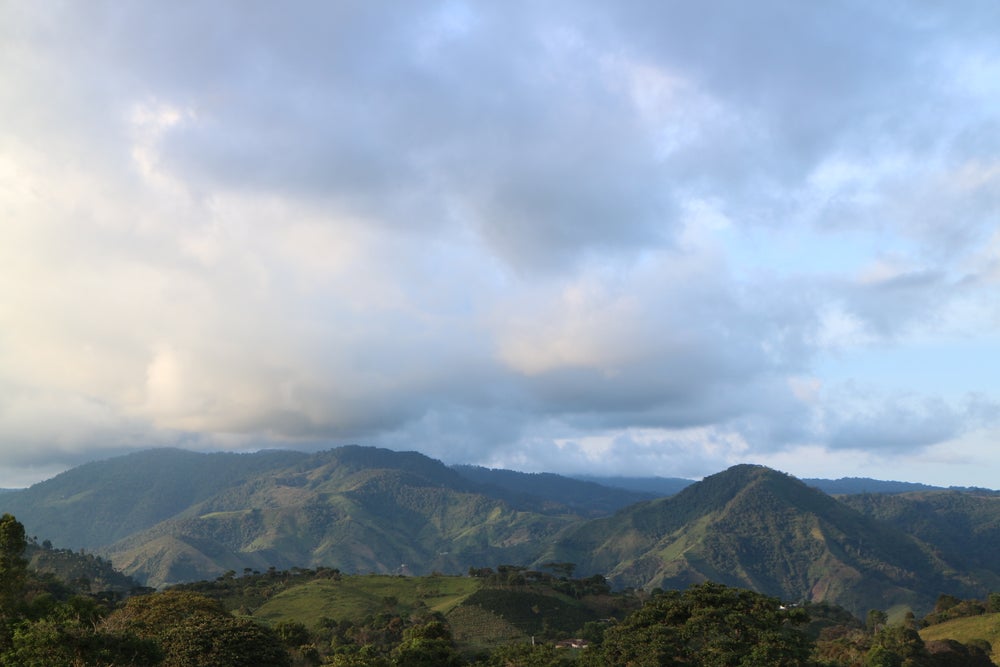

About This Coffee
Johan Espinoza is one of Jose Espinoza’s sons. Johan farms a smaller plot on Finca El Recreo and works alongside his father to produce superb specialty coffees. It was Johan’s interest in Anaerobic fermentation that spurred Jose Espinoza to reach out to Yonatan Gonzales at Cuatro Vientos and receive support to process Anaerobic Natural coffees.
Johan’s life at Finca El Recreo has been shaped by his father. Jose Espinoza was born on Finca El Recreo. He left the farm at 17 to herd livestock but returned later in life when he inherited the farm from his father. His father planted other crops but Jose believed coffee would be a good choice for his livelihood. When he worked with livestock, he noticed that coffee was being replaced by avocado farms and believed that planting coffee was the way to go. In 2016, he and his wife planted their first coffee trees. Today, Jose Espinoza and his wife live on Finca El Recreo with Johan, his brother and their respective children. They live in a community surrounded by their extended family.
During the first few years of the coronavirus pandemic, Jose and Johan built a greenhouse for drying coffee. They also have plans to begin purchasing cherry from their neighbors and continue expanding their processing infrastructure.
Harvest & Post-Harvest
Jose and Johan first started producing Naturals in June 2020. Now, nearly 80% of their harvest is produced using Natural and Anaerobic Natural processing.
Everyone in Algeciras uses Fully washed processing for their coffees, so they had to reach outside their community to gain to knowledge about Anaerobic and Natural processing. Yonatan Gonzales at Cuatro Vientos helped them understand yields, costs and sale price and they decided it was a profitable method.
To make their Anaerobic Naturals successful, they’ve expanded their drying capacity and built solar drying modules. In addition to better prices, Jose likes that Natural processing uses far less water than Fully washed processing and is better for the environment.
Ripe, red cherry is selectively handpicked and fermented anaerobically for 40 hours. Following fermentation, cherry is laid on marquesinas to dry. Cherry is raked frequently to ensure even drying. It takes 20 to 21 days for cherry to dry.
About Pink Bourbon
Pink Bourbon was previously thought to be a hybrid of Yellow and Red Bourbon varieties. The variety was first identified growing in and around Huila, Colombia. Recent research has found that Pink Bourbon is in fact not Bourbon at all. Pink Bourbon mostly likely comes from an Ethiopian landrace variety.
Pink Bourbon has a stunningly high cup potential that wows coffee professionals and consumers alike. Its impressively high cup quality makes even more sense now that we understand Pink Bourbon is not simply a hybrid of two Bourbon varieties but traces to Ethiopian landraces. Its siblings include the highly-prized Geisha, which has consistently produced incredibly high cup scores. Pink Bourbon will continue to be a highly distinguished and valued variety.
Some farmers also report that Pink Bourbon has more disease resistance than the Bourbons it grows alongside. Based on these new discoveries, this may be due to the genetic variety it has coming from Ethiopian landraces.
About Huila
The Huila region is one of the most well-known coffee growing areas of Colombia. The Department of Huila has a population of 1.125 million and is located in the southwest of the country. The capital of the department is Neiva, a city of about 380,000.
Along with Cauca and Nariño, Huila is one the three departments where the Colombian Massif is located. A massif is a group of mountain ranges and the Colombian Massif, which is known locally as Nudo de Almaguer, provides up to 70% of safe drinking and agricultural water for the Colombian population.
The Magdalena River, Colombia’s largest river, runs through the region, providing plenty of water for coffee farming and generating (directly and indirectly) up to 86% of Colombia's GDP. The mountain range also features the fertile volcanic soil so typical to the Andean Mountains.
About Cuatro Vientos
Cuatro Vientos is a family-owned exporter based in Colombia. Founded in 2018 by Julian & Yonatan Gonzalez and based in Huila, the company is named after the Gonzalez’s first farmnwhere the brothers spent much of their childhood. Yonatan and Julian learned much of what they know from their father, Armando Gonzalez who was a “pergaminero,” someone who bought and sold parchment coffee. Sucafina has worked with Cuatro Vientos since 2021.
Through their partnership with Sucafina, Cuatro Vientos is able to more effectively reach new markets. This, in turn, means they can work with more farmers and develop better programs to support their farmers.
Cuatro Vientos has 3 purchasing points in Huila: Acevedo, Santa Maria and Algeciras. These points are more than just places where they buy coffee, though. They are service hubs where farmers can access services to maintain quality and reach new markets. For Cuatro Vientos, farmers are long term partners who are focused on quality.
With these three locations, Cuatro Vientos is able to source fresh coffee year-round. In their unique position across Huila, they can tap into two alternative harvest seasons within Huila. The northern Huila harvest occurs in the first half of the year and the southern Huilaharvest happens during the second half of the year, providing high-quality coffees year round.
They also own 2 warehouses that are strategically placed in Acevedo (in Southern Huila) and Campo Alegre (in Northern Huila). The warehouses provide an array of important services to farmers. Farmers can dry their coffee, store dried parchment in silos and learn to grade and evaluate coffees in the cupping labs.
Cuatros Vientos adds value by offering logistics and milling support to the over 30 farms that they work with. These farmers are all specialty oriented and Cuatro Vientos’ focus on specialty processing helps farmers ensure that their coffees are handled properly.
One of Cuatro Vientos’ biggest impacts is their credit line offerings. Growers need financing at the beginning of the harvest and it is difficult for them to access financing through traditional banks due to a lack of financial documentation. By providing financing through their partner, Bancolombia, Cuatro Vientos is supporting long term farmer profitability. They also provide financial education workshops that increase farmers’ financial literacy and promotes overall success.
They also provide marketing services for farmers, helping them manage samples and tell their stories. Importantly, they act as an integral part of a two-way conversation between producers and roasters about what they’re looking for, what they can do and how they can best achieve the results they’re looking for.
Coffee in Colombia
Colombia has been producing and exporting coffee renowned for their full body, bright acidity and rich aftertaste, since the early 19th century.
Colombia boasts a wide range of climates and geographic conditions that produce their own unique flavors in coffee. This also means that harvest times can vary quite a bit. In fact, between all its different regions, Colombia produces fresh crop nearly all year round.
The increasing focus on the specialty industry is changing the way traders and farmers do business. It is becoming more common for farmers to isolate the highest quality beans in their lots to market separately. These higher-quality lots are often sold under specific brands or stories.
Besides its wide variety of cup profiles, Colombia has quickly expanded its certification options over the past 10 years. The most common certifications available are Fairtrade, Rainforest Alliance and Organic.