
About This Coffee
El Libano farm was acquired by Jhon Jairo’s parents 28 years ago. The farm has relied on coffee and cattle for income Today Jhon Jairo oversees coffee production and the farm’s general upkeep. He entered specialty coffee as an entrepreneurial push to produce high-quality coffee, optimize production and post-harvest practices, and reach new value-added markets. He employs 4 full-time workers and 3 seasonal workers.
What ultimately sets this coffee apart is the attention to detail with each step of production and commercialization.
Cultivation
The farm spans 14 hectares at 2,000 meters in El Placer, Santa María in Huila. Jhon Jairo cares for 7,000 coffee trees alongside fruit trees and a kitchen garden. Work in the field centers on picking at optimal maturity to keep processing inputs uniform.
Harvest & Post-Harvest
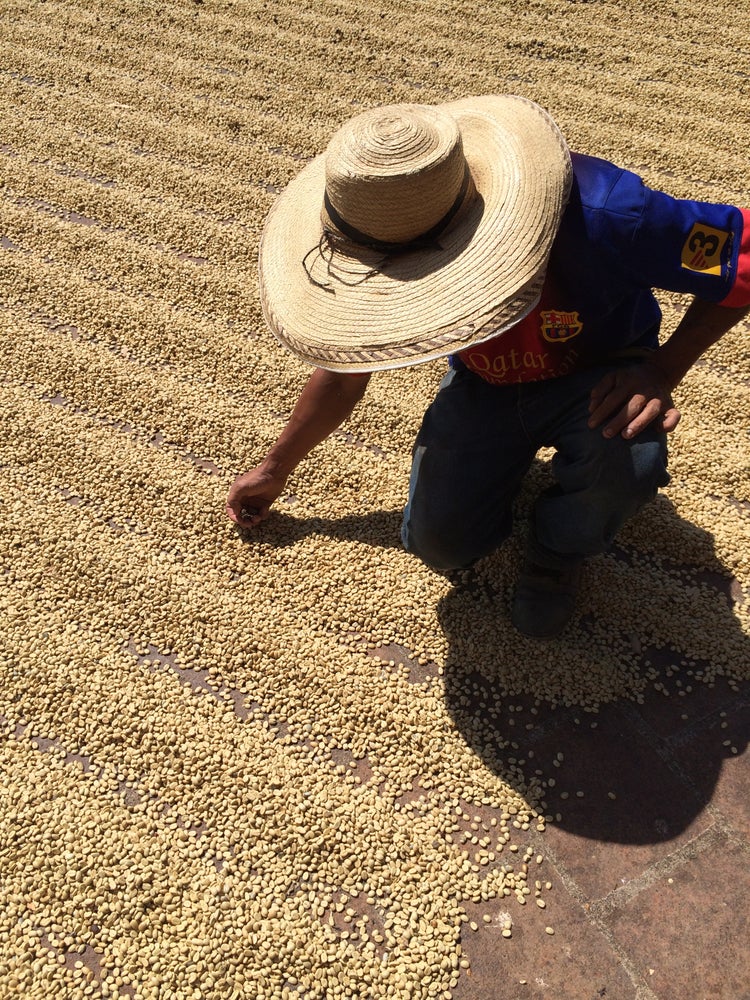
Jhon’ team selectively handpicks ripe, red cherry and processes it on his farm. After harvest, cherry undergoes a 24-hour fermentation and then is pulped and fermented a second time for 48 hours. Following washing, parchment dries in a raised beds for 20 to 30 days, depending on the weather.
Coffee in Colombia
Colombia has been producing and exporting coffee renowned for their full body, bright acidity and rich aftertaste, since the early 19th century.
Colombia boasts a wide range of climates and geographic conditions that produce their own unique flavors in coffee. This also means that harvest times can vary quite a bit. In fact, between all its different regions, Colombia produces fresh crop nearly all year round.
The increasing focus on the specialty industry is changing the way traders and farmers do business. It is becoming more common for farmers to isolate the highest quality beans in their lots to market separately. These higher-quality lots are often sold under specific brands or stories.
Besides its wide variety of cup profiles, Colombia has quickly expanded its certification options over the past 10 years. The most common certifications available are Fairtrade, Rainforest Alliance and Organic.