About This Coffee
Nyagashiha CWS is located in the high hills that overlook Lake Tanganyika, the second deepest lake in the world. The 83 farming families that deliver to the station have a long history of coffee farming. In the face of low coffee prices, these families and the washing station have sought to access more lucrative specialty markets. They continue to improve their quality year on year and succeeded in placing in 2019’s Burundi Cup of Excellence.
Nyagashiha CWS is run by The Societe d'Usinage et de Commercialisation du Cafe du Mumirwa (SUCCAM), which is working to increase prices across all their 13 washing stations. SUCCAM has partnered with various European roasters to help producers to earn sustainable incomes. Participating farms are UTZ certified and the high level of quality protection, environmental protection, traceability and social improvement programs is helping to raise prices – and reputation.
Cultivation
Most coffee trees in Burundi are Red Bourbon . Because of the increasingly small size of coffee plantings, aging rootstock is a very big issue in Burundi. Many farmers have trees that are over 50 years old, but with small plots to farm, it is difficult to justify taking trees entirely out of production for the 3-4 years it will take new plantings to begin to yield.
Despite the ubiquity of coffee growing in Burundi, each smallholder produces a relatively small harvest. The average smallholder has approximately 250 trees, normally in their backyards. Each tree yields an average of 1.5 kilos of cherry, so the average producer sells about 200-300 kilos of cherry annually.
Harvest & Post-Harvest
During the harvest season, all coffee is selectively hand-picked. Most families only have 200 to 250 trees, and harvesting is done almost entirely by the family.
Quality assurance begins as soon as farmers deliver their cherry. Cherries are wet processed under constant supervision. The pulping, fermentation time, washing, grading in the channels and a final soaking is closely monitored. All cherry is floated in small buckets as a first step to check quality.
After sorting, cherry is de-pulped within 6 hours of delivery. The machine can process up to 3 tons of cherries per hour. During pulping, cherry is separated into high- and low-grade by density on a Mackinon 3-disc pulper outfitted with an additional separation disk. The coffee is then fermented in water from a nearby stream for 10-12 hours, depending on ambient temperature. A small sign on the fermentation tank keeps track of each lot. The sign mentions the washing station name, date of cherry purchase, grade of the bean and the time when fermentation began. Trained agronomists check the beans by hand regularly to ensure fermentation is halted at the perfect time. The station workers trample the parchment for 30 minutes in the fermentation tank. This trampling process helps to remove mucilage on the fermented parchment. After this, the parchment is given fresh water to move it into the washing-grading canal, where it is washed.
After fermentation is completed, coffee is run through washing and grading canals. As the beans flow through, wooden bars that are laid across the canal prevent beans of specific densities from passing through. These bars are spaced across the channel. While the first blockade stops the most-dense beans, the next is arranged to stop the second most-dense beans and so on. In total, the channel separates beans into seven grades according to density. After washing, this parchment is poured onto wooden trays or nylon bags and carried to the drying tables, each in its separate quality group. Each tray and nylon bag of parchment keeps its traceability tag with all info.
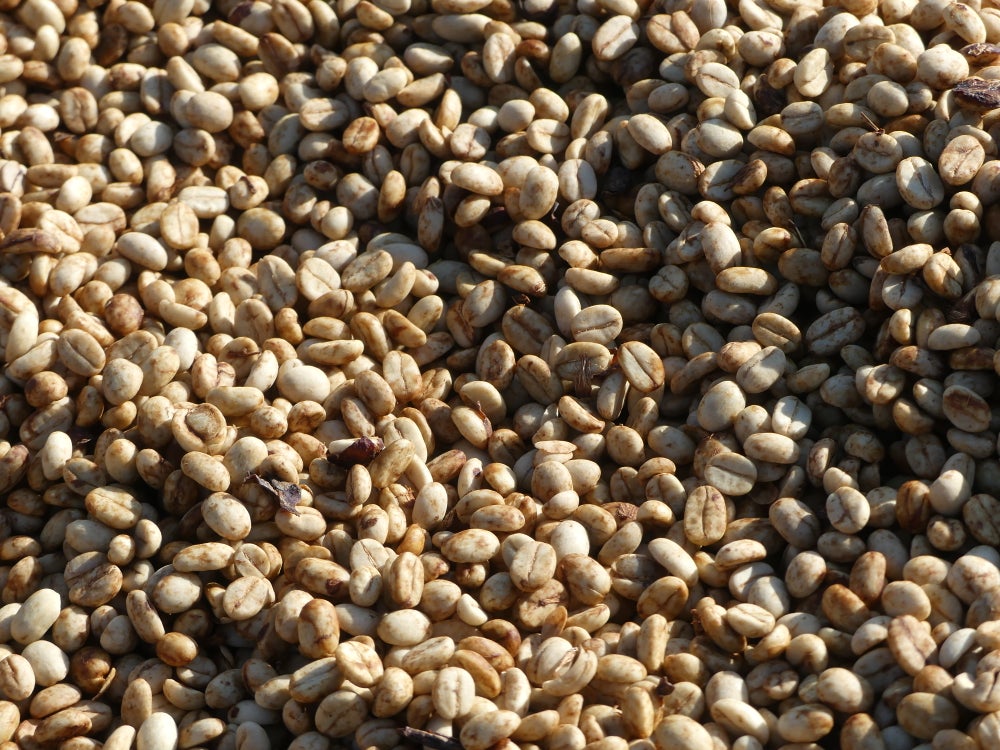
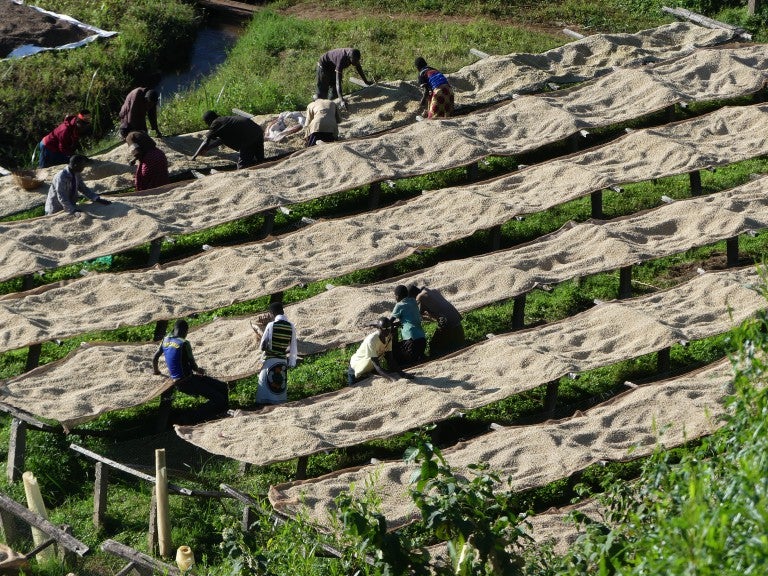
The beans are then transported to the drying tables where they will dry slowly for 2-3 weeks. Pickers go over the drying beans for damaged or defective beans that may have been missed in previous quality checks. Usually, each table holds 800kg of parchment. In the peak of the season, the maximum load for a table is 1000kg. Each table has a traceability tag with the lot info. The parchment is left to dry from sunrise to sunset and is covered with a sheet during the evening or when it rains. If the weather conditions are good, the parchment takes on average 10 to 14 days to dry. During this time it is stirred regularly. The moisture level is carefully monitored and any parchment with visual defects is removed. On the table, the beans are dried to 11.5%.
Once dry, the parchment coffee is then bagged and taken to the warehouse.
Coffee in Burundi
Burundi has long been overlooked in comparison to its neighboring East African specialty coffee producing powerhouses. However, Burundi season, for us, is one of the highlights of the annual coffee calendar. The country’s coffee is produced almost entirely by smallholder farmers, and much of this small-scale production is of exceptional quality. With its super sweet, clean and often floral coffees, Burundi, every year, is increasingly is putting itself on the specialty coffee map.
Coffee is of paramount importance to families and the country at large. Considering this, improving and expanding coffee infrastructure is not just a way to improve incomes, it is a way to revolutionize the earning potential of an entire nation.
Building washing stations and expanding agricultural extension work can be great ways to improve coffee quality. Washing stations are pivotal in improving cup profile standards and the global reputation of Burundian coffee.
Both state-owned and private actors drive Burundi’s coffee industry and play key roles as washing station management companies and exporters. State-owned companies are called Sogestals, short for “Sociétés de Gestions des Stations de Lavage” (Washing station management companies). Privately-owned companies can operate under a variety of different names.
Sucafina’s history in Burundi goes back to 2007 when Bucafe/Sucafina Burundi was established in Bujumbura. Through Bucafe, we work with several privately-owned washing station management companies and exporters. Our work bridges the entire supply chain, allowing us to be vertically integrated. Our supply chain is solid, reliable and transparent. Due to this, we are more efficient, able to supply better value and positioned to offer both producers and consumers of Burundian coffee a diversity of expertise.