
About This Coffee
Nestled between River Thuti and River Mumwe in Othaya, Nyeri County, Rukira Factory (as washing stations are called in Kenya) is part of Othaya Farmer Cooperative Society (FCS), which has 14,000 members across 19 wet mills. Rukira itself has 800 registered farmers, with 650 actively delivering cherries. Coffee is grown at high altitudes on the slopes of the Aberdare Ranges, and the main harvest runs from November to February.
The factory processes cherries from more than 670 smallholder farmers in the Nyeri highlands, an area known for its rich red volcanic soil high in phosphorus. The slow maturation of cherries at this elevation, combined with cool temperatures, extends drying times, leading to coffees with deep sweetness and excellent aging potential. These conditions make Rukira a prime location for producing standout microlots.
Cultivation
Producer members in Rukira Factory cultivate primarily SL28, SL34 and Ruiru 11. ‘SL’ varieties are cultivars originally released by Scott Agricultural Laboratories (SAL) in the 1930s and 1940s. They soon became the go-to trees for many growers in Kenya due to their deep root structure, which allows them to maximize scarce water resources and flourish even without irrigation. They are cultivated with a serious eye towards sustainability and Good Agricultural Practices, with minimal environmental impact where possible. Ruiru 11 is a new variety known for its disease resistance and high yields. It also starts yielding fruit after just 2 years.
Harvest & Post-Harvest
Farmers delivering to Rukira factory handpick ripe cherry and deliver it to the factory that day. At intake, cherry is meticulously sorted. All sorting is overseen by the cherry clerk, who ensures that only ripe, undamaged cherry Is received.
Once sorted, cherry is pulped on the factory’s disc pulper and then density sorted. Pulped cherry is fermented for 12 to 24 hours, depending on temperature and climate conditions, to break down the mucilage. Skilled staff oversee fermentation, checking regularly to ensure fermentation is halted at just the right moment. After fermentation, parchment is washed in fresh water through grading channels before being transferred to raised beds for drying.
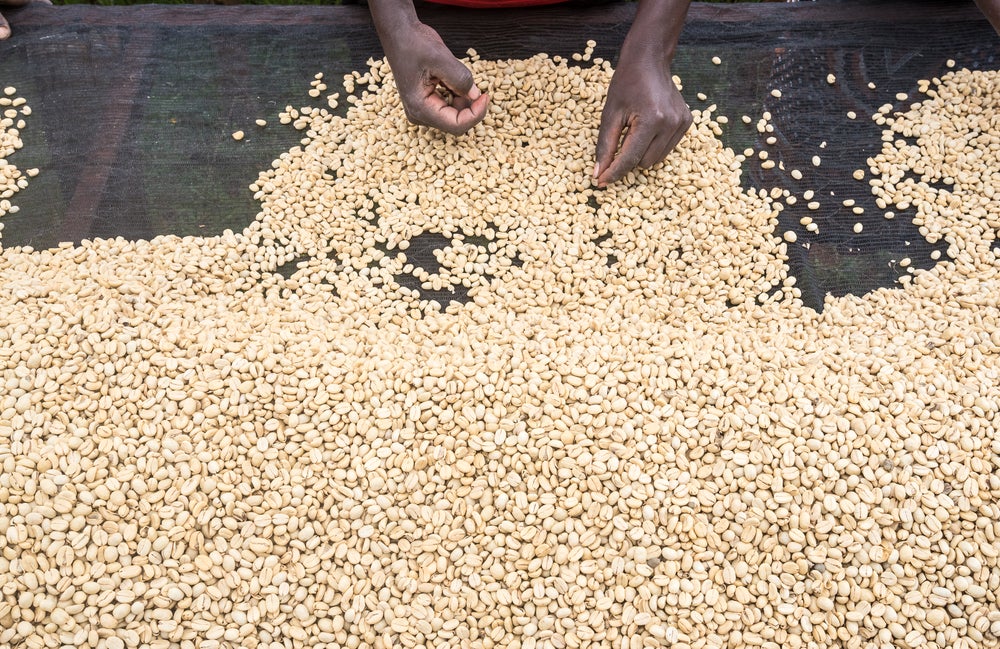
The drying process lasts 7 to 14 days, with workers frequently turning the parchment to ensure even drying and prevent defects.
Once fully dried, the parchment is removed through hulling and the beans are graded before export.
AA Grade
Kenyan coffees are classified by size. AA beans are the largest size. AA grade coffees are those that are 17/18 screen size, meaning that they are larger than 7.2 millimeters.
About Ruiru 11
Ruiru 11, a hybrid of Catimor and SL cultivars, is both Coffee Berry Disease (CBD) and Coffee Leaf Rust (CLR) resistant. Plus, it can be planted at a much higher density than the SL varieties, making optimal use of small plots of land.
Ruiru 11 has slowly ‘taken root’ across most of Kenya’s coffee growing landscape. The only issues were that with a shallower root structure, many farmers found the plant less hardy in drought conditions, and the trees required a more intense feeding program. Over time, farmers have found that by grafting Ruiru-11 to SL varieties they could take advantage of SL trees’ expansive root system and still reap the increased yields and higher immunity to disease of Ruiru-11.
Due to the grafted Ruiru-11’s growing popularity, most farms in Kenya today, both big and small, have a mixture of Ruiru-11 and SL varieties. As SL trees age, many farmers are opting to turn more towards Ruiru-11 (or the grafting solution) thanks to its ease of use and higher resistance to diseases.
Source: https://varieties.worldcoffeeresearch.org/varieties/ruiru-11 & https://sucafina.com/na/news/think-you-know-kenya-coffee-varieties-think-again
About SL28 & SL34
SL28 and SL34 were two of the cultivars released by Scott Agricultural Laboratories (SAL) during the height of SAL’s research in Kenya in the 1930s and 1940s. They soon became the cultivars of choice for most growers thanks to their deep root structure that allows them to maximize scarce water resources and flourish even without irrigation. SL varieties also had higher yields than the French Bourbon rootstock that they replaced and were known to be somewhat more disease resistant.
Coffee in Kenya
Though coffee growing had a relatively late start in Kenya, the industry has gained and maintained a impressive reputation. Since the start of production, Kenyan coffee has been recognized for its high-quality, meticulous preparation and exquisite flavors. Our in-country sister company, Sucafina Kenya, works with farmers across the country to ensure these exceptional coffees gain the accolades they deserve.
Today, more than 600,000 smallholders farming fewer than 5 acres compose 99% of the coffee farming population of Kenya. Their farms cover more than 75% of total coffee growing land and produce nearly 70% of the country’s coffee. These farmers are organized into hundreds of Farmer Cooperative Societies (FCS), all of which operate at least one factory. The remainder of annual production is grown and processed by small, medium and large land estates. Most of the larger estates have their own washing stations.
Most Kenyan coffees are fully washed and dried on raised beds. The country still upholds its reputation for high quality and attention to detail at its many washing stations. The best factories employ stringent sorting practices at cherry intake, and many of them have had the same management staff in place for years.