About This Coffee
Established in 1958, Kamavindi Estate is a family-owned and operated specialty coffee farm, now managed by the third generation, Peter Mbature. Located in Kamavindi Village, Embu County, the estate sits at 1,680 meters above sea level on the windward side of Mt. Kenya, benefiting from ideal growing conditions.
Kamavindi’s legacy began when John Njiru Mbature and Anna Rwamba planted their first coffee trees under colonial restrictions that limited native farmers to 100 trees. After Kenya gained independence, their son Martin Ireri Mbature and his wife Hellen Mbature purchased additional land and expanded the farm to 7,000 trees, paving the way for the next generation to take over. Peter has carried the legacy of innovation and forward thinking and is known for producing high-quality, consistent coffee and for his commitment to long-term partnerships.
Peter also helps and educates other producers in the surrounding area, both smallholders and small farm operators, helping them to improve processing and cultivation methods and access new markets.
Cultivation
Peter and the team at Kamavindi Estate cultivate primarily traditional varieties, such as SL28, SL34 and Ruiru 11. ‘SL’ varieties are cultivars originally released by Scott Agricultural Laboratories (SAL) in the 1930s and 1940s. They soon became the go-to trees for many growers in Kenya due to their deep root structure, which allows them to maximize scarce water resources and flourish even without irrigation.
Peter has also begun experimenting with non-traditional varieties, such as Geisha, on the farm. Geisha is very rare in Kenya, but after consulting with various customers and experts, he speculated that Geisha would adapt well to the growing conditions on his farm and would, potentially, produce an even higher quality cup.
All coffee is cultivated with a serious eye towards sustainability and Good Agricultural Practices, with minimal environmental impact where possible.
Harvest & Post-Harvest
Peter takes processing very seriously and reads widely on fermentation and processing science. His processing station is immaculately maintained, and his approach to managing every stage of processing, from harvest through to drying, is a huge reason that his coffees are so beloved by specialty buyers. He also actively seeks to teach other farmers to improve processing and to engage in cupping to better understand quality outcomes.
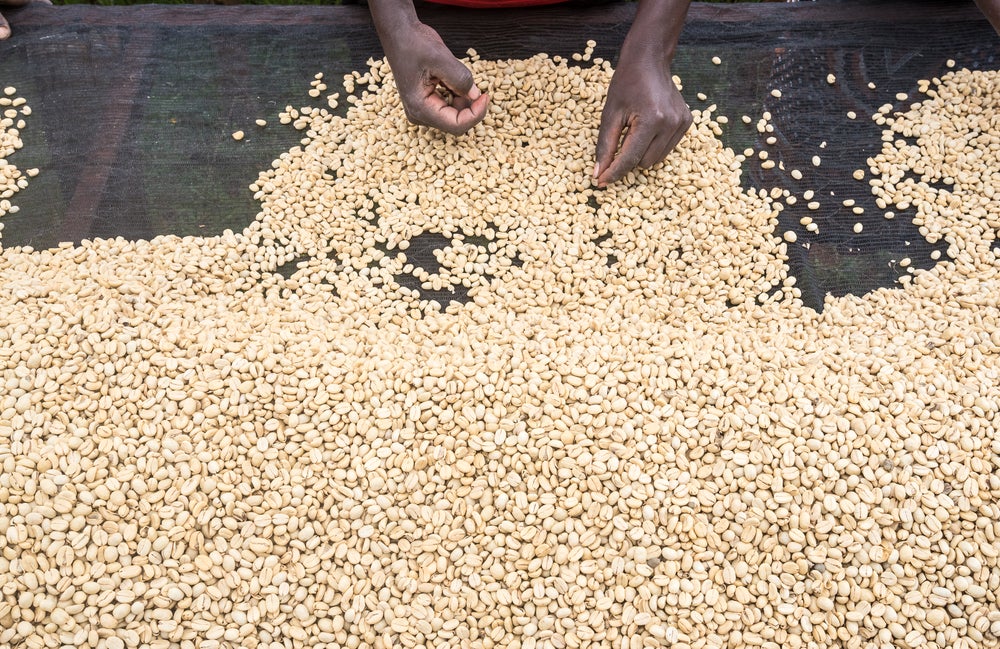
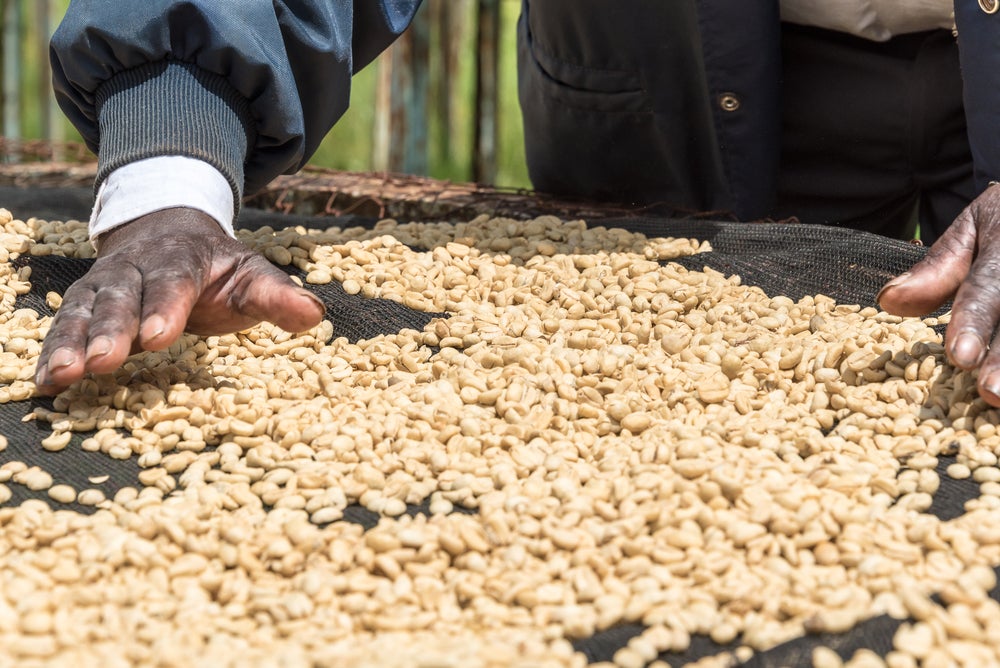
While every lot is carefully watched to ensure optimal conditions, generally the fully washed process will follow the following steps. Coffee cherries are carefully handpicked at peak ripeness and delivered to Kamavindi’s pulping station for processing. Cherries are first handsorted to remove underripes or damaged cherry before being pulped on the farm’s disk pulper to remove the outer skin. Parchment is then fermented for 12 to 24 hours, depending on temperature and climate conditions, to break down the mucilage. After fermentation, they are thoroughly washed before being transferred to raised beds for drying.
Peter has invested heavily in his drying infrastructure, in large part in response to changing climatic conditions on his farm, where unpredictable weather (unseasonable rain) was disrupting drying processes. He has established covered ‘coffee dehydrators’ (greenhouses with a digital control system preventing temperatures from exceeding 25C) with metal beds to ensure slow and even drying with good, consistent airflow. This adaptation also prevents an overflow solution during peak times of the harvest. Drying time in the new facility usually lasts around 14 days, with workers frequently turning the parchment to ensure even drying and prevent defects.
AB Grade
Kenyan coffees are classified by size. AB beans are those that are between screen size 15 and 18 meaning that beans are between 6 and 7 millimeters in size.
About Ruiru 11
Ruiru 11, a hybrid of Catimor and SL cultivars, is both Coffee Berry Disease (CBD) and Coffee Leaf Rust (CLR) resistant. Plus, it can be planted at a much higher density than the SL varieties, making optimal use of small plots of land.
Ruiru 11 has slowly ‘taken root’ across most of Kenya’s coffee growing landscape. The only issues were that with a shallower root structure, many farmers found the plant less hardy in drought conditions, and the trees required a more intense feeding program. Over time, farmers have found that by grafting Ruiru-11 to SL varieties they could take advantage of SL trees’ expansive root system and still reap the increased yields and higher immunity to disease of Ruiru-11.
Due to the grafted Ruiru-11’s growing popularity, most farms in Kenya today, both big and small, have a mixture of Ruiru-11 and SL varieties. As SL trees age, many farmers are opting to turn more towards Ruiru-11 (or the grafting solution) thanks to its ease of use and higher resistance to diseases.
Source: https://varieties.worldcoffeeresearch.org/varieties/ruiru-11 & https://sucafina.com/na/news/think-you-know-kenya-coffee-varieties-think-again
About SL28 & SL34
SL28 and SL34 were two of the cultivars released by Scott Agricultural Laboratories (SAL) during the height of SAL’s research in Kenya in the 1930s and 1940s. They soon became the cultivars of choice for most growers thanks to their deep root structure that allows them to maximize scarce water resources and flourish even without irrigation. SL varieties also had higher yields than the French Bourbon rootstock that they replaced and were known to be somewhat more disease resistant.
Coffee in Kenya
Though coffee growing had a relatively late start in Kenya, the industry has gained and maintained a impressive reputation. Since the start of production, Kenyan coffee has been recognized for its high-quality, meticulous preparation and exquisite flavors. Our in-country sister company, Sucafina Kenya, works with farmers across the country to ensure these exceptional coffees gain the accolades they deserve.
Today, more than 600,000 smallholders farming fewer than 5 acres compose 99% of the coffee farming population of Kenya. Their farms cover more than 75% of total coffee growing land and produce nearly 70% of the country’s coffee. These farmers are organized into hundreds of Farmer Cooperative Societies (FCS), all of which operate at least one factory. The remainder of annual production is grown and processed by small, medium and large land estates. Most of the larger estates have their own washing stations.
Most Kenyan coffees are fully washed and dried on raised beds. The country still upholds its reputation for high quality and attention to detail at its many washing stations. The best factories employ stringent sorting practices at cherry intake, and many of them have had the same management staff in place for years.