
About This Coffee
Kaguyu Factory is owned and operated by Inoi Farmer Cooperative Society (FCS). The 1,659 farmers delivering to Kaliluni Factory in Machakos, Kenya cultivate SL28, SL34, Ruiru 11 and Batian at the lofty altitudes of 1,700 to 1,900 meters above sea level.
Cultivation
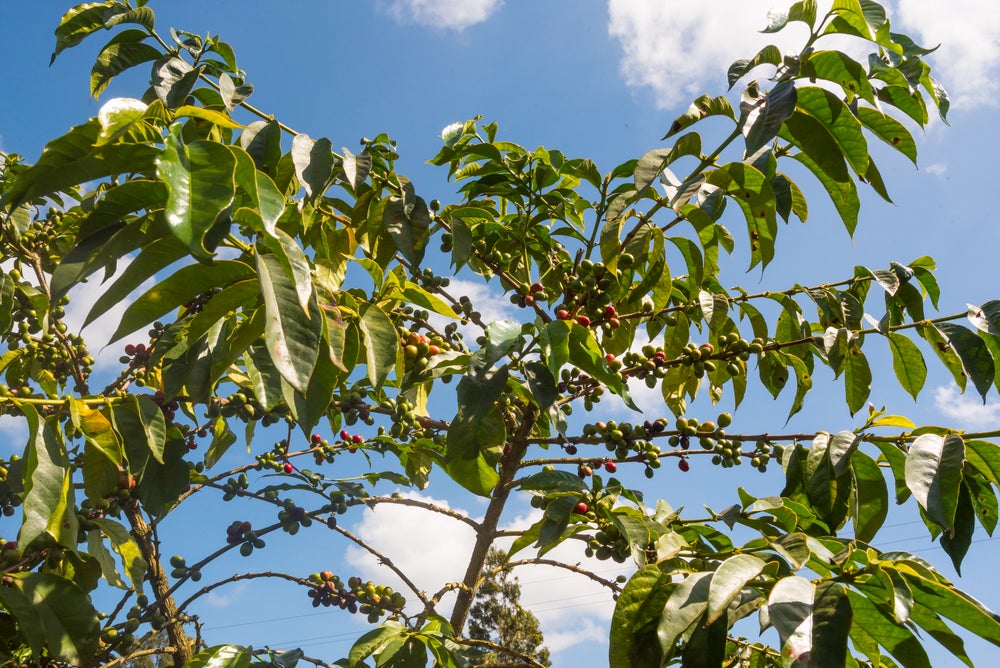
Farmers delivering to Kaguyu cultivate primarily SL28, SL34, Batian, and Ruiru 11 in small coffee gardens that are, on average, smaller than 1 hectare. ‘SL’ varieties are cultivars originally released by Scott Agricultural Laboratories (SAL) in the 1930s and 1940s. They soon became the go-to trees for many growers in Kenya due to their deep root structure, which allows them to maximize scarce water resources and flourish even without irrigation. They are cultivated with a serious eye to sustainability and Good Agricultural Practices, with minimal environmental impact where possible. Ruiru 11 and Batian are newer varieties known for their disease resistance and high yields. They both start yielding fruit after just 2 years.
Farmers receive technical agronomic support from Sucafina in Kenya. They also receive soil sampling from Kahawa Bora. The soil sampling program addresses a key step in farmer profitability. Lower input costs mean lower overall production costs and higher profits. More targeted input application also translates into healthier trees and higher quality cherry. Prior to Kahawa Bora’s soil sampling program, farmers had little access to soil analysis methods. Fertilizer, when applied, would be formulated according to a generalized recipe rather than one uniquely suited to the farm’s exact needs. Now, with better access to information through technology and agronomical assistance, farmers can apply the right fertilizer recipe at the right time, improving yields and cherry quality.
Harvest & Post-Harvest
Smallholders selectively handpick only ripe cherry and deliver it to Kaguyu Factory. At intake, the Cherry Clerk oversees meticulous visual sorting and floating, accepting only dense, ripe cherry.
After intake, cherry is pulped and fermented for approximately 12 to 24 hours. Following fermentation, coffee is washed in clean water and soaked for 12 to 24 hours. After soaking, parchment is laid to dry on raised beds. Workers rake parchment frequently to ensure even drying. They cover drying parchment during the hottest time of day, to maintain slow, even drying and at night, to shelter parchment from moisture. It takes approximately 10 to 20 days for parchment to dry.
The 'C' Stigma
Letter grades on Kenyan coffees refer to bean size, not coffee quality. So why do C lots tend to score lower? Enter the ‘C Stigma.’
The ‘C Stigma’ itself actually contributes to lower quality C lots. Because we expect lower quality, C grades are usually sold for lower prices. Due to low prices, resources and time are rarely spent to prep C lots as thoroughly as higher grades. Thus, by expecting less of C lots and by paying lower prices for them we are contributing to the circumstances that make C lots lower quality than AA and AB.
The ‘C Stigma’ is hurting everyone. Quality-focused farmers like the ones we work with are often unable to sell their C lots at value-added prices, even though they have the potential to be of high cup quality. C lots can compose up to 17% of any 100-bag lot. Because of this, we’re missing out on affordable, high-quality coffees.
The only way to break the cycle is to start placing more value on C lots. If we pay a bit more for C lots and emphasize better prep, we’ll make it possible and desirable for farmers to invest the time and money in prepping C lots the same way they prep their AA and AB lots.
Coffee in Kenya
Though coffee growing had a relatively late start in Kenya, the industry has gained and maintained a impressive reputation. Since the start of production, Kenyan coffee has been recognized for its high-quality, meticulous preparation and exquisite flavors. Our in-country sister company, Sucafina Kenya, works with farmers across the country to ensure these exceptional coffees gain the accolades they deserve.
Today, more than 600,000 smallholders farming fewer than 5 acres compose 99% of the coffee farming population of Kenya. Their farms cover more than 75% of total coffee growing land and produce nearly 70% of the country’s coffee. These farmers are organized into hundreds of Farmer Cooperative Societies (FCS), all of which operate at least one factory. The remainder of annual production is grown and processed by small, medium and large land estates. Most of the larger estates have their own washing stations.
Most Kenyan coffees are fully washed and dried on raised beds. The country still upholds its reputation for high quality and attention to detail at its many washing stations. The best factories employ stringent sorting practices at cherry intake, and many of them have had the same management staff in place for years.