
About This Coffee
Gathugu Factory takes its name from the village where it is situated. Gathugu Factory is owned and operated by Mugaga Farmers’ Cooperative Society (FCS). This washing station has been a vital hub for coffee production since its establishment in 1985. With a strong membership base of 500 active farmers, Gathugu plays a pivotal role in supporting and advancing coffee production for its members.
The Gathugu Factory provides a range of essential services to its members ensuring their coffee production is efficient and of the highest quality. With expertise in coffee processing techniques, the station ensures that members’ cherry undergoes meticulous processing to reach their full potential. By adhering to strict quality standards, Gathugu Factory produces coffee that is sought after in the market, attracting buyers who appreciate the exceptional flavors and characteristics of their coffee.
Cultivation
Gathugu Factory sources farm inputs for the farmers. By providing access to necessary agricultural inputs such as fertilizers, seeds and equipment, the station helps its members optimize their farming practices and improve their yields.
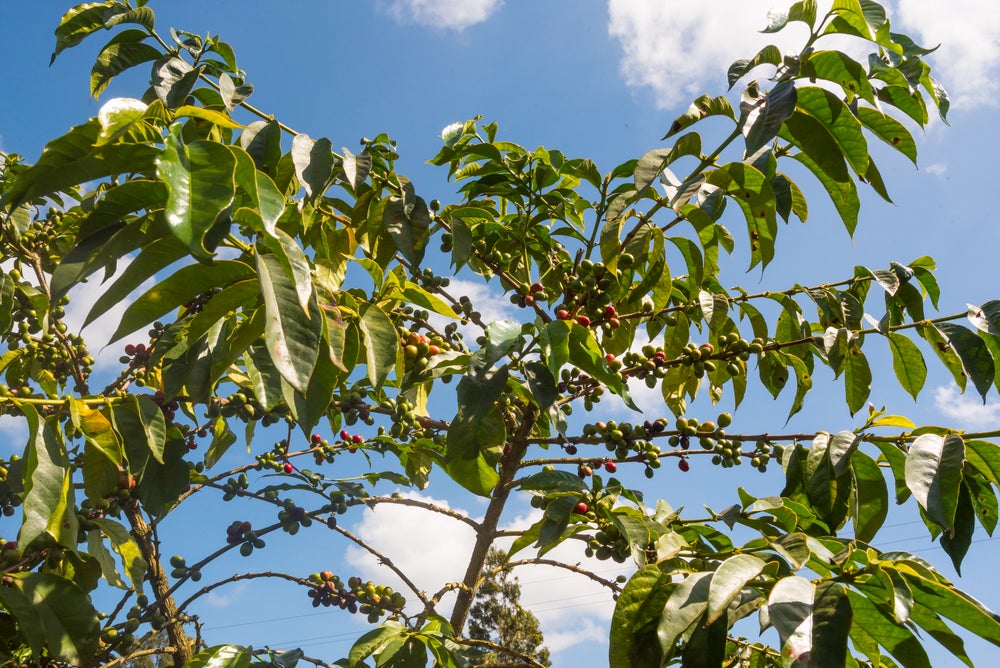
Farmers delivering to Gathugu cultivate primarily SL28 and Ruiru-11 in small coffee gardens that are, on average, smaller than 1 hectare. ‘SL’ varieties are cultivars originally released by Scott Agricultural Laboratories (SAL) in the 1930s and 1940s. They soon became the go-to trees for many growers in Kenya due to their deep root structure, which allows them to maximize scarce water resources and flourish even without irrigation. They are cultivated with a serious eye to sustainability and Good Agricultural Practices, with minimal environmental impact where possible.
Ruiru 11 is a new variety known for its disease resistance and high yields. It starts yielding fruit after just 2 years.
Harvest & Post-Harvest
Smallholders selectively handpick only ripe cherry and deliver it to Gathugu Factory. At intake, the Cherry Clerk oversees meticulous visual sorting and accepts only dense, ripe cherry.
After intake, cherry is pulped and fermented for 12 to 16 hours. Following fermentation, coffee is washed clean water and parchment is laid to dry on raised beds. Workers rake parchment frequently to ensure even drying. They cover drying parchment during the hottest time of day, to maintain slow, even drying and at night, to shelter parchment from moisture.
About Nyeri County
Nyeri County is one Kenya's most famous growing regions.
The name Nyeri is derived from the Masaai word nyiro, meaning red, after the red volcanic soil in the area. The name was adapted by white settler farmers to Nyeri. Most farmers in the area today grow tea and coffee as cash crops. Coffee varieties in the region are usually a mix between SL 28, SL 34 (roughly 80%) Batian and Ruiri 11.
Coffee in Kenya
Though coffee growing had a relatively late start in Kenya, the industry has gained and maintained a impressive reputation. Since the start of production, Kenyan coffee has been recognized for its high-quality, meticulous preparation and exquisite flavors. Our in-country sister company, Sucafina Kenya, works with farmers across the country to ensure these exceptional coffees gain the accolades they deserve.
Today, more than 600,000 smallholders farming fewer than 5 acres compose 99% of the coffee farming population of Kenya. Their farms cover more than 75% of total coffee growing land and produce nearly 70% of the country’s coffee. These farmers are organized into hundreds of Farmer Cooperative Societies (FCS), all of which operate at least one factory. The remainder of annual production is grown and processed by small, medium and large land estates. Most of the larger estates have their own washing stations.
Most Kenyan coffees are fully washed and dried on raised beds. The country still upholds its reputation for high quality and attention to detail at its many washing stations. The best factories employ stringent sorting practices at cherry intake, and many of them have had the same management staff in place for years.