News
Wednesday, January 3, 2024
It's a Robusta World
Prior to 2020, robusta was fading from view. It appeared that the robusta market share was receding from its peak saturation after Arabica’s steep rally in the 2010/2011 crop. Even as the spread of Coffee Leaf Rust decreased supply and premiumized differentials in the years following, washed arabica had been winning cup share for nearly a decade.

March 2020 – Peak Washed Arabica?
During the March 2020 meeting of the National Coffee Association, everyone was in a great mood. Business had been booming. Demand was up. And almost everyone had a profitable 2019 year. Even “third wave” specialty coffee players attended the conference since their businesses had grown in size, scope and complexity. The only thing looming in the back of people’s minds was the spread of Covid and the question of what it would mean for the world of coffee. The main concern was that the supply and demand presentations all agreed that arabica supply could get really tight in the coming year.
Few people were prepared or even expected the pandemic to be so impactful and long lasting. Within weeks of the conference, countries were shutting down, coffee shops closed and the boom of in-home consumption began. While specialty roasters worked hard to bring products onto store shelves and into ecommerce, the consumer pattern shift favored larger commercial brands. Roasters dumped unique and special roasts and favored large, mainstream brands to keep supermarket shelves full. The narrative around coffee shifted to one of high-end Arabica beans being in shortage to one of Robusta becoming the flavor of the month.
What happened in the next 3 years only served to solidify robusta’s hold on the market.
July 2021 – Frost in Brazil
The Arabica market got a shock when not one but two frosts hit Brazil’s arabica producing regions. This was something that had not happened since the 1990’s. We flew down to the country to survey the damage. It was shocking how bad things looked from the air. However, the ground level showed a bit less production loss. Still, it was enough to shift not only Arabica but the entire balance sheet into a large deficit for two consecutive crops (21/22 and 22/23). There were two key outcomes of this deficit. First, the subsequent market rally guaranteed that robusta would continue to be favored as a cheaper blend component. Second, ICE certified stocks would fall during thirteen of the next fifteen months.
February 2022 – The Ukraine Effect
The idea that Russia could invade Ukraine was not new. However, it was not front of mind as we entered the new year. When asked what impact it might have on the coffee market, I said that it shouldn’t have a huge impact either way on coffee but should trigger a large rally in the energy and grains complex. I got half of the answer right. The war did lead to a large commodity rally, but coffee sold off aggressively. The storyline was that this was due to demand destruction in the region, but I do not believe that was or is accurate. Rather, reducing risk in the case of coffee meant liquidating longs that were multiple standard deviations above its historic, long-term price (80 cents/lb higher than the average price of the last 10 years). This sell-off helped to close the arbitrage (difference) with robusta a bit, but Robusta still remained cheap enough to continue increasing market share. What’s more, the marcoeconomic shock – real or perceived – as well as runaway inflation and the corresponding interest rate rally sent consumers rushing towards cheaper products bought in smaller increments.
October 2022 – Price Inflation = Trade Deflation
The Swiss Coffee Trade Association event was a fairly depressing affair. The pantry-stocking effect of the early COVID days were long gone, and roasters were reporting less demand than expected after passing on price increases to consumers. This meant trade houses would have less coffee to sell, even though fixed overheads and CAPEX investments done during the boom years could not be easily reduced. At the same time, an unprecedented interest rate rally further squeezed the cash available to trade and store goods. This gave Robusta yet another advantage. Against this backdrop, it remained clear that blend optimization would continue to favor Robusta incorporation.
2023 – The Trend Persists
The first half of 2023 saw one disappointing demand update after the other, whether in statistical “disappearance” of reported warehouse stocks of green coffee, in the reporting of publicly traded coffee companies, or in actual retailer sales data. The latter pointed squarely at the biggest loser – top shelf washed Arabica-based blends.
On June 29th, the regulation governing European deforestation monitoring was signed into law. While the intention is fantastic, the practical application is still a bit unknown at the time of writing this article. However, what is clear is that large origins (Brazil) or those that can put forward national level solutions (Vietnam) stand to be winners. These happen to be the two largest Robusta producing countries in the world.
Another trend observed during the year was the expansion of “convenience” machines at hotels, airports and offices where you press a button (Cappuccino, ChocoLatte, Flat White, etc…) and any type of coffee beverage magically comes out. Many times, these are sweet or milk-based beverages, and more times than not, they are based on soluble coffee, which has in it a high concentration of Robusta coffee.
Today and Tomorrow – The Trend Is Your Friend, Or Is It?
If not clear by now, please go grab a single origin coffee from a boutique producing country and lament with us the path the coffee market is on.
If we continue to consume coffee on the same trendline as from 2000 to now, we would see Robusta and Natural Arabica account for more than 80% of the coffee in the world by 2050 as well as an accelerated concentration of production into just a few countries. At least we aren’t as bad as cocoa, right? Actually, check that. Comparing the below two tables, assuming stable cocoa crops, we’re already approaching similar origin concentration in 2024/2025.
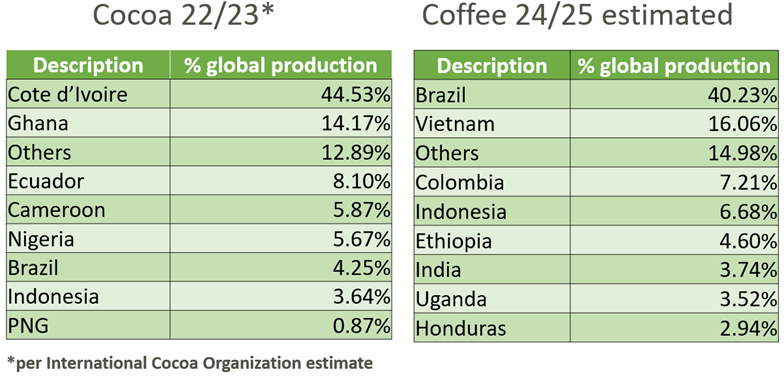
Is it an anomaly that global coffee consumption has stagnated or even possibly declined at a time when the quality of coffee consumers are drinking has gotten worst? Many analysts want to blame stretched consumers due to inflation. I don’t buy it. Revenge travel is all the rage. Housing prices have soared and up until 8% interest rates, had found willing buyers. Luxury goods companies have thrived. Taylor Swift and Beyonce are selling a billion dollars each of concert tickets for a single, global tour. I don’t see how consumers don’t have money for a cheap luxury, which was clearly highlighted in Starbucks’s last corporate earnings report.
What I do think is that if you lower the quality of a product or the consumer perceives that the value per money is worse, they consume less of it. Coffee is a drug. People won’t stop, but they will drink less. When I stay in a hotel, if the coffee is horrible, I’ll still drink one (with some milk and sugar). If the quality is great, I’ll have multiple cups. Hence, my own personal belief is that there is a direct correlation between quality and volume consumed.
The last big boom in coffee consumption happened off the back of the specialty coffee renaissance. The question is, will brands and retailers be bold enough to fight origin concentration and blend degradation and try profiting on a quality proposal in the near future, or will they continue to accelerate in their race to the bottom?
Until the data and cup quality says otherwise, it’s a robusta world and we’re just living in it.
David Behrends has over twenty years of experience working in the coffee industry, working for several multinational corporations before joining Sucafina in 2015 as Managing Partner and Head of Trading and founding Farmer Connect in 2019. Prior to working in coffee, he served as a Small Business Development volunteer in Bolivia with the Peace Corps and for an energy start-up company in Argentina. David is a passionate believer that technology will be a key driver in the evolution of agriculture supply chains in the coming decade. He is the proud father of an 11 year old girl and enjoys live music and street art in his (rare) free time.
Jordan Hooper began his coffee career at the end of a two-year volunteer stint in Nicaragua. He’s always worked in the trade, starting in the cupping lab of a specialty importer prior to experience trading and managing both commercial and specialty trading businesses. He’s currently the managing director of Sucafina Americas, overseeing imports into North America and sourcing from Spanish-speaking Americas. In 2024 he’ll be starting a new role as Head of Green Trading for Sucafina.