
About This Coffee
Fernely originally bought San Jose in partnership with another farmer but became sole owner after four years. Since then, he’s transformed it into both a source of income and a home. He lives there with his wife Derly and their son, while his daughter, granddaughter and son-in-law live nearby. San Jose has become a place of continuity, where coffee supports not just livelihoods but a way of life.
He began planting Pink Bourbon before adding Caturra, motivated by the potential of specialty coffee. What started as a financial strategy soon became a commitment to quality. Today, every step from seed selection to harvest is managed with precision. He leads a team of 3 permanent workers and up to 15 more during peak season, maintaining a hands-on approach throughout the harvest cycle.
Cultivation
San Jose spans 8 hectares and supports around 32,000 coffee trees, shaded by plantain and fruit trees. The farm sits at 1,850 meters and benefits from fertile soil and a cool microclimate that supports slow cherry development. Fernely leads all cultivation practices and is part of the local community council, helping connect coffee growing to wider community development.
Harvest & Post-Harvest
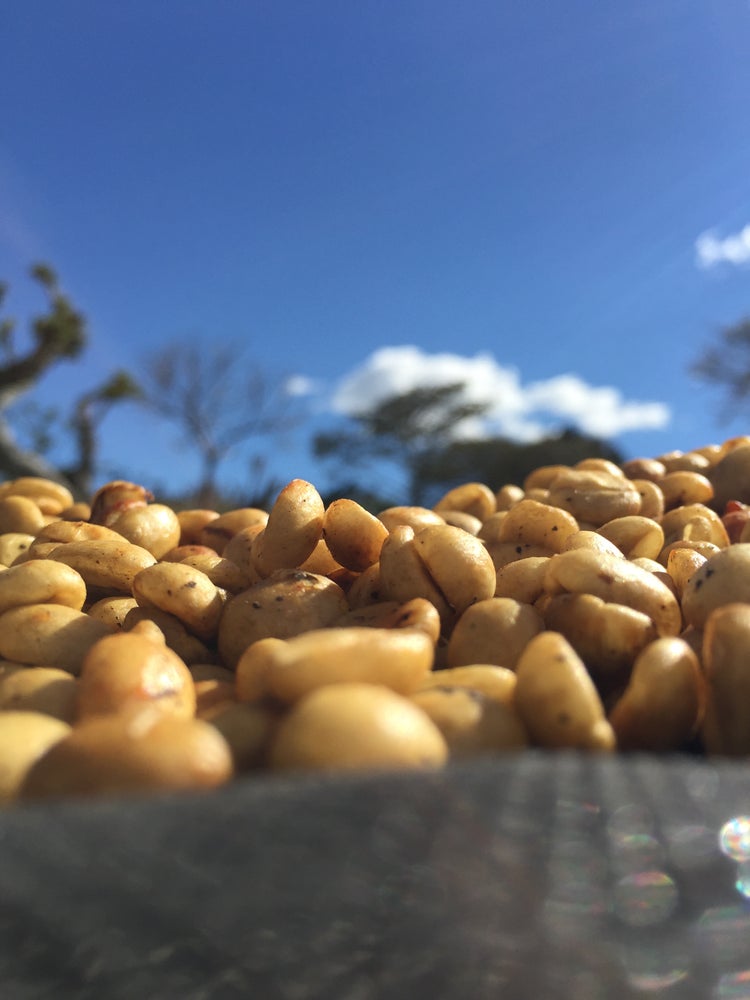
Cherry is selectively handpicked at peak ripeness and floated to remove defects. After dry pulping, coffee ferments in tiled concrete tanks for two to three days. The parchment is stirred several times by hand to ensure even fermentation. Once complete, coffee is fully washed with clean water and dried on raised beds in raised beds for 10 to 12 days.
About Caturra
Caturra, a coffee variety known for its short, compact stature, is a natural mutation of Bourbon. It was first discovered in Minas Gerais, Brazil around 1915. The variety is the result of the mutation in a single gene of the Bourbon variety that made the plant smaller but still high yielding. As it spread, Caturra enabled higher-density coffee cultivation.
As a direct descendant of Bourbon, Caturra is well known for delicate and complex flavors that are often floral and fruity. At the same time, its close relationship with Bourbon means Caturra is very susceptible to coffee leaf rust (CLR) and other common coffee diseases and pests. As a result, Caturra was later bred with CLR-resistant hybrids from Timor-Leste, producing the Catimor and its subsequent varieties.
Coffee in Colombia
Colombia has been producing and exporting coffee renowned for their full body, bright acidity and rich aftertaste, since the early 19th century.
Colombia boasts a wide range of climates and geographic conditions that produce their own unique flavors in coffee. This also means that harvest times can vary quite a bit. In fact, between all its different regions, Colombia produces fresh crop nearly all year round.
The increasing focus on the specialty industry is changing the way traders and farmers do business. It is becoming more common for farmers to isolate the highest quality beans in their lots to market separately. These higher-quality lots are often sold under specific brands or stories.
Besides its wide variety of cup profiles, Colombia has quickly expanded its certification options over the past 10 years. The most common certifications available are Fairtrade, Rainforest Alliance and Organic.