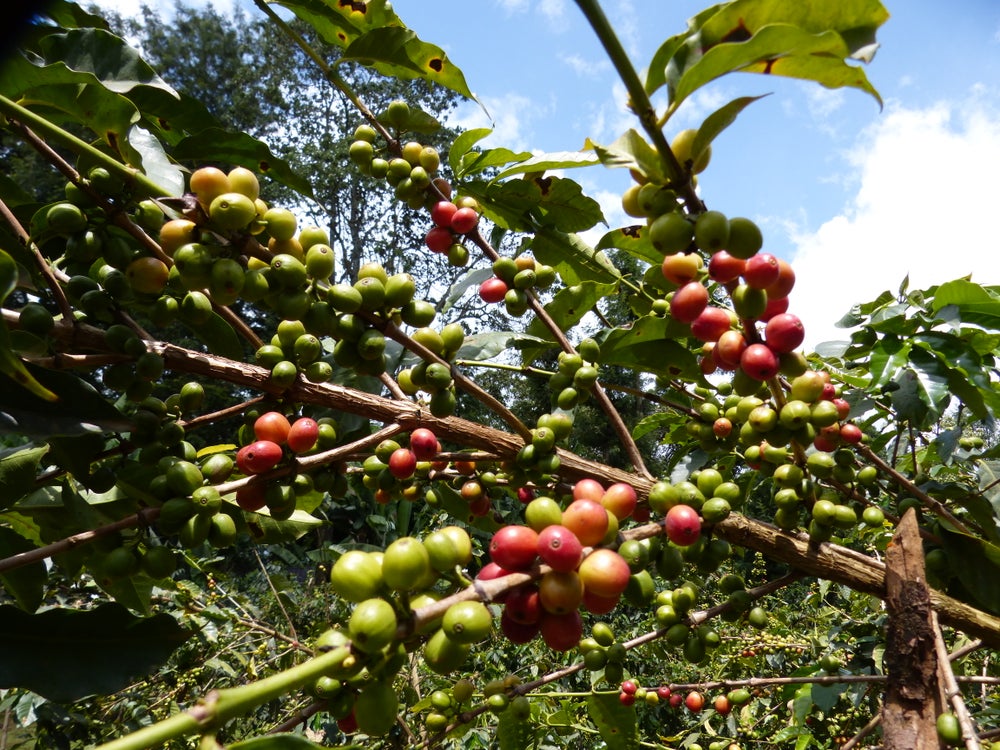

About This Coffee
Mbokam Estate is a family-owned and operated farm that has been passed down through three generations. The estate is known for its high-quality coffee and uses regenerative practices, such as cover cropping and mulching, to maintain the quality of its land. Mbokam Estate plans to continue maintaining its high quality and increase its coffee production.
Cultivation
Arthur and his family cultivate primarily SL28 and Ruiru 11 varieties. ‘SL’ varieties are cultivars originally released by Scott Agricultural Laboratories (SAL) in the 1930s and 1940s. They soon became the go-to trees for many growers in Kenya due to their deep root structure, which allows them to maximize scarce water resources and flourish even without irrigation. They are cultivated with a serious eye towards sustainability and Good Agricultural Practices, with minimal environmental impact where possible.
Ruiru 11 is a new variety known for its disease resistance and high yields. It also starts yielding fruit after just 2 years.
Harvest & Post-Harvest
Arthur selectively handpicks ripe, red cherry and processes it on his farm. Once picked, cherry is selectively sorted and then pulped. Coffee is fermented for 12-16 hours in fermentation tanks. Following fermentation, parchment is washed in clean water and then dried on raised beds for several days to achieve optimal moisture content.
About Peaberries
PB stands for peaberry. Peaberry is a name given to a very specific shape of coffee bean. In Spanish, peaberries are called “caracol”, which means “snail”. The name aptly describes the shape of the peaberry bean, which appears slightly curved in on itself.
Peaberries are the result of a natural mutation in the coffee cherry. Whereas there are usually two beans nestled together in each fruit, a cherry with a peaberry mutation only forms one bean. Thus, peaberries are a single, rounder bean.
Peaberry mutations occur in approximately 5% of all coffee. The beans are known for being rounder, smaller and denser, which can contribute to a more even roast color when handled correctly. Many people find peaberries to have a sweeter flavor profile, as well.
Since peaberries are a natural mutation that is not visible from the outside of the cherry, peaberries must be sorted out during the screen grading stage of dry milling. The peaberry screens have the smallest holes, which are oblong to allow the rounder beans to fall through.
Coffee in Kenya
Though coffee growing had a relatively late start in Kenya, the industry has gained and maintained a impressive reputation. Since the start of production, Kenyan coffee has been recognized for its high-quality, meticulous preparation and exquisite flavors. Our in-country sister company, Sucafina Kenya, works with farmers across the country to ensure these exceptional coffees gain the accolades they deserve.
Today, more than 600,000 smallholders farming fewer than 5 acres compose 99% of the coffee farming population of Kenya. Their farms cover more than 75% of total coffee growing land and produce nearly 70% of the country’s coffee. These farmers are organized into hundreds of Farmer Cooperative Societies (FCS), all of which operate at least one factory. The remainder of annual production is grown and processed by small, medium and large land estates. Most of the larger estates have their own washing stations.
Most Kenyan coffees are fully washed and dried on raised beds. The country still upholds its reputation for high quality and attention to detail at its many washing stations. The best factories employ stringent sorting practices at cherry intake, and many of them have had the same management staff in place for years.