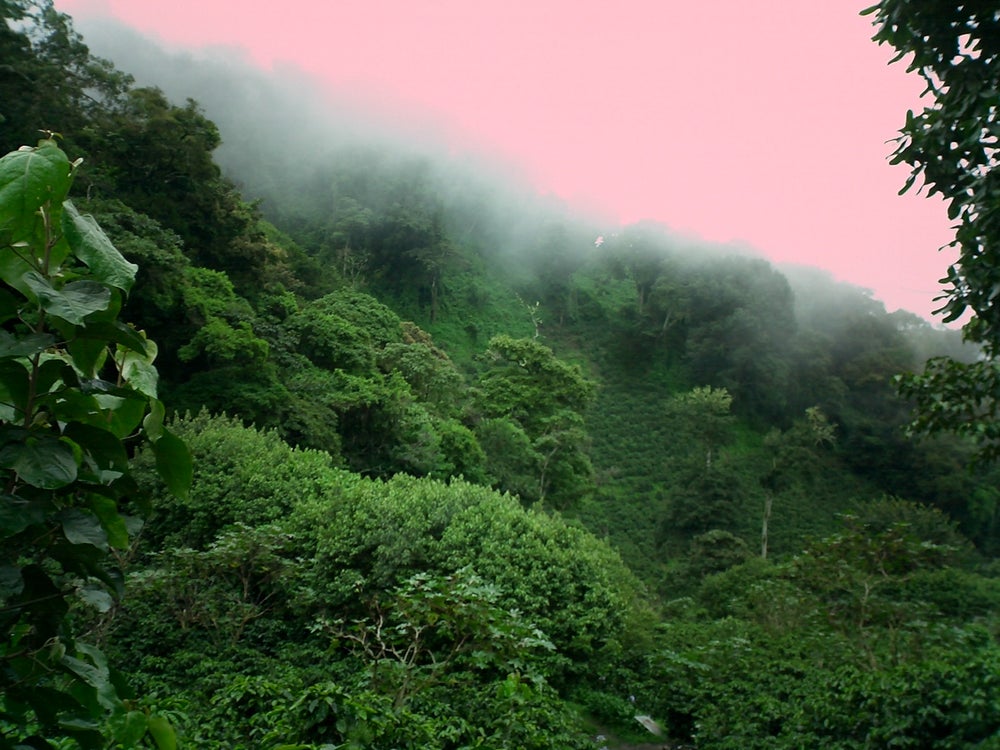

About This Coffee
The Peterson family purchased La Esmerelda Estate in 1967, when it was predominately a cattle ranch. They diversified production in the 1980s and planted their first coffee trees. In 1997, the family purchased Jaramillo farm, a plot added to La Esmerelda Estate that they selected for its high altitude and proximity to Volcan Baru, a volcano whose eruptions had left nutrient-rich volcanic soil on the farm.
Geisha is now renowned for its high cup score. At La Esmerelda Estate, the Peterson’s focus on high-quality cultivation, combined with high altitudes and a superb microclimate create the ideal conditions for growing a nuanced, floral coffee that evokes the best flavors of Geisha
Cultivation
Geisha is grown in the shade of Inga and banana trees. Shade creates the cooler environment where sweet, dense cherry can concentrate sugars and mature more slowly.
Harvest & Post-Harvest
Ripe, red cherry is selectively handpicked and processed on the estate. Cherry is laid in thin layers on cement patios and raked frequently to ensure even drying.
About Geisha
Geisha (also known as Gesha) is known for its exceptional cup quality, especially when grown at high altitudes. The variety comes from Ethiopian landrace coffees and was collected from Ethiopian coffee forests in the 1930s. The name supposedly derives from Ethiopia’s Gori Gesha forest.
There is some confusion with several genetically distinct varieties that have all been called Geisha, but the most famous variety is the Panama one. The variety was brought to Lyamungu research station in Tanzania and from there to Centro Agronómico Tropical de Investigación y Enseñanza (CATIE) in Central America in 1953. At CATIE, the variety was logged as T2722. CATIE distributed T2722 across Panama in the 1960s for its Coffee Leaf Rust (CLR) resistance, but its brittle branches meant it was not widely planted.
Panama Geisha reached its modern fame in 2005 when a Geisha lot won the “Best of Panama” competition and broke contemporary records at over $20/pound. DNA analysis has demonstrated that the Panama Geisha descended from T2722 is distinct and uniform. Today, Geisha is known for its delicate florals, jasmine and stone fruit.
Coffee in Panama
Though small in coffee production, Panama is a mighty player in coffee quality. In particular, Panama is famous for producing Geisha variety lots that have fetched prices exceeding $800 per pound. Today, its renown as a producer of rare and sought-after varieties positions Panama as a contender for a new kind of ‘coffee-tourism’ that has the potential to change the way we produce, purchase, consume and talk about specialty coffee on a global scale.
The high value of Geisha has brought out both the best and worst in the industry. For established producers who receive excellent prices for their Geisha and other lots, the high prices they receive have often been reinvested in their communities and in renovating their farms to be as environmentally sustainable as possible. Unfortunately, the lure of Geisha’s high value has led some people bypass traditional land purchasing agreements and illegally deforest areas of national parks to get the best location for new (and illicit) Geisha farms.
Even as the number of producers those receiving high prices for their Geisha remains relatively low, the blossoming coffee industry in Panama has demonstrated potential to raise incomes for a wider spectrum of producers and coffee workers.