
About This Coffee
Wagner and Rosane Ferrero began cultivating coffee in 1982. Though they started in the Mogiana region, a severe frost occurred soon after they arrived and decimated their coffee trees. So, in 1990, they moved to a farm near Patrocinio in Cerrado Mineiro, where the climate was more amenable to coffee production. Once they set down (literal and figurative) roots, they started to flourish.
Their farms, Fazenda Caixetas and Fazenda Pântano, are located in Pântano Region, which is one of the most promising high-quality coffee region in the heart of Cerrado Region. The farms sit at about 1,200 meters above sea level. They farm over 150 varieties in different experimental fields but the main varieties they grow are Paraiso, Bourbon and IAC125. Approximately 70 to 80% of their total production is sold as specialty coffee.
Cultivation
The Ferreros have remained focused on sustainability since day one. Fazenda Pântano was awarded the “Best Sustainable Farm of the Year” in 2014.
They invest in upgrading their equipment to help them farm and process coffee better. Recently, they built a new fermentation plant with the goal of processing a full 30% of their coffees with specialty fermentation processes.
Brazil Harvest & Post-Harvest
Most Brazilian coffee is grown on huge farms, built and equipped for mechanical harvesting and processing that are designed to maximize productivity. The relatively flat landscape across many of Brazil’s coffee regions combined with high minimum wages has led most farms to opt for this type of mechanical harvesting over selective hand-picking.
In the past, this mechanization meant that strip-picking was the norm. However, today’s mechanical harvesters are increasingly sensitive, meaning that farms can selectively harvest only fully ripe cherries at each pass. This is great news for specialty-oriented producers.
In many cases and on less level sections of farms, a mixed form of ‘manual mechanized’ harvesting may be used. The derricadeira – a sort of mechanized rake that uses vibration to harvest ripe cherry - can be used to selectively pick ripe cherry more quickly and cost-effectively than individual hand pickers. A tarp is spanned between coffee trees to capture the cherry as it falls.
With the aid of these newer, more selective technologies, there’s a growing number of farms that are increasingly concerned with – and able to deliver - cup quality.
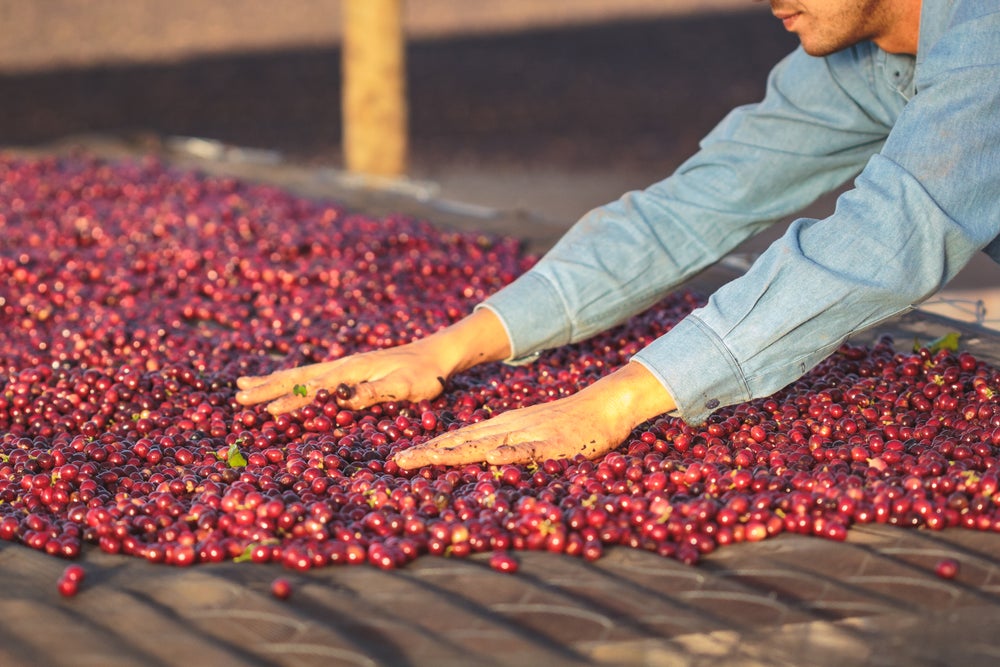
After harvest, cherry is typically laid to dry in thin layers on patios. Under direct sunlight, cherry is carefully monitored and turned frequently.
Paraiso
Paraiso was developed by EPAMIG (Minas Gerais Agricultural Research and Development Company) and released in 2012. It is a hybrid of Yellow Catuai and Timor. Paraiso is prized for its high productivity and strong disease resistance, as well as its high cup quality. Trees are short and resistant to coffee leaf rust. They also start fruiting after just two years, compared to the average three.
About Cerrado Mineiro
The Cerrado Mineiro is a mix of grassy savannah, scrublands and forests with a rich biodiversity of over 10,000 plant species and 800 bird species. It is the largest woodland savannah in South America. At over 2 million square kilometers, it’s three times the size of Texas and constitutes 21% of all of Brazil’s land area.
Since the 1960s, over 40% of the Cerrado Mineiro’s original land mass has been converted into agricultural land. Coffee has been grown in the area for over 40 years and there are now over 3,000 farms, most of which are smallholder plots.
Cerrado coffee is known for its more pronounced and elegant acidity.
About Cuatro Vientos
Cuatro Vientos is a family-owned exporter based in Colombia. Founded in 2018 by Julian & Yonatan Gonzalez and based in Huila, the company is named after the Gonzalez’s first farmnwhere the brothers spent much of their childhood. Yonatan and Julian learned much of what they know from their father, Armando Gonzalez who was a “pergaminero,” someone who bought and sold parchment coffee. Sucafina has worked with Cuatro Vientos since 2021.
Through their partnership with Sucafina, Cuatro Vientos is able to more effectively reach new markets. This, in turn, means they can work with more farmers and develop better programs to support their farmers.
Cuatro Vientos has 3 purchasing points in Huila: Acevedo, Santa Maria and Algeciras. These points are more than just places where they buy coffee, though. They are service hubs where farmers can access services to maintain quality and reach new markets. For Cuatro Vientos, farmers are long term partners who are focused on quality.
With these three locations, Cuatro Vientos is able to source fresh coffee year-round. In their unique position across Huila, they can tap into two alternative harvest seasons within Huila. The northern Huila harvest occurs in the first half of the year and the southern Huilaharvest happens during the second half of the year, providing high-quality coffees year round.
They also own 2 warehouses that are strategically placed in Acevedo (in Southern Huila) and Campo Alegre (in Northern Huila). The warehouses provide an array of important services to farmers. Farmers can dry their coffee, store dried parchment in silos and learn to grade and evaluate coffees in the cupping labs.
Cuatros Vientos adds value by offering logistics and milling support to the over 30 farms that they work with. These farmers are all specialty oriented and Cuatro Vientos’ focus on specialty processing helps farmers ensure that their coffees are handled properly.
One of Cuatro Vientos’ biggest impacts is their credit line offerings. Growers need financing at the beginning of the harvest and it is difficult for them to access financing through traditional banks due to a lack of financial documentation. By providing financing through their partner, Bancolombia, Cuatro Vientos is supporting long term farmer profitability. They also provide financial education workshops that increase farmers’ financial literacy and promotes overall success.
They also provide marketing services for farmers, helping them manage samples and tell their stories. Importantly, they act as an integral part of a two-way conversation between producers and roasters about what they’re looking for, what they can do and how they can best achieve the results they’re looking for.
Coffee in Brazil
Just under 40% of all coffee in the world is produced in Brazil - around 3.7 million metric tons annually. With so much coffee produced, it’s no wonder that the country produces a wide range of qualities. Brazil produces everything from natural Robusta, to the neutral and mild Santos screen 17/18, to the distinctive Rio Minas 17/18. In recent years, Brazilian producers have also begun investing more heavily in specialty coffee production. Through our in-country partners in Brazil, including our sister company, we are able to provide a wide range of Brazilian coffees to our clients: from macrolot to microlot.
Today, the most prolific coffee growing regions of Brazil are Espirito Santo, São Paulo, Minas Gerais, and Bahia. Most Brazilian coffee is grown on large farms that are built and equipped for maximizing production output through mechanical harvesting and processing. The relatively flat landscape across many of Brazil’s coffee regions combined with high minimum wages has led most farms to opt for this type of mechanical harvesting over selective hand-picking.
In the past, mechanization meant that strip-picking was the norm; however, today’s mechanical harvesters are increasingly sensitive, meaning that farms can harvest only fully ripe cherries at each pass, which is good news for specialty-oriented producers.
In many cases and on less level sections of farms, a mixed form of ‘manual mechanized’ harvesting may be used, where ripe coffee is picked using a derriçadeira – a sort of mechanized rake that uses vibration to harvest ripe cherry. A tarp is spanned between coffee trees to capture the cherry as it falls.
With the aid of these newer, more selective technologies, there’s a growing number of farms who are increasingly concerned with – and able to deliver - cup quality.