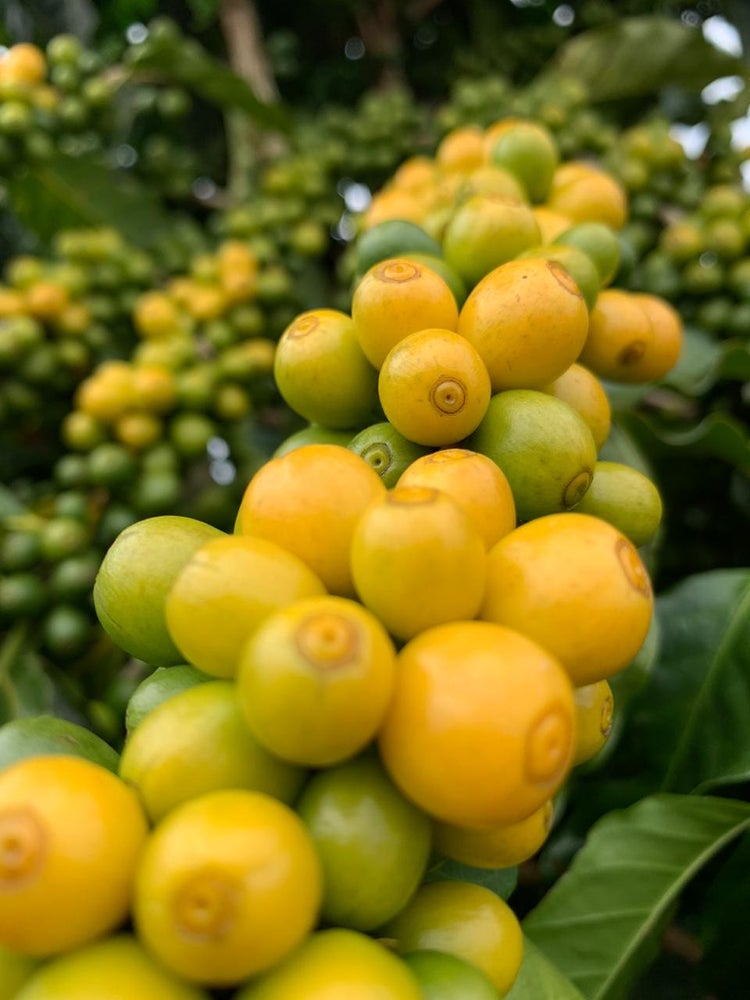

About This Coffee
Sul de Minas is the biggest region for Arabica coffees in Brazil. 30% of Brazil’s total Arabica production comes from South Minas. The region can be easily accessed through the Port of Santos, Brazil’s busiest coffee port.
Our Sul de Minas blend is known for its chocolatey, round flavor. We source our medium to good bean (MTGB) is sourced from the Sul de Minas region. The most important point with this MTGB is that it’s stable, balanced and relatively clean for its price. It shouldn’t contain primary defects or major taste flaws.
Harvest & Post-Harvest
Most Brazilian coffee is grown on huge farms, built and equipped for mechanical harvesting and processing, maximizing productivity. The relatively flat landscape across many of Brazil’s coffee regions combined with high minimum wages has led most farms to opt for this type of mechanical harvesting over selective hand-picking.
In the past, this mechanization meant that strip-picking was the norm; however, today’s mechanical harvesters are increasingly sensitive, meaning that farms can harvest only fully ripe cherries at each pass, which is good news for specialty-oriented producers.
In many cases and on less level sections of farms, a mixed form of ‘manual mechanized’ harvesting may be used, where ripe coffee is picked using a derricadeira – a sort of mechanized rake that uses vibration to harvest ripe cherry. A tarp is spanned between coffee trees to capture the cherry as it falls.
With the aid of these newer, more selective technologies, there’s a growing number of farms who are increasingly concerned with – and able to deliver - cup quality.
This Natural coffee is dried on large patios under sun. The coffee is raked and turned regularly to ensure even drying and a clean cup profile.
Coffee in Brazil
Just under 40% of all coffee in the world is produced in Brazil - around 3.7 million metric tons annually. With so much coffee produced, it’s no wonder that the country produces a wide range of qualities. Brazil produces everything from natural Robusta, to the neutral and mild Santos screen 17/18, to the distinctive Rio Minas 17/18. In recent years, Brazilian producers have also begun investing more heavily in specialty coffee production. Through our in-country partners in Brazil, including our sister company, we are able to provide a wide range of Brazilian coffees to our clients: from macrolot to microlot.
Today, the most prolific coffee growing regions of Brazil are Espirito Santo, São Paulo, Minas Gerais, and Bahia. Most Brazilian coffee is grown on large farms that are built and equipped for maximizing production output through mechanical harvesting and processing. The relatively flat landscape across many of Brazil’s coffee regions combined with high minimum wages has led most farms to opt for this type of mechanical harvesting over selective hand-picking.
In the past, mechanization meant that strip-picking was the norm; however, today’s mechanical harvesters are increasingly sensitive, meaning that farms can harvest only fully ripe cherries at each pass, which is good news for specialty-oriented producers.
In many cases and on less level sections of farms, a mixed form of ‘manual mechanized’ harvesting may be used, where ripe coffee is picked using a derriçadeira – a sort of mechanized rake that uses vibration to harvest ripe cherry. A tarp is spanned between coffee trees to capture the cherry as it falls.
With the aid of these newer, more selective technologies, there’s a growing number of farms who are increasingly concerned with – and able to deliver - cup quality.