
About This Coffee
Muhathi Estate sits at 1,700 meters above sea level in Kenya’s Kiambu County. Located in Ngewa-Komothai, in Kiambu, the farm has an ideal microclimate for cultivating specialty coffee. The warm days and cool nights support sweet, dense cherry growth.
Peris works with our team at Sucafina/Kahawa Bora to improve the quality of his coffee and the productivity of his trees. Field staff provide training and support in a wide range of agricultural and processing techniques.
Cultivation
Kiambu is right outside Kenya’s capital city of Nairobi but is nonetheless known for agriculture – specifically coffee and tea. The county is also home of the Kenyan Coffee Research Foundation.
Kiambu County is also well known for its dairy production, and is the largest dairy producing county in Kenya. Many of the growers here adhere to organic fertilizing practices, using only cow manure instead of agrochemicals on their coffee trees.
Farmers in Kiambu face low production due to pests and disease while simultaneously having to pay high prices for inputs. In recent years, many have felt the strain and have sold their land to real-estate developers, as the region borders Nairobi. Support from partners like Kahawa Bora, who help farmers build long-term profitability, can make all the difference.
Muhathi is planted with ‘traditional’ SL28 & SL34 coffee trees, as well as Batian and Ruiru 11. The SL28 cultivar was originally released by Scott Agricultural Laboratories (SAL) in the 1930s and 1940s. Along with SL34, it soon became the go-to tree for many growers in Kenya due to its deep root structure, which allows it to maximize scarce water resources and flourish even without irrigation. Batian is a relatively new variety introduced by the Kenya Coffee Research Institute (CRI) in 2010. Batian is named after the highest peak on Mt. Kenya and is resistant to both Coffee Berry Disease (CBD) and Coffee Leaf Rust (CLR). The variety has the added benefit of early maturity – cropping after only two years. Similar to Batian, Ruiru 11 is a new variety known for its disease resistance and high yields. It also starts yielding fruit after just 2 years.
Peris receives regular training from Sucafina in Good Agricultural Practices, including fertilizer application, pruning guidance and renovation advice, which helps him to keep his small farm in optimal condition.
Harvest & Post-Harvest
At 8 hectares, Muhathi is categorized as a ‘small estate’ in Kenya. Traditionally, many farmers of this size in the country did not operate their own processing equipment. They have historically delivered cherry to a centralized cooperative-owned ‘Factory’ (as washing stations are called, locally), where their production is combined with that of others from their region. Peris, however, operates a small wet-mill and processes his own coffee, ensuring full traceability back to the farm.
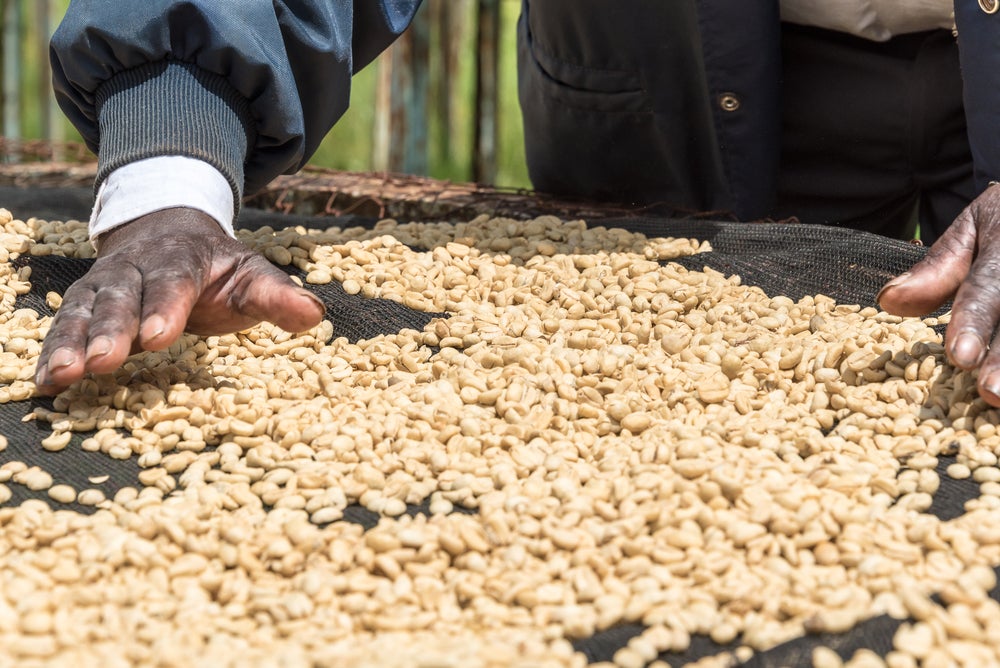
Cherry is selectively handpicked and then pulped on Peris’ disc pulper. Coffee is dry fermented for 16 to 24 hours and washed in clean water to remove any remaining mucilage. Parchment is soaked for 12 hours and then transferred to raised beds where it sundries for 14 to 18 days. As it dries, parchment is turned regularly to ensure even drying.
To cater for single producer lots that are very small, Kahawa Bora/Sucafina has a separate microlot milling line that was custom made to hull (remove the parchment from the green coffee beans) lots as small as one bag at a time. This setup is highly unusual in Kenya, and the line makes it possible for growers like Peris to maintain their own ‘brand’ when selling their coffee. We feel this is a push in the right direction for Kenyan growers to gain market access to quality-focused buyers overseas.
About Peaberries
PB stands for peaberry. Peaberry is a name given to a very specific shape of coffee bean. In Spanish, peaberries are called “caracol”, which means “snail”. The name aptly describes the shape of the peaberry bean, which appears slightly curved in on itself.
Peaberries are the result of a natural mutation in the coffee cherry. Whereas there are usually two beans nestled together in each fruit, a cherry with a peaberry mutation only forms one bean. Thus, peaberries are a single, rounder bean.
Peaberry mutations occur in approximately 5% of all coffee. The beans are known for being rounder, smaller and denser, which can contribute to a more even roast color when handled correctly. Many people find peaberries to have a sweeter flavor profile, as well.
Since peaberries are a natural mutation that is not visible from the outside of the cherry, peaberries must be sorted out during the screen grading stage of dry milling. The peaberry screens have the smallest holes, which are oblong to allow the rounder beans to fall through.
About Kiambu
Kiambu is right outside Kenya’s capital city of Nairobi but is nonetheless known for agriculture – specifically coffee and tea. The county is also home of the Kenyan Coffee Research Foundation.
Kiambu County is also well known for its dairy production, and is the largest dairy producing county in Kenya. Many of the growers here adhere to organic fertilizing practices, using only cow manure instead of agrochemicals on their coffee trees.
Farmers in Kiambu face low production due to pests and disease while simultaneously having to pay high prices for inputs. In recent years, many have felt the strain and have sold their land to real-estate developers looking to build on the edge of Nairobi.
Coffee in Kenya
Though coffee growing had a relatively late start in Kenya, the industry has gained and maintained a impressive reputation. Since the start of production, Kenyan coffee has been recognized for its high-quality, meticulous preparation and exquisite flavors. Our in-country sister company, Sucafina Kenya, works with farmers across the country to ensure these exceptional coffees gain the accolades they deserve.
Today, more than 600,000 smallholders farming fewer than 5 acres compose 99% of the coffee farming population of Kenya. Their farms cover more than 75% of total coffee growing land and produce nearly 70% of the country’s coffee. These farmers are organized into hundreds of Farmer Cooperative Societies (FCS), all of which operate at least one factory. The remainder of annual production is grown and processed by small, medium and large land estates. Most of the larger estates have their own washing stations.
Most Kenyan coffees are fully washed and dried on raised beds. The country still upholds its reputation for high quality and attention to detail at its many washing stations. The best factories employ stringent sorting practices at cherry intake, and many of them have had the same management staff in place for years.