
About This Coffee
This lot is the result of the dedication of the 500 smallholder farmers from Guji region who deliver their cherry to Hadeso washing station. The Guji region lies approximately 300 to 400 km south of Addis Ababa in the Guji Zone of the Oromia Region. The Guji region has a long genealogy. In 2002, Guji itself detached from Yirgacheffe, which had previously been folded in with the Sidamo name. The Guji region, which was created in 2002, takes its name from the Oromo people, a tribe who have farmed coffee on the land for generations.
Coffee from Guji was once lumped in with coffees from all over the Yirgacheffe region. Before Yirgacheffe was its own region, those coffees were blended with coffee from a wide geographical area that encompassed much of central-south Ethiopia under the grade “Sidamo”. Despite its long journey, Guji coffees are widely recognized as distinct from both Yirgacheffe and Sidamo coffee thanks to the unique local varieties and microclimates.
Cultivation
Farming methods in Guji remain largely traditional. Guji farmers typically intercrop their coffee plants with other food crops. This method is common among smallholders because it maximizes land use and provides food for their families.
In addition to remaining traditionally intercropped, most farms are also traditional and organic-by-default. Farmers in Guji typically use very few—if any—fertilizers or pesticides. Most farm work is done manually and very few tasks are mechanized, even during processing.
This Certified Organic lot represents years of commitment from farming families who manage their plots through careful composting, shade management and soil regeneration. Their work preserves both land and livelihood, and it shows in a cup that’s delicious and deeply rooted in place.
Harvest & Post-Harvest
Due to the size of most plots, coffee is typically handpicked by landowners and their family.
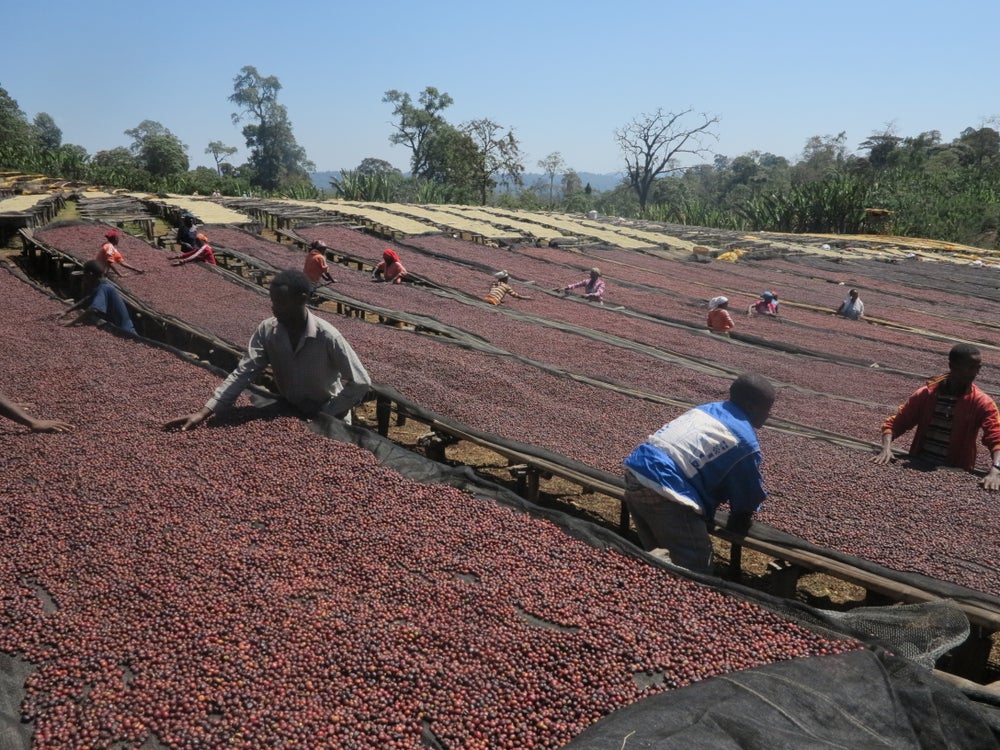
Each day, only the ripest cherries are selectively picked and brought to Hadeso washing station, where they undergo a second round of hand-sorting to pull out any underripe, overripe, or damaged fruit. This careful selection ensures a reliably great result in overall cup quality. After sorting, the cherries are separated by density and then spread across raised drying tables. They start in very thin layers and are turned frequently to promote uniform drying and avoid unwanted fermentation, with workers taking care not to bruise the fruit.
As the cherries lose moisture and reach roughly 25 percent humidity (often referred to as the “raisin stage”) the layers are gradually deepened. Close monitoring during this period helps ensure even moisture loss and preserves a clean, balanced flavour profile. Turning continues throughout the day, and the coffee is shaded during the strongest midday sun and covered again at night to protect it from dew.
When the cherries reach their target moisture level, typically after 15 to 18 days on the beds, the dried fruit is hulled. The coffee is then stored in parchment and allowed to rest before it is prepared for export.
Grade 2
In the Ethiopian grading system, grade 2 refers to the cup quality as well as physical quality of a coffee. A grade 2 allows between four and 13 full defects per 300gr green sample. The cup typically has fruity and clean characteristics without any off-flavors.
Ethiopia Sidamo 2 is a classic in every coffee range and is especially popular in blends. The cup quality can be very surprising for prices well below the grade 1 price point. For us, grade 2 coffee typically sits around an 83-84 cup score.
Coffee in Ethiopia
While Ethiopia is famous as coffee’s birthplace, today it remains a specialty coffee industry darling for its incredible variety of flavors. While full traceability has been difficult in recent history, new regulations have made direct purchasing possible. We’re partnering directly with farmers to help them produce top quality specialty lots that are now completely traceable, adding value for farmers and roasters, alike.
The exceptional quality of Ethiopian coffee is due to a combination of factors. The genetic diversity of coffee varieties means that we find a diversity of flavor, even between (or within) farms with similar growing conditions and processing. In addition to varieties, processing methods also contribute to end quality. The final key ingredients for excellent coffee in Ethiopia are the producing traditions that have created the genetic diversity, processing infrastructure and great coffee we enjoy today.
Most producers in Ethiopia are smallholders, and the majority continue to cultivate coffee using traditional methods. As a result, most coffee is grown with no chemical fertilizer or pesticide use. Coffee is almost entirely cultivated, harvested and dried using manual systems.