About This Coffee
Arley Calderon lives at Finca Villa Betulia with his parents and farms a plot of the land. His father, Luis Anibal Calderón, purchased the farm in 2005. Luis and Arley have a quality lab that allows them to roast and taste specialty coffees. With the lab, they can evaluate their coffees and learn what clients like.
In search of a way to remain profitable, they began planting specialty coffee varieties in 2012, when they planted 5,000 Geisha trees on around 5% of the farm.
Ten years later, it was apparent to Arley and Luis Anibal that returns from cultivating Geisha were worth the extra effort. They decided to dedicate the entire farm to farm more delicate and rare specialty varieties, such as Geisha and the Pink Bourbon in this lot. Their dream is to produce 100% exotic varieties like these on their farm and would like drinkers of their coffee to understand the effort and love the family puts into their coffees.
Today, Villa Betulia is planted with a wide range of specialty varieties including Red, Pink and Yellow Geisha, Tabi, Java, Sidra, Striped Bourbon, Maragogype, Pacamara, Marageisha and several dwarf varieties of Geisha.
Cultivation
In addition to coffee, Luis Anibal and Arley also cultivate plantains, bananas, cassavas and limes.
Harvest & Post-Harvest
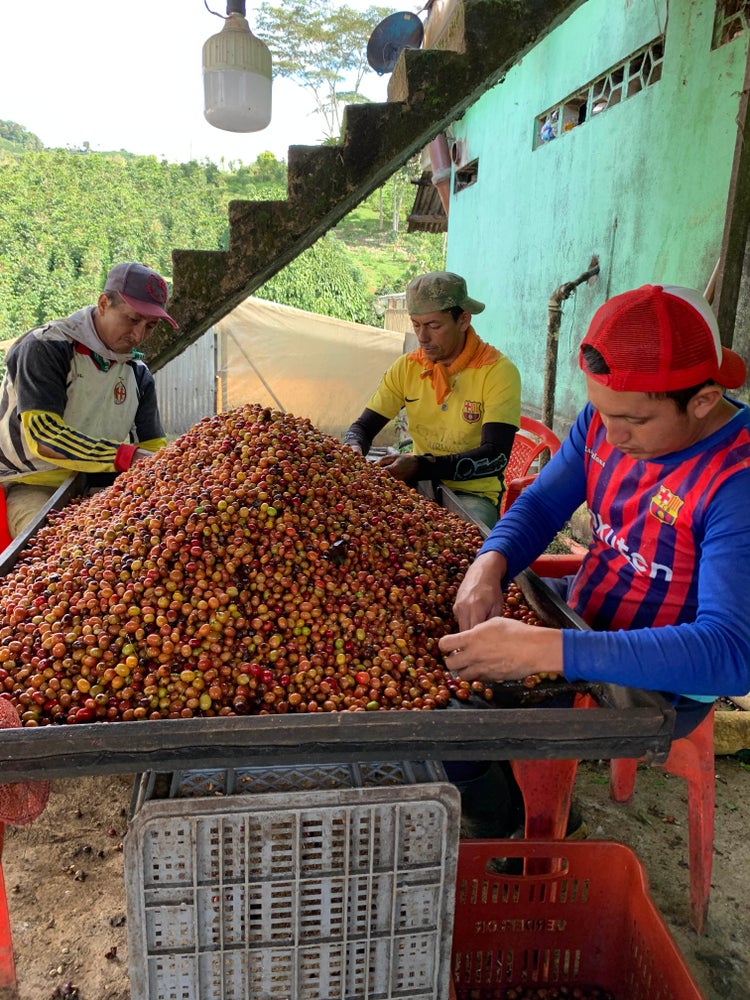
After selective handpicking, ripe cherry is placed in tanks and fermented anaerobically for 4 days. Then, cherry is pulped using a classic drum pulper and laid to dry on marquesinas, raised beds on the roof of the house. The sweet, sticky layer of mucilage and coffee sundries for 15 to 20 days. Once dry, coffee is stored for 20 to 30 days in a temperature-controlled warehouse in Armenia before being transported to the warehouse in Valle del Café.
About Pink Bourbon
Pink Bourbon was previously thought to be a hybrid of Yellow and Red Bourbon varieties. The variety was first identified growing in and around Huila, Colombia. Recent research has found that Pink Bourbon is in fact not Bourbon at all. Pink Bourbon mostly likely comes from an Ethiopian landrace variety.
Pink Bourbon has a stunningly high cup potential that wows coffee professionals and consumers alike. Its impressively high cup quality makes even more sense now that we understand Pink Bourbon is not simply a hybrid of two Bourbon varieties but traces to Ethiopian landraces. Its siblings include the highly-prized Geisha, which has consistently produced incredibly high cup scores. Pink Bourbon will continue to be a highly distinguished and valued variety.
Some farmers also report that Pink Bourbon has more disease resistance than the Bourbons it grows alongside. Based on these new discoveries, this may be due to the genetic variety it has coming from Ethiopian landraces.
About Cuatro Vientos
Cuatro Vientos is a family-owned exporter based in Colombia. Founded in 2018 by Julian & Yonatan Gonzalez and based in Huila, the company is named after the Gonzalez’s first farmnwhere the brothers spent much of their childhood. Yonatan and Julian learned much of what they know from their father, Armando Gonzalez who was a “pergaminero,” someone who bought and sold parchment coffee. Sucafina has worked with Cuatro Vientos since 2021.
Through their partnership with Sucafina, Cuatro Vientos is able to more effectively reach new markets. This, in turn, means they can work with more farmers and develop better programs to support their farmers.
Cuatro Vientos has 3 purchasing points in Huila: Acevedo, Santa Maria and Algeciras. These points are more than just places where they buy coffee, though. They are service hubs where farmers can access services to maintain quality and reach new markets. For Cuatro Vientos, farmers are long term partners who are focused on quality.
With these three locations, Cuatro Vientos is able to source fresh coffee year-round. In their unique position across Huila, they can tap into two alternative harvest seasons within Huila. The northern Huila harvest occurs in the first half of the year and the southern Huilaharvest happens during the second half of the year, providing high-quality coffees year round.
They also own 2 warehouses that are strategically placed in Acevedo (in Southern Huila) and Campo Alegre (in Northern Huila). The warehouses provide an array of important services to farmers. Farmers can dry their coffee, store dried parchment in silos and learn to grade and evaluate coffees in the cupping labs.
Cuatros Vientos adds value by offering logistics and milling support to the over 30 farms that they work with. These farmers are all specialty oriented and Cuatro Vientos’ focus on specialty processing helps farmers ensure that their coffees are handled properly.
One of Cuatro Vientos’ biggest impacts is their credit line offerings. Growers need financing at the beginning of the harvest and it is difficult for them to access financing through traditional banks due to a lack of financial documentation. By providing financing through their partner, Bancolombia, Cuatro Vientos is supporting long term farmer profitability. They also provide financial education workshops that increase farmers’ financial literacy and promotes overall success.
They also provide marketing services for farmers, helping them manage samples and tell their stories. Importantly, they act as an integral part of a two-way conversation between producers and roasters about what they’re looking for, what they can do and how they can best achieve the results they’re looking for.
Coffee in Colombia
Colombia has been producing and exporting coffee renowned for their full body, bright acidity and rich aftertaste, since the early 19th century.
Colombia boasts a wide range of climates and geographic conditions that produce their own unique flavors in coffee. This also means that harvest times can vary quite a bit. In fact, between all its different regions, Colombia produces fresh crop nearly all year round.
The increasing focus on the specialty industry is changing the way traders and farmers do business. It is becoming more common for farmers to isolate the highest quality beans in their lots to market separately. These higher-quality lots are often sold under specific brands or stories.
Besides its wide variety of cup profiles, Colombia has quickly expanded its certification options over the past 10 years. The most common certifications available are Fairtrade, Rainforest Alliance and Organic.