
About This Coffee
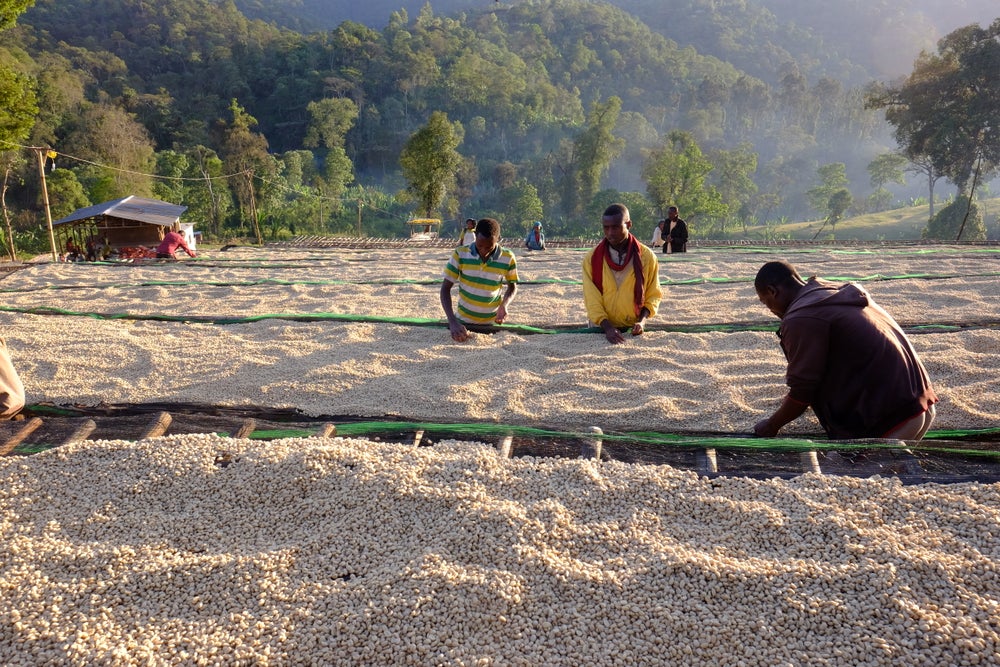
Guji-native Tadesse Edema is a pioneer among producers in Uraga. He was among the first to build a washing station in the region. His Tome washing station was built in 2008.
Tadesse is a community leader and has built schools and roads in the region. In addition to washing stations, he owns two farms - one in Shakiso and another in Anasora. During the ten years when the Ethiopian Commodity Exchange (ECX) restricted direct exports, Tadesse delivered his lots to the regional warehouse where traceability was obscured.
Beginning in the 2019/2020 season, Tadesse is finally able to deliver his world-class coffees directly to us.
Changes to the ECX
Due to recent changes in regulation, even the little guys can directly export their coffee to foreign markets. With Ethiopia’s staggering levels of variety diversity, we believe that amazing new coffees are just waiting to be discovered.
The Ethiopian Commodity Exchange (ECX) was established in 2008 as a way to help farmers receive higher prices, get paid more quickly and receive better payment for better quality. To accomplish these goals, the ECX was intentionally designed to semi-anonymize coffees so that those who graded and those who purchased the coffees, did so on the merit of the cup not the reputation of the name.
In response to the demand for more traceable coffee, the Ethiopian Coffee & Tea Development and Marketing Authority introduced a bill in 2017 that allowed Ethiopian coffee, including coffee sold through the ECX, to be marketed and sold with full traceability.
Ethiopia Grade 1
Grades in Ethiopia depend on visual inspection for defects and on cup quality. Grade 1 is considered the highest quality coffee. Grade 1 and 2 are considered specialty coffee, grades 3-9 are classified as commercial coffee. Grade 1 is free of cup faults and taints and has zero quakers.
Coffee in Ethiopia
While Ethiopia is famous as coffee’s birthplace, today it remains a specialty coffee industry darling for its incredible variety of flavors. While full traceability has been difficult in recent history, new regulations have made direct purchasing possible. We’re partnering directly with farmers to help them produce top quality specialty lots that are now completely traceable, adding value for farmers and roasters, alike.
The exceptional quality of Ethiopian coffee is due to a combination of factors. The genetic diversity of coffee varieties means that we find a diversity of flavor, even between (or within) farms with similar growing conditions and processing. In addition to varieties, processing methods also contribute to end quality. The final key ingredients for excellent coffee in Ethiopia are the producing traditions that have created the genetic diversity, processing infrastructure and great coffee we enjoy today.
Most producers in Ethiopia are smallholders, and the majority continue to cultivate coffee using traditional methods. As a result, most coffee is grown with no chemical fertilizer or pesticide use. Coffee is almost entirely cultivated, harvested and dried using manual systems.