
About This Coffee
Morita is the plot situated at the highest altitude on Nichol Colbran’s Baroida Estate. Morita is planted with an uncommon coffee variety called Arusha. Arusha was originally discovered in Tanzania and is believe to be a descendant of the beloved SL-varieties from Kenya.
Ben Colbran is the father of the current owner and a significant pioneer for coffee growing in the Eastern Highlands, especially in Kianantu District. Colbran and his family moved from New Zealand to PNG in 1963 with his wife, Norma, and their three children.
Today the farm is managed by Ben’s son, Nichol, and composes around 220 hectares of mature coffee trees alongside some sections of newer plantings. The Colbrans also work with farms and farmers in the surrounding region, offering processing and marketing support.
Harvest & Post-Harvest
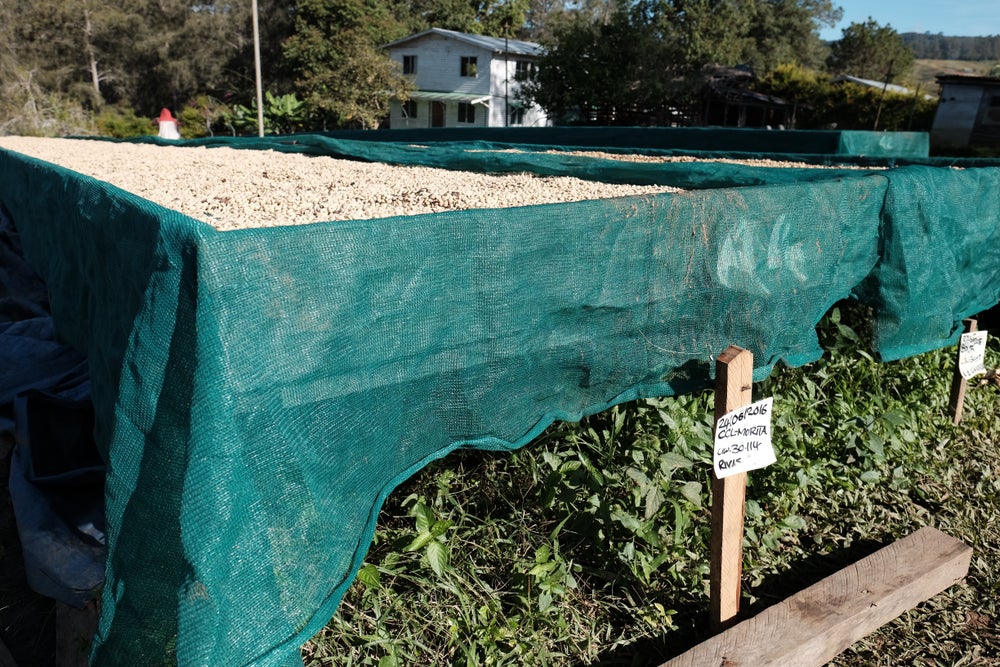
Meticulous separation for quality control helps maintain the high quality of the estate’s coffee. After careful sorting, cherry is pulped on disk pulpers. Then, it dry-ferments in vats for approximately 36 hours. Water is pumped into the vats in a circular motion to naturally agitate the coffee and remove any remaining mucilage. Coffee is then sundried on raised beds, where it is turned regularly to ensure even drying. It takes approximately 1 week for parchment to dry.
We source the best quality lots, which are separated and allocated specifically for us before being hulled, graded and prepared for export.
About Arusha
Arusha is a sub-variety of Bourbon and is most common in PNG and Tanzania. The variety was introduced to PNG around the 1950s and was screened intensively by the PNG Coffee Research Institute (CRI) in the 1980s before being released to farmers.
The exact origins of Arusha are still a mystery, but many coffee experts and agronomists think that this variety is most likely a descendant of a hybrid of an SL variety that was discovered on a coffee farm in Arusha, Tanzania.
The predominant theory is that many of the popular SL varieties released in Kenya were brought to Tanzania through Arusha. In the 1950s, Kenya and Tanzania were British colonies and Arusha, on Tanzania's northern border with Kenya, was a direct crossing point between Kenya and Tanzania. It is a fairly widespread theory that SL varieties made their way from Kenya to Tanzania (and then on to PNG) by way of Arusha. The hybrids discovered in Arusha then gave their region’s name to one of the varieties that became widespread in Tanzania and PNG.
Arusha is characterized by its tall height, vigorous growth and high yield. It has large cherries with a big stem diameter.
PNG - Baroida Estate
The Baroida Estate, run by Ben Colbran, has pioneered growing coffee in the Eastern Highlands, especially in Aiyura, Kianantu District. The estate, which weathered political turmoil throughout the second half of the 20th century, has become known for superb quality control.
The name Baroida comes from the name for a spirit that resides in a large boulding sitting in one of the rivers that runs through the estate. According to the locals, Colbran’s ability to withstand difficult times and continue producing great coffees can be attributed to the boulder, which has been there longer than they can remember.
The plantation is 220 hectares. Meticulous separation for quality control helps maintain the high quality of the estate. After careful sorting, cherry is pulped on disk pulpers. Then, it dry-ferments in vats for 36 hours. Water is pumped into the vats in a circular motion to naturally agitate the coffee and remove any remaining mucilage.
Coffee in Papua New Guinea
Papua New Guinea (PNG) is a relative newcomer to the specialty coffee scene. The remote locations of the nation’s smallholders—who produce 85% of total coffee in the country—combined with historically-poor infrastructure has made the transition to specialty difficult. Nonetheless, the country is working towards innovative solutions that will hopefully lead to better quality coffee and improved livelihoods for the nation’s smallholder coffee producers.