
About This Coffee
The idea behind the Decaf Rainbow Blend is truly rooted in the love for a good decaf. This Rainbow Decaf "is the pot of gold at the end of the rainbow," but only decaffeinated.
Those who processed this coffee aimed to highlight the spectrum of colors and accompanying flavor profiles found across our many coffee-producing departments or states in Colombia. This blend is the reward at the end of many, many long days of work: a treasure of a coffee that shines in cup quality and is supported by a solid and pleasing sensorial profile.
Cultivation
These coffees come from our producers in the North of Huila, in the municipalities of Algeciras, Iquira and Palermo who have Castillo, Caturra, and Colombia trees planted between 1,500 and 2,000 m.a.s.l.
Harvest & Post-Harvest
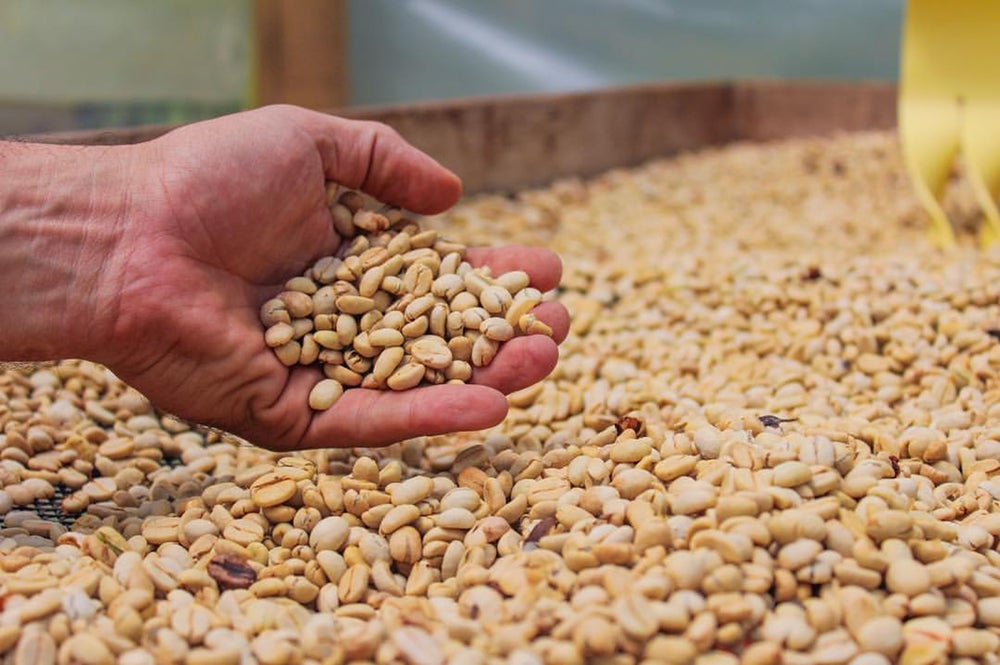
This coffee went through a fermentation process called “fermentación por cochadas” and it takes a period of two days and one night. The fermentation in tanks starts after the first coffee is de-pulped. 24 hours later, the second round of cherries is picked, de-pulped, and added to the coffee that has already started fermenting. 24 hours later, another pass is added. Finally, the next morning, the coffee from 3 passes is washed – the total hours of fermentation is 60. Then, the coffee is dried in a two-stage process, where firstly, the beans are put out on raised beds for an average period of 15 to 30 days to later finish reducing the moisture in mechanical dryers for up to 40 hours.
The decaffeination agent we use is called ethyl acetate (also known as ethyl alcohol) and is derived from a mix of acetic acid (vinegar) and a natural extract distilled from sugar cane, blackberries, beets, or sometimes grapes. We use a direct-solvent process, meaning that first, the beans are steamed to open their pores and are then rinsed in ethyl acetate repeatedly to remove the caffeine. Next, the beans are dried, but not completely; 10 - 12% humidity remains. The remaining ethyl acetate within the beans is lower than that of a ripened banana!
Azahar
Azahar Colombia works directly with producers to source excellent, traceable coffee from Colombia’s best producing regions. They pride themselves on transparent relationships that improve incomes and quality.
In addition to their exporting arm, Azahar also operates a roastery in Quindío and several cafés in Bogotá that serve superb locally-produced coffees to Colombian consumers.
Coffee in Colombia
Colombia has been producing and exporting coffee renowned for their full body, bright acidity and rich aftertaste, since the early 19th century.
Colombia boasts a wide range of climates and geographic conditions that produce their own unique flavors in coffee. This also means that harvest times can vary quite a bit. In fact, between all its different regions, Colombia produces fresh crop nearly all year round.
The increasing focus on the specialty industry is changing the way traders and farmers do business. It is becoming more common for farmers to isolate the highest quality beans in their lots to market separately. These higher-quality lots are often sold under specific brands or stories.
Besides its wide variety of cup profiles, Colombia has quickly expanded its certification options over the past 10 years. The most common certifications available are Fairtrade, Rainforest Alliance and Organic.