
About This Coffee
Gumba Factory is owned and operated by Rugi Farmers Cooperative Society (FCS). Located in Nyeri, Central Kenya, Gumba Factory receives coffee from a community of 850 farmers. The cooperative provides essential services such as farm inputs, training programs and marketing assistance to its members.
Nyeri is located in the central highlands of Kenya, between the eastern base of the Aberdare (Nyandarua) Range and the western slopes of Mount Kenya. This region is renowned for its favorable coffee-growing conditions, including fertile volcanic soil, high altitudes and a temperate climate with moderate rainfall. These factors contribute to the production of high-quality coffee beans with distinct flavors and bright acidity, making Nyeri one of Kenya's most famous coffee-producing areas. Coffee is one of the most important cash crops for the surrounding communities of the region.
Cultivation
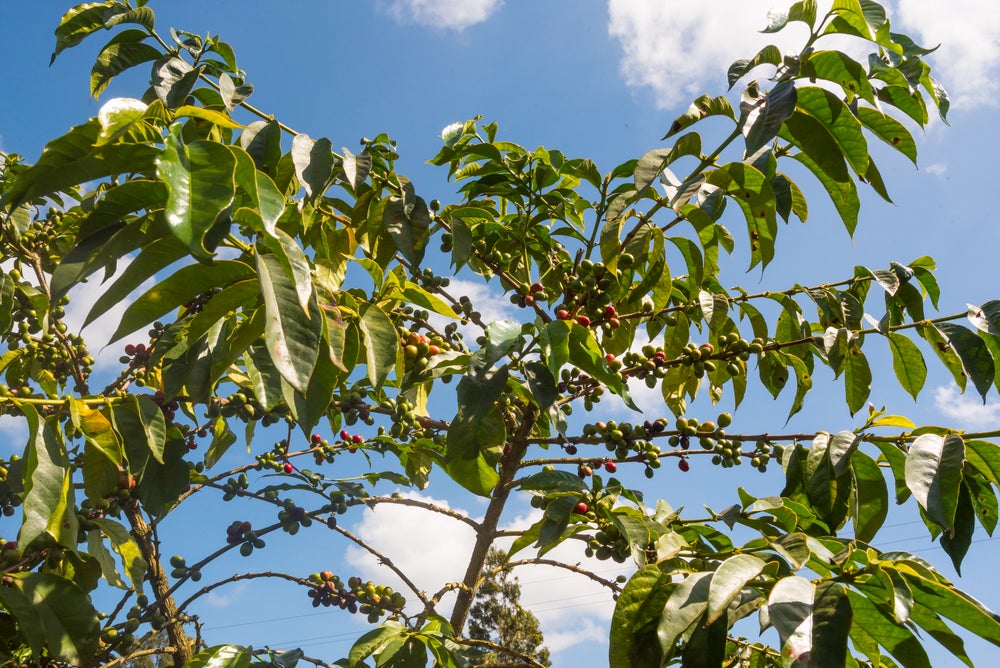
Farmers delivering to Gumba washing station cultivate primarily SL28, Ruiru 11 and Batian in small coffee gardens that are, on average, smaller than 1 hectare. ‘SL’ varieties are cultivars originally released by Scott Agricultural Laboratories (SAL) in the 1930s and 1940s. They soon became the go-to trees for many growers in Kenya due to their deep root structure, which allows them to maximize scarce water resources and flourish even without irrigation. They are cultivated with a serious eye towards sustainability and Good Agricultural Practices, with minimal environmental impact where possible.
Batian is a relatively new variety introduced by the Kenya Coffee Research Institute (CRI) in 2010. Batian is named after the highest peak on Mt. Kenya and is resistant to both CBD and CLR. The variety has the added benefit of early maturity – cropping after only two years. Similar to Batian, Ruiru 11 is a new variety known for its disease resistance and high yields. It also starts yielding fruit after just 2 years.
Harvest & Post-Harvest
Farmers selectively handpick ripe, red cherry and deliver it to Gumba Factory. At intake, a cherry clerk oversees all cherry and ensure only the highest quality cherry is accepted. After pulping, coffee undergos fermentation for 16 hours, followed by a soaking period of 12 to 24 hours. Parhcment is laid on raised beds to dry. Workers rake parchment frequently to ensure even drying. It takes an average of 14 days for parchment to dry.
AA Grade
Kenyan coffees are classified by size. AA beans are the largest size. AA grade coffees are those that are 17/18 screen size, meaning that they are larger than 7.2 millimeters.
Coffee in Kenya
Though coffee growing had a relatively late start in Kenya, the industry has gained and maintained a impressive reputation. Since the start of production, Kenyan coffee has been recognized for its high-quality, meticulous preparation and exquisite flavors. Our in-country sister company, Sucafina Kenya, works with farmers across the country to ensure these exceptional coffees gain the accolades they deserve.
Today, more than 600,000 smallholders farming fewer than 5 acres compose 99% of the coffee farming population of Kenya. Their farms cover more than 75% of total coffee growing land and produce nearly 70% of the country’s coffee. These farmers are organized into hundreds of Farmer Cooperative Societies (FCS), all of which operate at least one factory. The remainder of annual production is grown and processed by small, medium and large land estates. Most of the larger estates have their own washing stations.
Most Kenyan coffees are fully washed and dried on raised beds. The country still upholds its reputation for high quality and attention to detail at its many washing stations. The best factories employ stringent sorting practices at cherry intake, and many of them have had the same management staff in place for years.