
About This Coffee
Geruke Mazoriya washing station was established in 1960 at the Oromia region, Djimma zone. The station is a critical bridge between the coffee farm and the global market, transforming red, ripe coffee cherries into exportable beans. Geruke carries a unique flavor fingerprint shaped by altitude, soil, local varietals and microclimate. The station also participates in different activities to support communities’ development such as building schools, maintain roads, clean waters and supporting health centers.
Situated at an elevation of 1,900 to 2,000 meters above sea level, farmers in the region benefit from a year-round cool temperature and nutrient-rich soils. These favorable conditions, along with producers’ dedication, result in sweet, dense beans. For this Fully washed lot, expect sweet cups with delicate floral aroma. The Organic certification is like a cherry on top.
Cultivation
Farming methods in the region remain largely traditional. Farmers typically intercrop their coffee plants with other food crops, a common practice among smallholders that maximizes land use and provides food for their families. Coffee trees are typically grown under a natural shade canopy of other crops.
In addition to being traditionally intercropped, most farms are also organic by default. Farmers in this region typically use very few, if any, fertilizers or pesticides. Fertilizer is usually made of manure mixed with discarded coffee cherry pulp made available to farmers at the end of each season from the washing station. Additionally, most farm work is done manually by the immediate family.
Harvest & Post-Harvest
Cherries are selectively handpicked and delivered to the washing station. At intake, cherries are carefully sorted to ensure optimal quality. The farm’s state-of-the-art machinery pulps the cherries while separating them into three grades based on density. These grades are then processed separately to produce the highest quality lots possible.
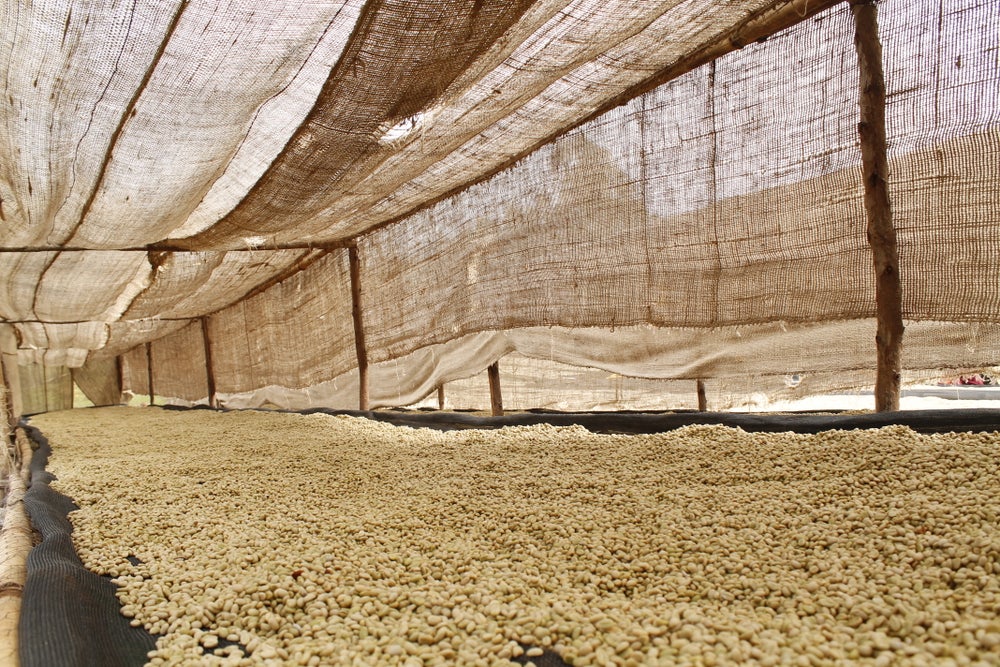
After pulping, parchment is fermented for 18-36 hours before thoroughly washed in clean water to fully remove remaining mucilage. The parchment is then brought to dry on raised beds. During the drying stage, workers rake parchment frequently to ensure even drying. It typically takes 15-18 days for parchment to dry, depending on the weather.
Grade 2
In the Ethiopian grading system, grade 2 refers to the cup quality as well as physical quality of a coffee. A grade 2 allows between four and 13 full defects per 300gr green sample. The cup typically has fruity and clean characteristics without any off-flavors.
Ethiopia Sidamo 2 is a classic in every coffee range and is especially popular in blends. The cup quality can be very surprising for prices well below the grade 1 price point. For us, grade 2 coffee typically sits around an 83-84 cup score.
About Oromia
The Oromos in Ethiopia were consuming coffee centuries before the appearance of the legendary story of Kaldi and his goats.
The Oromos’ coffee-origin story tells of Waqa, the supreme sky God, who punished one of his men with death. It was only after the man’s death that Waqa realized the man was innocent and had been a loyal servant. The next morning, Waqa visited the man’s burial place. Full of grief about killing an innocent and loyal man, tears fell from his eyes onto the grave. Watered by Waqa’s tears, a previously unseen plant emerged from the soil. As you may have guessed, that mysterious, new plant that grew nourished by Waqa's tears was coffee.
Today, Oromia’s fertile red soil is primed for coffee cultivation. The highland slopes nurture countless heirloom varieties that are found nowhere else.
Coffee in Ethiopia
While Ethiopia is famous as coffee’s birthplace, today it remains a specialty coffee industry darling for its incredible variety of flavors. While full traceability has been difficult in recent history, new regulations have made direct purchasing possible. We’re partnering directly with farmers to help them produce top quality specialty lots that are now completely traceable, adding value for farmers and roasters, alike.
The exceptional quality of Ethiopian coffee is due to a combination of factors. The genetic diversity of coffee varieties means that we find a diversity of flavor, even between (or within) farms with similar growing conditions and processing. In addition to varieties, processing methods also contribute to end quality. The final key ingredients for excellent coffee in Ethiopia are the producing traditions that have created the genetic diversity, processing infrastructure and great coffee we enjoy today.
Most producers in Ethiopia are smallholders, and the majority continue to cultivate coffee using traditional methods. As a result, most coffee is grown with no chemical fertilizer or pesticide use. Coffee is almost entirely cultivated, harvested and dried using manual systems.